Deck Sanding & Oiling
Priced turn-key from $45–$120/m² across the Peninsula, depending on suburb and job size
A deck is an exterior timber floor with none of the protection an interior floor gets, and on the Mornington Peninsula it takes the full southerly wind, unfiltered summer UV and salt spray on anything within a few streets of the water. The finish that looked right two summers ago is very likely silver, splintering and beginning to lift. That is normal and it is the point at which restoration is still straightforward.
Left longer, it stops being straightforward. Once the surface has weathered past the point where the fibres break down, water gets into the board through the split grain, works down to the fixings, and boards start splitting through the screw or nail line. At that stage the job becomes board replacement rather than restoration, and the cost profile changes completely. The single best piece of advice we give on decks is to do it a season early rather than a season late.
The strip-back is more aggressive than an interior sand because there is more to remove. Weathered timber has a grey, degraded surface layer that has to come off entirely to reach sound fibre underneath, plus whatever remains of the previous oil or stain. On a deck that has been coated repeatedly over the years there can be several layers, and on hardwood decking those layers are worked into a dense, tight-grained surface that does not give them up easily.
Fixings are the recurring problem. Deck screws and nails work loose with seasonal movement and sit proud, and any fixing above the board surface will destroy an abrasive belt and score the timber. Every fixing gets checked and driven down before sanding starts. Where a screw head has corroded past the point of taking a driver, it comes out and gets replaced. On a coastal deck with twenty years of salt exposure, that is not a small number of fixings.
Board condition then gets assessed individually. Splits that run through a fixing point are structural rather than cosmetic and the board comes out. Boards that have cupped badly enough to hold water in the middle will keep holding it regardless of finish and are better replaced or turned. Anything with soft rot at the joist bearing points needs the substructure looked at, not just the board, and we will say so rather than coating over it.
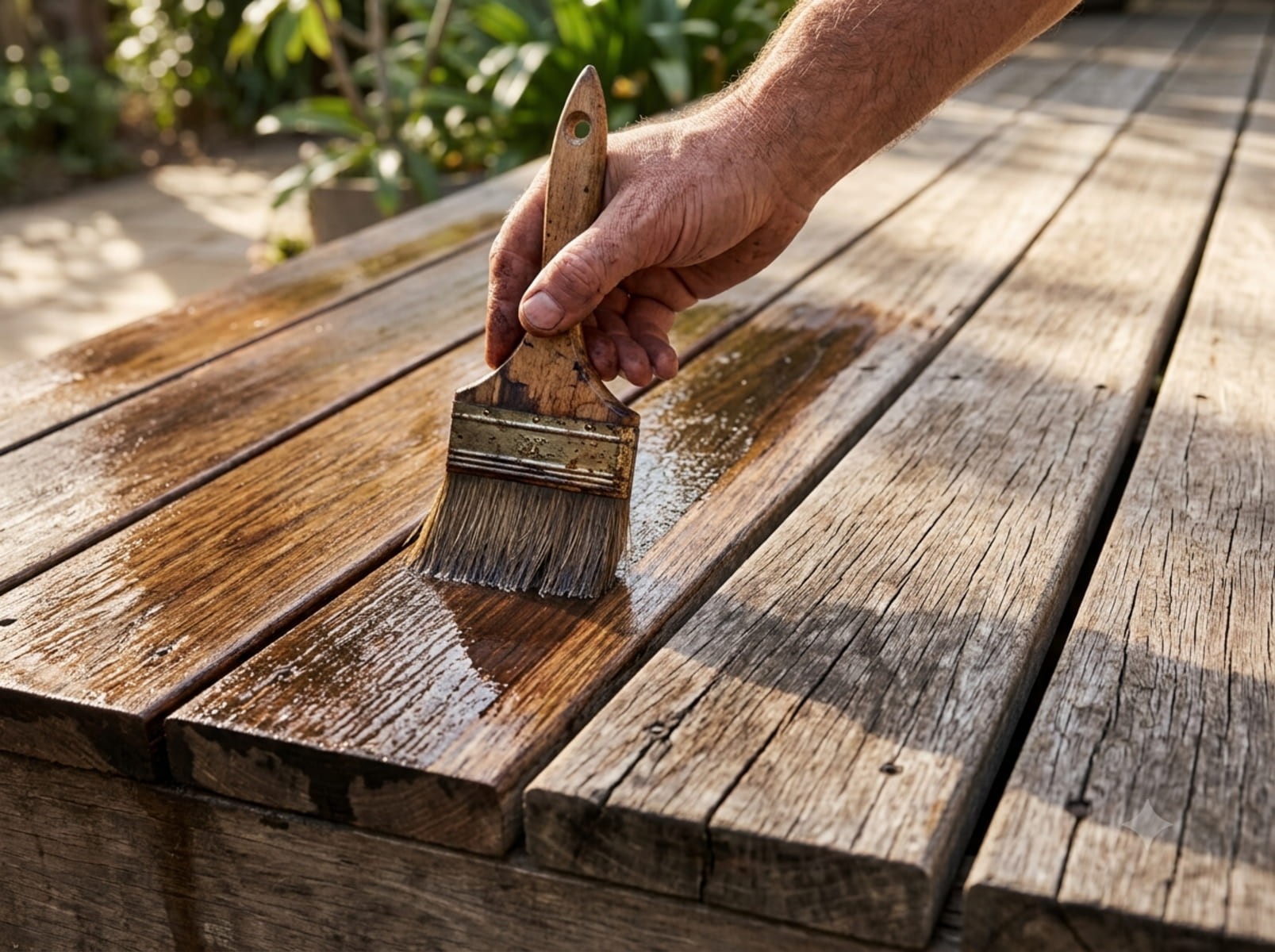
Oil rather than film finish is almost always the right answer outdoors. A film-forming coating on an exterior deck fails by peeling — UV degrades it from above, moisture gets underneath, and it lifts in sheets that then have to be stripped completely before the next application. A penetrating oil wears rather than peels, which means the next maintenance coat goes over a cleaned surface rather than requiring a full strip-back.
Matching the oil to the exposure is the part that gets skipped. A north-facing deck in full Peninsula sun needs higher UV pigment loading than a shaded southern courtyard, and a deck within a few hundred metres of open water needs a system that tolerates salt deposition. We specify per property rather than applying one product everywhere, and we say plainly that a heavily exposed deck will need a maintenance coat every two summers regardless of what goes on it.
On a holiday or short-stay property we schedule against the booking calendar. A Monday start with the final coat down Thursday gives a deck that is usable for weekend guests. Oils need a genuine cure window before furniture goes back, and dragging an outdoor setting across a deck that has been oiled for 36 hours will mark it. Tell us the booking gaps at quote stage and we will build the programme around them.
OUR PROCESS
- 01 Assessment: board-by-board condition check, fixing survey, substructure and joist bearing inspection, exposure and aspect noted for oil specification.
- 02 Clearing: furniture, planters and fittings removed; adjacent walls, glazing and garden beds masked and protected.
- 03 Fixing correction: loose screws and nails driven down, corroded fixings extracted and replaced, protruding heads punched below surface.
- 04 Board replacement where splits run through fixing points, where cupping holds standing water, or where rot has taken the bearing point.
- 05 Coarse strip-back to remove the weathered grey surface layer and all remaining previous coating, worked with the board run.
- 06 Medium and fine passes to open the grain evenly for oil penetration without burnishing the surface closed.
- 07 Detail sanding at edges, around posts and balustrade fixings, and into the board ends where weathering is worst.
- 08 Full clean-down and dry period — oil goes onto dry timber, and a deck coated damp will not penetrate evenly.
- 09 First oil coat applied and worked into the grain, with excess removed before it sets.
- 10 Second coat after the manufacturer’s recoat window, with cure time allowed before furniture returns.
WHAT’S INCLUDED
- Turn-key deck work quoted on the same band basis as interior floors — from $45/m² in the Frankston band, $55/m² in the Mount Eliza band and $70/m² across the Peninsula band.
- Board replacement: $8 to $20/m², or from $50 per board where individual boards are being swapped.
- Fixing correction and replacement included in the base scope, not added later as an extra.
- Oil system specified to aspect and salt exposure rather than applied uniformly.
- Penetrating oil rather than a film finish, so future maintenance is a clean-and-coat rather than a full strip.
- Realistic maintenance expectation stated up front: two summers on an exposed Peninsula deck, longer in a sheltered position.
- Scheduling against holiday-let booking calendars where the property is a short-stay rental.
- Substructure problems flagged honestly rather than coated over.
COMMON QUESTIONS
How often does a Peninsula deck need re-oiling?
Roughly every two summers on an exposed site, longer where the deck is shaded or set back from the water. That is not a product failure — it is what unfiltered UV and salt do to any exterior finish. The advantage of an oil over a film coating is that the maintenance coat goes over a cleaned surface rather than requiring a full strip-back first.
My deck has gone grey. Is it too late?
Grey is the weathered surface layer and it sands off to sound timber underneath in most cases. What is not recoverable is boards that have split through the fixing line or gone soft at the joist bearing points. We assess board by board and tell you how many need replacing before quoting the finish.
Can you use a polyurethane on a deck?
We do not recommend it. A film-forming coating outdoors fails by peeling — UV breaks it down from above, moisture gets underneath, and it lifts in sheets. Removing failed film from a deck is considerably more work than maintaining an oil. Penetrating oils wear back gradually instead, which makes every subsequent maintenance cycle cheaper.
How long before we can use it again?
Light foot traffic generally the day after the final coat. Furniture should wait for a full cure — dragging an outdoor setting across a deck oiled 36 hours earlier will mark it. On a short-stay property we plan a Monday to Thursday turnaround so the deck is usable for weekend guests with the cure window respected.
What causes the splitting around the screws?
Seasonal movement working against a fixed point. The board expands and contracts, the screw does not, and the stress resolves as a split running along the grain from the fixing. Once a board has split through the fixing line it is structural, not cosmetic, and it needs replacing rather than filling.
Do you do the balustrade and steps too?
Yes, and they should be included. Steps take the heaviest wear on any deck and the balustrade is the most UV-exposed timber on the property. Doing the deck surface and leaving the handrail silver looks worse than leaving both. We quote them as part of the scope rather than as an afterthought.
Can it be done while we are still using the house?
Usually yes — a deck is exterior work, so there is no evacuation requirement and no coating odour indoors. What we need is the deck kept clear and dry through the sanding and coating window, which means moving furniture off it and keeping pets and foot traffic away for the cure.
Is it cheaper to replace the deck than restore it?
Rarely, if the substructure is sound and most boards are recoverable. Replacement means new timber, new fixings, disposal and the labour to do all of it. Restoration is sanding, a handful of replacement boards and an oil system. The calculation flips when a majority of boards are splitting or the joists have gone — and we will tell you when it has.