
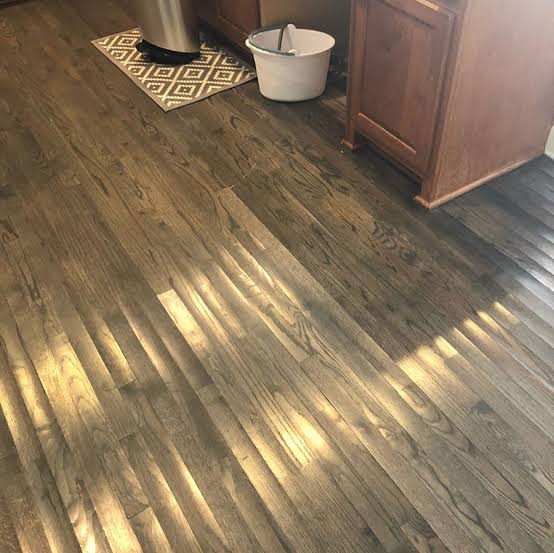
If you own a timber floor anywhere in the low country between Seaford and Tootgarook, there is a reasonable chance you have run your hand across the boards and felt a faint ridge at every joint. Look along the floor with the afternoon sun raking across it and you will see it more clearly: a series of shallow troughs running the length of each board, edges sitting proud, centres dipped.
That is cupping. It is the most common timber floor defect on this side of the Peninsula, it is almost always fixable, and the single fastest way to turn it into an expensive problem is to sand it flat.
What is actually happening
A timber floorboard is not a sealed object. It exchanges moisture with the air on every surface, and it expands and contracts across its width as it does. What it does not do is exchange moisture evenly, because the two faces of a floorboard live in completely different environments.
The top face sits in a heated, ventilated room. Through a Peninsula winter that air is relatively dry, particularly where there is ducted heating running. The underside sits in a subfloor cavity over bare earth, in the dark, with whatever ventilation the original builder provided and whatever has happened to it since.
In the low-lying pockets — Seaford, the Karingal drainage basin, Capel Sound, Tootgarook behind the wetland — the ground under the house holds water. It evaporates upward. It reaches the underside of the boards and is absorbed there, while the top face of the same board is drying out into the room above.
The bottom of the board expands. The top does not. And because the board is fixed at its edges and free across its width, that differential swelling forces the edges to curl upward. Multiply it across a room and you have a floor that rolls underfoot, catches a vacuum head at every joint, and shows a fine shadow line at each board edge under raking light.
Why it looks worse than it is
Cupping reads as damage. It is not. It is the timber doing exactly what timber does in response to a moisture gradient, and it is largely reversible.
A cupped board that comes back to a uniform moisture content will flatten again, substantially and often almost completely. The wood fibres that swelled will shrink back. The curl will relax. On floors where we have fixed the subfloor and come back six months later, the difference is frequently dramatic.
That reversibility is the whole reason the sequence matters so much.
The mistake that costs a floor
Here is what happens when a contractor without a moisture meter takes on a cupped floor in Seaford.
They arrive, they see a floor that is not flat, and they do what a floor sander does: they cut it flat. The drum takes the raised edges down until the surface is level. It looks superb. The coating goes on, the invoice goes out, and everyone is pleased.
Then the subfloor dries. Summer arrives, or the vents finally get cleared, or the garden bed against the north wall gets dug out. The moisture gradient reverses. The boards relax toward their natural flat profile — except the edges that would have come back down have been sanded away. So instead of flattening, the centre of every board rises above its shoulders.
That is crowning, and it is a worse defect than the cupping it replaced. It is more visible, because a raised centre catches light differently to a dished one. It is harder underfoot, because you are walking on a series of shallow ridges. And correcting it requires another full cut into boards that have already lost a millimetre they were not budgeted to lose.
On a 1960s Seaford cottage floor that has been sanded once before, there may not be another cut available at all.
The test that prevents all of it
A pin-type moisture meter costs less than a decent power tool. Using one takes about ten minutes across a house. The reading it gives you is the single most useful number in a floor sanding quote.
The threshold is 14 to 16 per cent. Below that, the timber is stable enough to cut flat and expect it to stay flat. Above it, the board is still carrying water that it is going to give up eventually, and anything you do to its geometry now is provisional.
Two details matter about how the reading is taken. First, multiple points — a floor can sit comfortably at 11 per cent in the middle of a heated living room and 18 per cent along the wall backing onto the wet side of the house. One reading by the front door tells you very little. Second, seasonality. A floor that reads high in August will frequently read acceptably in February, and where a job is not urgent, timing it for the drier end of the year is free.
What to do when the reading is high
The honest answer is: not sand it yet, and look at why.
In practice the cause is nearly always one of three things, and none of them are expensive.
Blocked vents. This is the most common and the easiest. Subfloor vents that were adequate when the house was built in 1958 have been buried by six decades of accumulated sand, mulch, garden bed build-up and shrub growth. Clearing them is a weekend with a spade. We find this in Capel Sound and Tootgarook constantly.
No cross-flow. Some houses were built with vents only on two sides, or later extensions have sealed off what air movement there was. Mechanical subfloor ventilation fans solve it, and it is a straightforward trade job.
No vapour barrier. A great many pre-1970s Peninsula houses have bare earth under the floor with nothing between the soil and the timber. Laying continuous polyethylene sheet across the ground is the single highest-value intervention available, and it costs a fraction of what a second sanding job would.
We will tell you which of those your house needs. We do not do that work, and we have no interest in inflating it — but we will not cut a floor flat while it is wet either.
Why we bring this up before quoting
This conversation costs us jobs, and we have made our peace with it.
A contractor who does not own a moisture meter will quote the sand, do the sand, invoice, and be well gone before the crowning shows up eighteen months later. There is no way to compete with that on price. The only thing to compete on is whether the floor is still flat in three years.
If you are getting quotes for a floor in Seaford, Capel Sound, Tootgarook, low-lying Frankston or anywhere else near the water table, ask each contractor what your moisture reading was. If they cannot tell you, they did not take one, and the number they have quoted you is a guess about a floor they have not actually assessed.
The good news
Cupped floors are usually worth saving, and often they are among the better floors we work on.
The moisture problem that produced the cupping is a subfloor problem, and subfloor problems are fixable. The timber itself — typically narrow-strip native hardwood or wide Baltic Pine in this housing stock — has generally been protected under carpet since the house was built. It has full thickness. It has never been cut. It has not seen UV.
Sort the ventilation, let the boards come back to a stable moisture content, then sand. Done in that order, a Seaford or Capel Sound floor that looked alarming on the first visit comes up as a genuinely excellent original floor with decades of life ahead of it.
Done in the wrong order, it becomes a crowned floor with no thickness left to fix it. The difference is a ten-minute measurement and the patience to act on it.
COMMON QUESTIONS
What is cupping in a timber floor?
Cupping is when the edges of a floorboard sit higher than its centre, giving the board a shallow concave cross-section. It happens when the underside of the board absorbs moisture from a damp subfloor while the top face dries out in heated room air. The bottom expands more than the top and the board curls upward at both edges.
Is a cupped floor ruined?
Almost never. Cupping is the timber responding to a moisture difference, not failing. A floor that comes back to a stable moisture content will flatten substantially on its own. That is precisely why sanding it flat while it is still damp is the wrong move — it removes the raised edges permanently.
What is crowning and how is it different?
Crowning is the opposite profile — the centre of the board sits higher than the edges. It is almost always caused by sanding a cupped floor flat before the timber has dried. The raised edges get cut away, then the subfloor dries, the board relaxes toward flat, and the centre rises above edges that no longer exist.
What moisture reading is safe to sand at?
Below 14 to 16 per cent on a pin-type meter, taken at multiple points across every room rather than one spot near the door. Above that threshold the timber is still carrying water it will eventually give up, and cutting it level now means it will not be level later.
How do I fix the subfloor?
Usually cheaply. Clearing perimeter vents that garden beds or sand build-up have buried is often the whole fix. Beyond that, mechanical subfloor ventilation fans move air where there is no natural cross-flow, and a continuous polyethylene vapour barrier laid across the soil is the single highest-value intervention. All cost a fraction of a second sanding job.
Can crowning be corrected?
Only with another full cut into timber that has already lost thickness, which is why it matters so much. On a floor that has been sanded before there may not be another cut available. Preventing crowning costs a moisture reading. Correcting it costs a sand you may not have.