Floor Sanding & Polishing
Priced turn-key from $45–$120/m² across the Peninsula, depending on suburb and job size
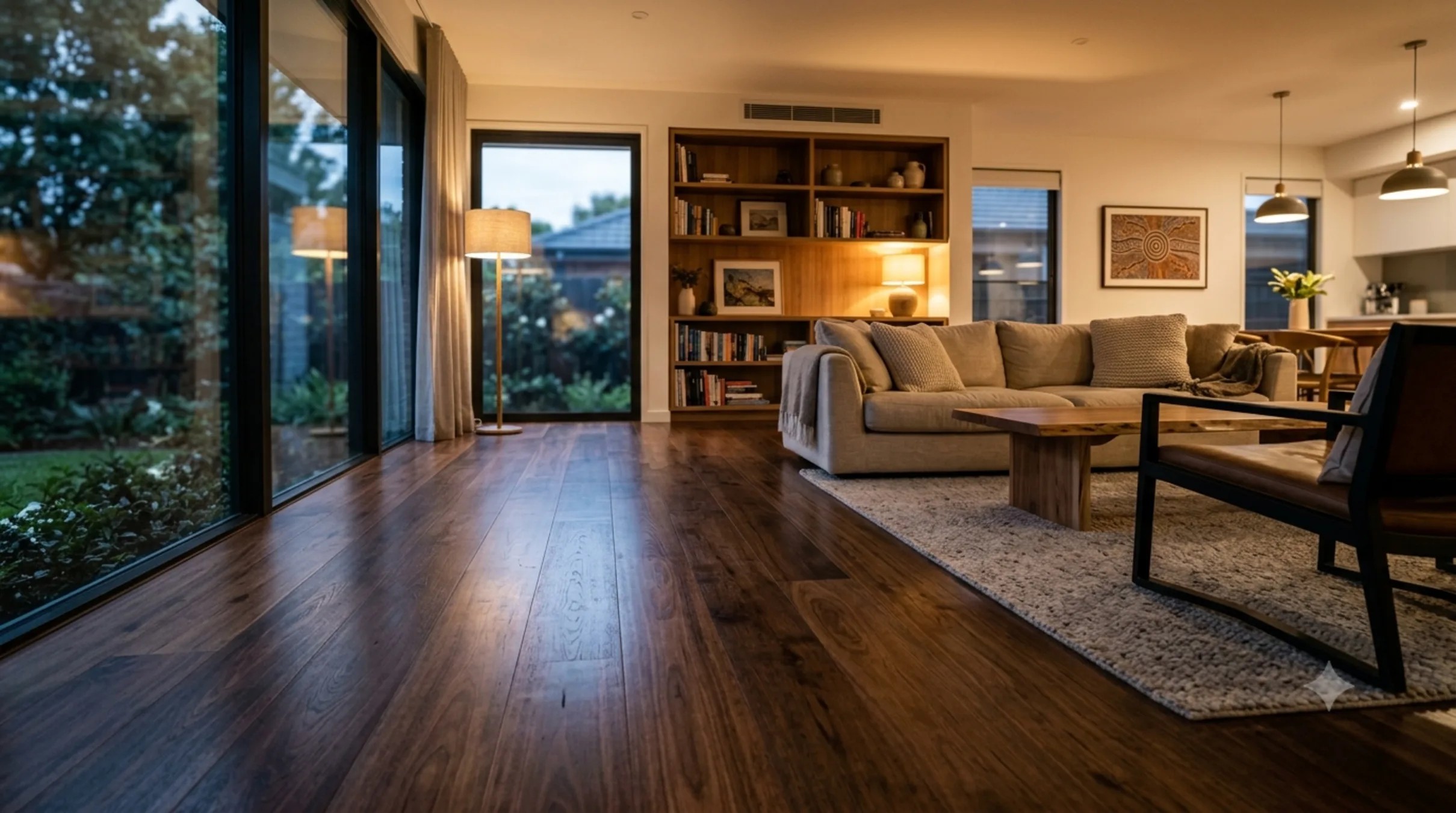
Floor sanding and polishing is the core work of this trade, and the service most timber floors on the Peninsula will need two or three times across their life. A solid hardwood floor is built to be sanded — there are eight to twelve millimetres of usable timber above the tongue on a typical strip floor, and each full cut takes roughly a millimetre. Used carefully, that is a century of service.
The job is not the sanding. The sanding is the visible part, but the outcome is decided before a machine is switched on. We check species, board condition, remaining thickness, existing coating, fixing method and subfloor moisture at the first visit, because each of those changes the scope. A floor that reads above 14 to 16 per cent moisture on a pin-type meter is not ready to be cut flat, and sanding it anyway is how a cupped floor becomes a crowned one two summers later.
Preparation is where the hours go. Carpet tack strips leave a continuous band of nail holes 20 to 30 millimetres in from every wall, and staples get driven through the boards in their hundreds. Every one comes out by hand before an abrasive touches the timber, because a single missed staple tears a belt and scores a line the length of the room. Exposed nails get punched below the surface. Legacy adhesive — black mastic under old lino is the usual culprit — gets scraped and cut back.
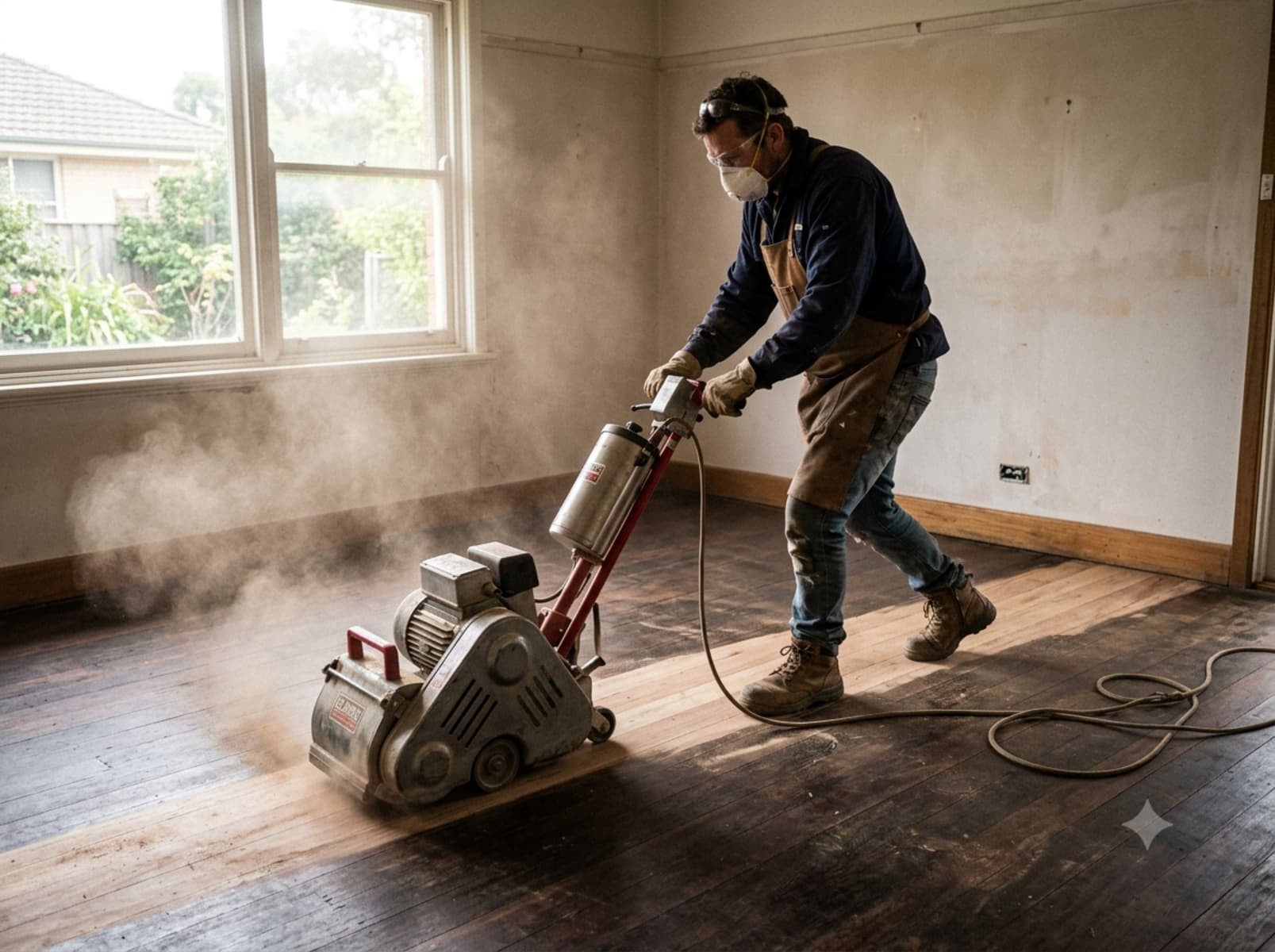
The cutting sequence itself runs coarse to fine. A 36 or 40-grit belt removes the old coating and levels the surface, worked in multiple directions on an uneven floor. Then progressively finer grits — 80, then 120 — take out the scratch pattern the previous grit left. Skipping a grit is the most common shortcut in this industry and it shows up as visible scratching under the finish, particularly in raking afternoon light.
The perimeter is separate work. A belt sander cannot get within about 100 millimetres of a wall, so everything inside that margin is edge grinder and hand scraping. Edgers cut with a rotating disc and leave a different scratch pattern to a belt, and blending that band into the field so the transition is invisible is one of the genuinely skilled parts of the job. Done badly it produces a halo around every room that only appears once the coating goes on.
Coating is a system rather than a product. A sealer goes down first, then the floor is screened with a 150-grit mesh pad to knock back the grain the water in the coating has raised, vacuumed thoroughly, and the topcoats applied. On tannin-rich species — Spotted Gum, Blackbutt, Australian Cypress — a shellac or alcohol-based isolation primer goes on before anything waterborne, or the evaporating water draws tannins to the surface as dark blotchy discolouration that cannot be fixed without cutting the floor back.
A typical 60 square metre residential job runs two to three days on site. A 120 square metre open-plan home runs four to five. Waterborne systems allow light foot traffic after 24 hours; full cure and furniture placement takes three to seven days, and heavy furniture or rugs on a large job should wait seven to ten. Solvent-based systems need the house evacuated for five to seven days while they off-gas, which is the single biggest practical argument for waterborne in an occupied home.
OUR PROCESS
- 01 Site inspection: species identification, board thickness above the tongue, existing coating, fixing method, and pin-type moisture readings taken at multiple points across every room.
- 02 Containment: adjacent rooms sealed, joinery and kitchens protected, dust extraction set up before any machine runs.
- 03 Preparation: carpet tack strips and staples removed by hand, exposed nails punched below the surface, legacy adhesive scraped and cut back, loose boards refixed.
- 04 Coarse cut at 36 to 40 grit with a belt sander, worked multi-directionally where the floor is uneven, to remove old coating and level the surface.
- 05 Medium and fine passes at 80 then 120 grit, each removing the scratch pattern of the grit before it.
- 06 Edge grinding and hand scraping at the perimeter, thresholds and corners, blended into the field so no halo shows under raking light.
- 07 Isolation primer where the species requires it — shellac or alcohol-based, on tannin-rich hardwoods and cypress.
- 08 Sealer coat, then a 150-grit mesh screen to knock back raised grain, followed by a full vacuum and tack-off.
- 09 Two topcoats of the specified system, with light abrading between coats and an additional coat through traffic lanes where specified.
- 10 Cure and handover: light foot traffic at 24 hours on waterborne, furniture at three to seven days, rugs and heavy pieces at seven to ten.
WHAT’S INCLUDED
- Turn-key sand-and-polish from $45/m² in the Frankston band, $55/m² in the Mount Eliza band and $70/m² across the Peninsula band — the range reflects suburb, floor area and coating system.
- A full sand with a three-coat 2K waterborne system runs $55 to $75/m² as a standard market rate.
- Carpet tack strip, staple and adhesive removal: $10 to $20/m², itemised rather than assumed.
- Nail punching and perimeter joint filling: $5 to $10/m².
- Gap filling with wood-flour resin on stable hardwoods, or pine splines on wide softwoods: $5 to $15/m².
- Additional topcoat through entries and traffic lanes: $10 to $15/m², and it roughly doubles finish life where it matters.
- Choice of matte, satin or gloss. Satin is the usual recommendation; gloss shows every remaining imperfection in the floor.
- Dust-controlled sanding as standard, with extraction running on every machine.
COMMON QUESTIONS
What does a $22 to $35 per square metre quote actually cover?
A sanding pass on a floor that is already prepared. It generally excludes GST, nail punching and perimeter joint filling at $5 to $10/m², removal of black mastic adhesive or heavy legacy paint at $8 to $15/m², and the extra topcoats a high-traffic area needs at $10 to $15/m². Add those back and the promotional number lands close to where a turn-key quote started.
How many times can a floor be sanded?
A solid strip floor has roughly eight to twelve millimetres above the tongue when new, and a full cut takes about a millimetre. That is realistically six to ten sands, though heavy edge grinding takes more from the perimeter than the field. Engineered floors are a different matter — the wear layer is two to six millimetres, so there may be only one cut available.
How long does the whole job take?
Two to three days on site for a typical 60m² scope, four to five for a 120m² open-plan home. Day one is preparation and the coarse and medium passes with the sealer down late. Day two is fine rotary work, screening, vacuuming and topcoats. Cure runs beyond that: light traffic at 24 hours, furniture at three to seven days.
Do we need to move out?
With a waterborne system, usually not. VOC content sits under 27 grams per litre, odour is minimal and you can be back on the floor within 24 hours of the final coat. With a solvent-based system, yes — the site needs to be evacuated for five to seven days while it off-gasses. That difference decides the specification for most occupied homes.
How much dust does it make?
With extraction running on every machine, very little becomes airborne. There will be fine settled dust on window ledges and horizontal surfaces at the end of the cutting stage, which we clean thoroughly before any coating goes down. Anyone quoting a genuinely dust-free sand is overselling it — dust-controlled is the honest description.
Can you sand engineered timber?
Only where the wear layer supports it. We measure at a threshold, floor vent or stair nosing rather than estimating. Three millimetres or more and a careful rotary sand is reasonable. Below two millimetres the honest answer is a screen-and-recoat at $25 to $40/m², which restores the surface without spending timber the floor cannot replace.
Why does my floor need a primer when my neighbour’s did not?
Species. Spotted Gum, Blackbutt and Australian Cypress carry high levels of water-soluble tannins. Apply a waterborne coating straight onto bare timber and the evaporating water draws those tannins up as dark brown blotching, uneven sheen and adhesion failure. A shellac or alcohol-based isolation primer locks them into the grain. Tasmanian Oak and Baltic Pine generally do not need it.
What if the moisture reading comes back high?
We stop and look at the subfloor before cutting anything. Above 14 to 16 per cent the timber is still carrying water it will eventually give up, and sanding it flat now means it will not be flat later — the board centres rise as it dries, which is crowning. The fix is usually blocked vents, subfloor ventilation or a polyethylene vapour barrier across the soil, and all of those cost a fraction of a second sanding job.