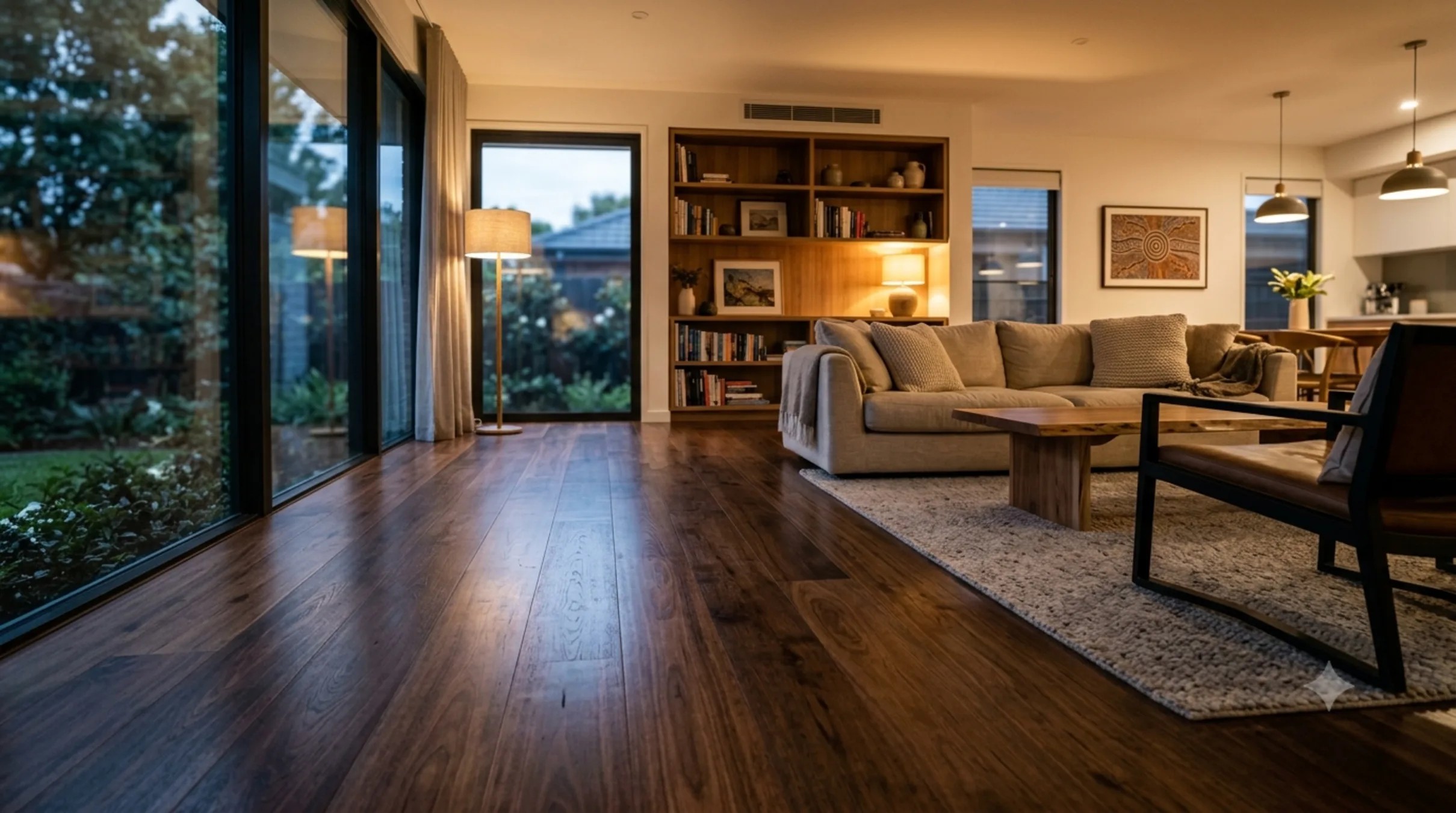
Dustless Floor Sanding
Priced turn-key from $45–$120/m² across the Peninsula, depending on suburb and job size
The honest term is dust-controlled, not dustless, and we would rather use it. Sanding timber creates dust as a matter of physics, and no equipment eliminates it entirely. What good extraction does is capture the overwhelming majority at the point of generation, before it becomes airborne and distributes itself through the house. That is a genuine and substantial difference, and it is worth paying for. It is not the same as a guarantee of zero dust, and anyone offering that is overselling.
The system is extraction at every machine rather than a vacuum run afterwards. The belt sander, the edge grinder and the rotary orbital all connect to a dedicated extraction unit through sealed hosing, so the dust generated at the abrasive is drawn away immediately rather than being thrown into the room. Multi-stage filtration then captures the fine fraction that matters most, and the unit vents outside where the property allows it.
The fine fraction is the part worth caring about. Coarse sanding dust is visible, settles quickly and is easy to clean up. The particles that stay suspended for hours and travel through a house are far smaller, and they are what ends up on top of wardrobes, inside cupboards and in the fabric of upholstery. Capturing those at the source is the entire justification for the equipment, and it is why filtration quality matters more than suction on paper.
Containment does as much work as extraction. Doorways to rooms outside the scope get sealed with sheeting and taped, wet areas and kitchens get protected, and where the floor being sanded connects to the rest of the house through an open plan, we build a temporary barrier rather than relying on the machines alone. Extraction plus containment is the combination that produces a genuinely clean job. Either on its own does not.
Where this matters most is in occupied houses, and particularly in households with asthma, respiratory conditions or small children. Timber sanding dust is a respiratory irritant and hardwood dust in particular is a recognised occupational hazard, which is why it is treated seriously on a work site. The same logic applies in a home. If someone in the house has a respiratory condition, the extraction specification stops being a comfort question.
It also matters commercially. A retail tenancy, a consulting suite or an office that needs to keep operating during the work cannot accommodate uncontrolled dust in adjoining spaces, and the containment and extraction plan is usually the deciding factor in whether the job can run out of hours around the business rather than closing it. We plan that at quote stage rather than improvising on site.
There is still a clean-down. After the cutting is complete and before any coating goes down, the floor and every horizontal surface in the working area gets vacuumed and tacked off. Fine dust remaining on the floor at coating time is permanent — it cures into the finish and the only remedy is cutting back and recoating. That final clean is not a courtesy, it is a technical requirement of getting a good finish.
Dust control is included in our standard scope rather than sold as an upgrade, and we think that is the right way round. A quote that prices dust extraction as an optional extra is describing a base service that puts hardwood dust through your house. The band rates for your suburb include extraction running on every machine, full containment of adjacent spaces and the pre-coating clean-down.
Filter maintenance during the job is the part nobody sees and the part that decides whether the system is actually working. An extraction unit with a loaded filter still makes noise and still moves some air, but it has stopped capturing the fine fraction that travels through a house, which is precisely the fraction the equipment exists to catch. Filters get checked and cleared through the working day rather than at the end of the job, and on a large floor with an old solvent-based coating coming off, that can be several times.
The other half of a clean job is what happens between the cutting and the coating. Fine dust settles for hours after the machines stop, so vacuuming immediately and coating straight away traps whatever is still in the air. We allow settling time, then vacuum the floor and every horizontal surface in the work area, then tack off just before the sealer goes down. That sequence costs an hour and it is the difference between a smooth finish and one with nibs cured permanently into it.
OUR PROCESS
- 01 Site assessment: extraction routing planned, containment lines identified, and venting location established before equipment arrives.
- 02 Containment built — doorways sealed with sheeting and taped, open-plan boundaries barriered, wet areas and joinery protected.
- 03 Extraction unit positioned and connected, with sealed hosing run to every machine that will be used.
- 04 Standard preparation with extraction running: tack strips, staples, nail punching and adhesive removal.
- 05 Coarse cutting with the belt sander connected to extraction at the point of generation.
- 06 Edge grinding with the edger connected to the same system — edgers generate a disproportionate share of the fine dust.
- 07 Fine sanding and rotary orbital work, extraction maintained throughout.
- 08 Filter maintenance during the job, because a loaded filter stops capturing the fine fraction that matters most.
- 09 Full clean-down: floor vacuumed, horizontal surfaces in the work area cleaned, tack-off immediately before coating.
- 10 Containment removed only after coating, so nothing is disturbed into a curing finish.
WHAT’S INCLUDED
- Dust control included in the standard band rate — from $45/m² in the Frankston band, $55/m² in the Mount Eliza band, $70/m² across the Peninsula band. Not an optional extra.
- Extraction connected at every machine including the edge grinder, which generates a disproportionate share of fine dust.
- Multi-stage filtration to capture the fine airborne fraction, not just the visible coarse dust.
- Physical containment of adjacent rooms and open-plan boundaries, because extraction alone is not enough.
- Full pre-coating clean-down, which is a technical requirement rather than a courtesy.
- Honest terminology: dust-controlled, not dustless. There is no such thing as zero dust.
- Particularly relevant where there is asthma, respiratory illness or small children in the household.
- Out-of-hours and staged programmes available for commercial premises that need to keep trading.
COMMON QUESTIONS
Is it genuinely dust free?
No, and we would not claim it. Sanding timber generates dust as a matter of physics. What extraction does is capture the great majority at the point of generation before it becomes airborne, and multi-stage filtration captures the fine fraction that travels furthest. There will still be a light settled dust on horizontal surfaces at the end of cutting, which we clean before coating.
What does the dust control cost extra?
Nothing. It is included in the band rate for your suburb, along with full containment of adjacent rooms and the pre-coating clean-down. A quote that prices extraction as an optional upgrade is describing a base service that puts hardwood dust through your house, which is not a base service we offer.
Can we stay in the house during the work?
Generally yes, with containment in place and the working area sealed off from the rest of the house. Where someone in the household has asthma or a respiratory condition, we will talk through the specifics and may recommend staying elsewhere for the cutting days even with extraction running. It is a conversation worth having at quote stage.
Why does the edger matter so much?
Because edge grinders cut with a rotating disc at high speed close to a wall, and they generate a disproportionate share of the fine airborne fraction relative to the area they cover. An operator running a well-extracted belt sander and an unextracted edger has solved the visible half of the problem and left the half that actually travels.
Do I need to cover my furniture?
We contain the work area and protect joinery, kitchens and wet areas as part of the scope. Furniture and soft furnishings in rooms outside the containment are generally fine. Anything remaining inside the work area should be removed rather than covered, because it will be in the way of the machines regardless of dust.
What happens to the dust that is collected?
It is contained in the extraction unit and removed from site. Timber sanding dust, particularly hardwood dust, is a recognised respiratory irritant and it is handled accordingly rather than being emptied into a household bin or blown out into a garden.
Why do you clean the floor again before coating?
Because any fine dust remaining at coating time cures into the finish permanently, and the only remedy is cutting back and recoating. The vacuum and tack-off immediately before the sealer is a technical requirement of getting a clean finish, not a tidy-up. It is one of the steps most reliably skipped on a rushed job.
Can you work in a shop or office without closing it?
Often, with a staged programme and out-of-hours work. The containment and extraction plan is usually what determines whether that is possible, and it needs planning at quote stage rather than improvising. We will give you an honest view of which areas can stay in use and when, rather than promising no disruption at all.