Timber Floor Restoration
Priced turn-key from $45–$120/m² across the Peninsula, depending on suburb and job size
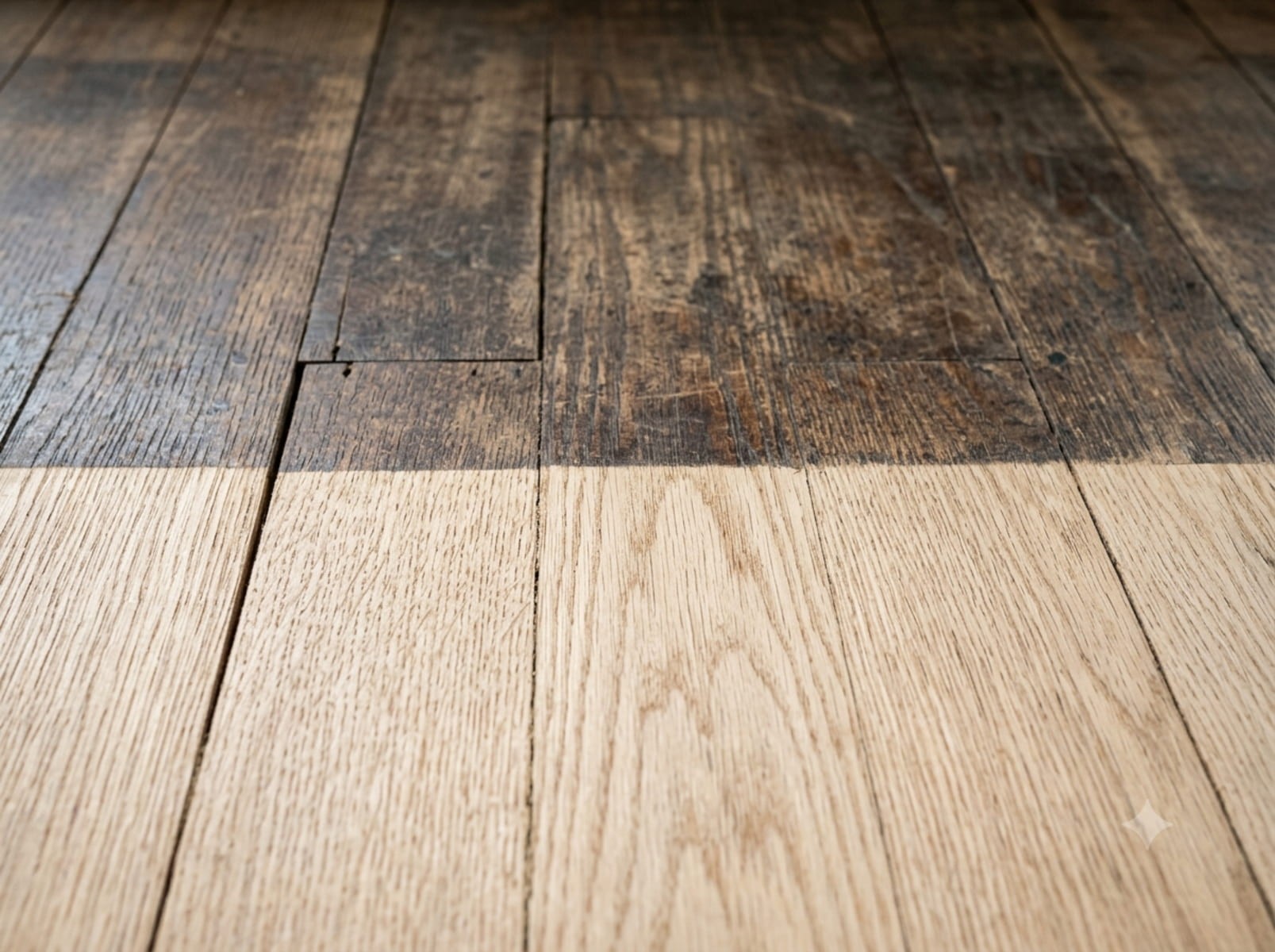
Restoration is what a sand-and-polish becomes when the floor has real problems. The distinction matters because the two jobs are quoted differently and take different amounts of time. A sand-and-polish assumes sound boards, consistent species and a floor that needs its finish renewed. A restoration assumes none of that, and starts with an assessment of what is actually wrong before anyone talks about coating.
Most restoration work on the Peninsula falls into four categories: boards damaged by long-term subfloor moisture, boards compromised by borer, floors that have been patched repeatedly across decades of renovation, and floors carrying failed previous work — crushed gap filler, drum stop marks, aggressive edge cutting. Each has a different fix and a different cost, and lumping them into a single rate per square metre serves nobody.
Borer assessment comes first where the signs are present. One to two millimetre exit holes with powdery dust around them mean the Common Furniture Beetle has been at the timber, and the critical question is whether the infestation is active or historical. Fresh, pale, creamy-white frass that falls freely when the board is tapped means active. Dark grey compacted dust means historical. We check board undersides through the subfloor access, because the exit holes are on top and the galleries are underneath.
Sanding a badly infested board is the mistake that turns a repairable floor into a replaced one. The larvae hollow out the internal structure and leave a thin solid wear layer over the void. Take two millimetres off the top and the surface opens into the galleries and collapses underfoot. Compromised boards come out and get replaced with matched aged reclaimed timber, and where the infestation is live, penetrating borate-based preservative goes onto the joists and board undersides before any coating.
Water-damaged boards are the other common replacement. Long-term subfloor damp produces cupping, and cupping that has run for years can pass the point where the board recovers. Ends that meet a wet wall go soft. Boards delaminate at the tongue. The judgement is board by board, and we make it before quoting rather than discovering it on day two and asking for more money.
Matched replacement stock is where restoration separates from repair. A new board next to a fifty-year-old one will read as a patch forever, regardless of stain, because the grain compression and surface character of aged timber cannot be manufactured. We source reclaimed stock of the right species, width and period where the board count justifies it. Where it does not, we discuss honestly whether a visible honest repair is a better outcome than a bad pretended match.
Only once the boards are sound does the sanding sequence begin, and on a restoration it is usually longer than on a straight refinish. Replacement boards sit at a slightly different height and need levelling in. Old patches from previous decades need blending. Multi-directional coarse cutting is often required where the floor has moved. Then the normal progression through 80 and 120 grit, edge grinding, screening and coating.
Timelines run longer than people expect and we would rather say so up front. A restoration on a 100 square metre floor with board replacement, a fireplace zone needing individual attention and blending across old patch work is five to eight days rather than the three a straight sand would take. Where borate treatment is in scope, add drying time before any coating can go down.
The judgement we are paid for is knowing when a floor is not worth restoring, and we give that view before anyone has spent money on it. A floor sanded twice already with no usable thickness above the tongue, borer damage across a majority of boards, or rot running back into the joists at a wet area can all point toward overlay or replacement instead. Restoration is the right answer often enough on the Peninsula that we would rather protect our credibility on the cases where it is not.
OUR PROCESS
- 01 Full condition assessment: species, thickness above the tongue, board-by-board soundness, subfloor access inspection, pin-type moisture readings across multiple points.
- 02 Borer determination where signs are present — frass colour and behaviour tested, board undersides examined, active versus historical established before scope is agreed.
- 03 Written scope separating the sanding from the repairs, with board replacement and any treatment itemised individually.
- 04 Borate-based preservative applied to subfloor joists and board undersides where infestation is active, with drying time allowed before coating.
- 05 Damaged and compromised boards lifted and replaced with matched aged reclaimed stock of the correct species, width and period.
- 06 Loose boards refixed, exposed nails punched, historic patch work assessed for lifting or blending.
- 07 Multi-directional coarse cutting at 36 to 40 grit to level replacement boards and correct movement across the floor.
- 08 Progression through 80 and 120 grit, with edge grinding, corner scraping and threshold detail worked by hand.
- 09 Stain sampling on the actual boards where old and new timber need blending, tested before any whole-floor commitment.
- 10 Isolation primer where species requires, sealer, 150-grit screen, vacuum, then topcoats with full cure allowance.
WHAT’S INCLUDED
- Turn-key restoration from $45/m² in the Frankston band, $55/m² in the Mount Eliza band and $70/m² across the Peninsula band, before repair items.
- Subfloor repairs and board replacement: $8 to $20/m², or from $50 per board for individual replacements in matched aged stock.
- Borate treatment of joists and board undersides quoted per property, because the extent varies enormously with the infestation.
- Gap treatment: $5 to $15/m² — wood-flour resin on stable hardwoods, tapered pine splines on wide softwoods.
- Stain blending across mixed-age timber: $12 to $25/m², sample-tested on the actual floor before committing.
- Carpet, tack strip and legacy adhesive removal: $10 to $20/m².
- Every repair item quoted as its own line rather than folded into a rate per square metre.
- An honest assessment at quote stage on whether the floor is economic to restore at all — some are not, and we say so.
COMMON QUESTIONS
How do I know if my floor is worth restoring?
Three things decide it: thickness remaining above the tongue, how many boards are structurally compromised, and whether the subfloor problem that caused the damage can be fixed. A floor with plenty of timber, a handful of bad boards and a solvable moisture issue is worth restoring almost every time. A floor sanded twice already with widespread borer damage usually is not.
How do I tell active borer from old borer damage?
Tap the board near the exit holes and look at the dust. Active infestation produces fresh, pale, creamy-white powdery frass that falls freely. Historical infestation leaves dark grey, compacted dust that does not move. It is worth checking properly, because active infestation needs borate treatment to the joists and board undersides before any coating goes on.
Can you match old boards?
We source reclaimed timber of the right species, width and period where the board count justifies it, and that gets close. Perfectly matching a fifty or hundred-year-old board is not possible with new stock — the grain compression and surface character of aged timber cannot be reproduced. Where a good match is not achievable we say so rather than promising one.
What does board replacement cost?
$8 to $20 per square metre where a section is being replaced, or from $50 per board for individual replacements in matched aged stock. The variation is mostly about sourcing — a common Tasmanian Oak strip is straightforward, a 180mm heritage Baltic Pine board of the right period is not.
Why is restoration more expensive than sanding?
Because the sanding is only part of it. Board assessment, sourcing matched stock, lifting and replacing boards, levelling replacements into the existing floor, treating an active infestation and blending across mixed-age timber all take time before the first coarse pass. The sanding itself costs roughly the same either way.
How long does a restoration take?
Five to eight days on a 100m² floor with board replacement and blending, against two to three for a straight sand of the same area. Where borate treatment is in scope, add drying time before coating. We give a realistic number at quote rather than an optimistic one, because a job that runs over disrupts a household more than one that was honestly scoped.
My floor is cupped. Is it ruined?
Almost certainly not. Cupping is the board edges curling upward because the underside is absorbing moisture the top face is not, and a floor that comes back to a stable moisture content will flatten substantially on its own. That is exactly why sanding it flat while damp is the wrong move — it produces crowning later. Fix the subfloor, let it stabilise, then cut it.
Should I fill the gaps in my old pine floor?
Generally no, not with rigid filler. Wide Baltic Pine moves significantly across its width with seasonal humidity and will crush a resin filler and eject it the first humid summer. The durable options are open gaps cleaned out properly, or tapered pine splines glued in and sanded flush, at $5 to $15/m². On narrower hardwood strip a wood-flour resin mix will generally hold.