Floor Sanding Mornington
Mornington · 3931 · Mornington Peninsula
Two distinct floors exist in Mornington and the same contractor rarely handles both well. Through the old town centre there are 1900s cottages with wide-board Baltic Pine, top-nailed, often still carrying the original coating under a century of overlays. Around the edges there is 1980s-onward brick and rendered stock with native hardwood strip or engineered oak. The first requires patience and restraint. The second requires efficiency. Quoting them the same way produces a poor result on one of them.
The period cottage floors are the more interesting proposition. Baltic Pine laid at the turn of the century runs 130 to 200 millimetres wide, considerably wider than the 150 millimetre post-war standard, with prominent knots and a resin content that has hardened and darkened over the decades. These floors have usually been covered at some point — lino in the fifties, carpet in the seventies, occasionally both — and the timber underneath is generally intact and generally worth restoring.
Board width is the technical issue that follows. A 200 millimetre pine board moves substantially more across its width with seasonal humidity than an 80 millimetre hardwood strip does, and that movement is what destroys rigid gap fillers. We see failed filler in Mornington cottages constantly: hard grey lines of cracked resin standing proud of the timber, crushed out of the joints by the first humid summer after the job. The fix is to clear it out entirely and either leave the gaps open or spline them with tapered reclaimed pine.
Matching replacement stock in a period cottage is its own challenge and it is where a lot of restorations fall short. A century-old Baltic Pine board has a colour, a grain compression and a level of surface wear that new pine simply does not have, and a patched-in modern board will read as a patch forever regardless of how well it is stained. We use aged reclaimed timber where the board count justifies sourcing it, and where it does not, we discuss whether the affected section is better left as honest repair than pretended away.
Mornington sits in the Mount Eliza pricing band. Turn-key rates run $55 to $80 per square metre, with typical scopes of 90 to 140 square metres putting whole-job contracts between $6,050 and $8,800. Period cottage restorations sit at the upper end of that because the timber demands slower machine work, the board repairs are more involved, and the resin content complicates the coating. Board replacement is quoted separately at $8 to $20 per square metre or from $50 a board.
Resin is the specific coating problem in old pine. Baltic Pine carries a high natural resin content that heats and softens under a coarse belt, clogging abrasive within a few passes, and that same resin can interfere with coating adhesion where it has concentrated around knots. A shellac-based spot seal over the resinous areas before the main sealer solves it. Skipping that step produces patchy sheen and, in the worst cases, coating that never fully hardens over the knots.
On the newer Mornington stock the work is more conventional. Native hardwood strip in the 1980s and 90s builds, engineered oak in anything recent, standard preparation and a waterborne finish. The main thing worth checking is whether the floor has been sanded before and how much thickness is left, particularly on engineered product where the wear layer sets a hard limit. That is a measurement, taken at a threshold or a vent, not an estimate.
Timeline for a Mornington period cottage is four to six days, longer than the floor area alone would suggest. The extra time goes into the pine: lighter, more sequential grit passes to avoid dishing the soft springwood, more frequent belt changes to stay ahead of resin clogging, the shellac spot seal, and an additional sealer coat because pine absorbs the first one unevenly across the growth rings. Newer stock runs closer to the standard four to five days for a 120 square metre home.
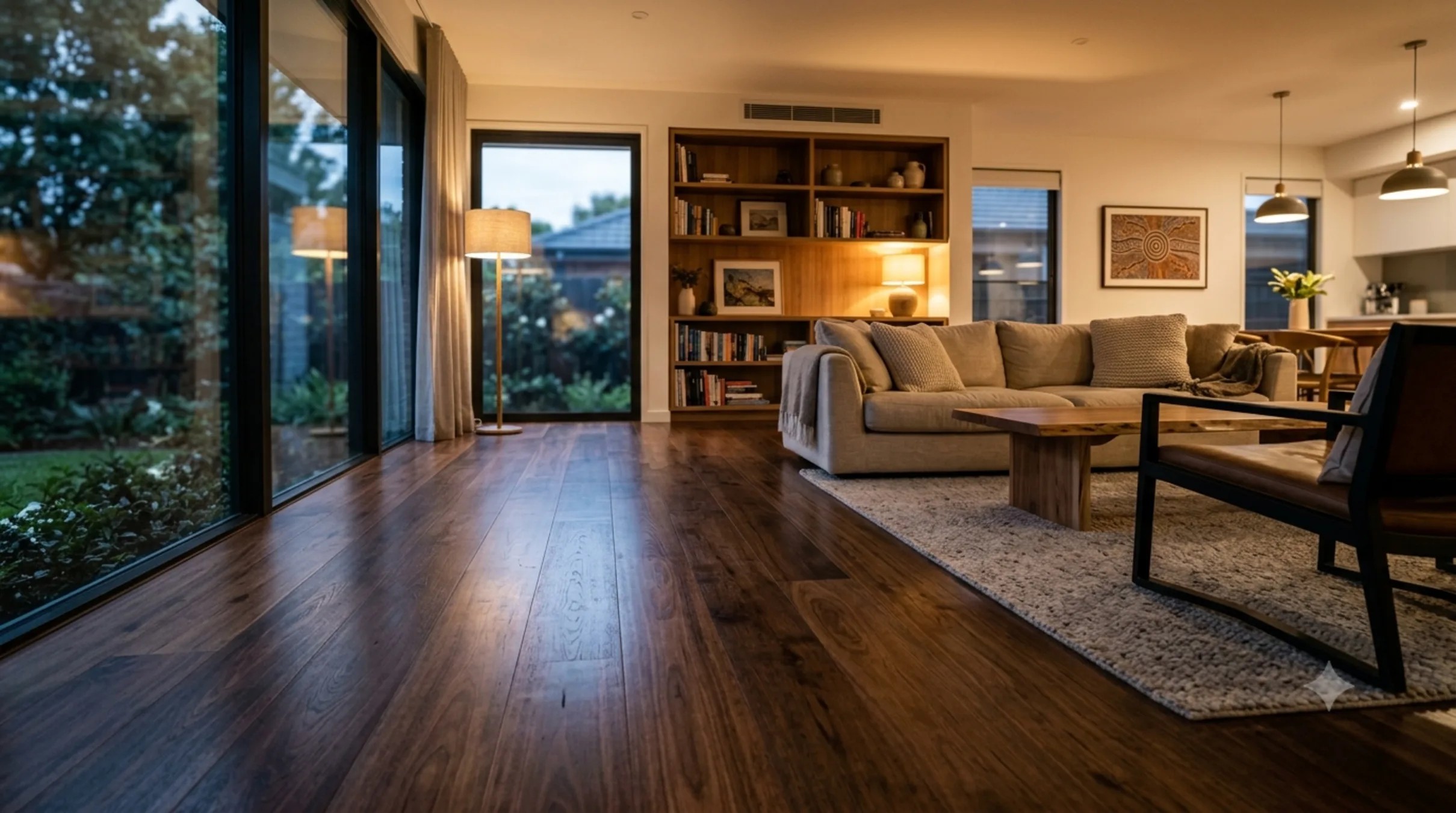
For coating we recommend matte or satin waterborne on the period pine. It sits into the timber rather than on top of it, holds the ambered honey patina the floor has developed without pushing it further orange, and photographs well in the warm light most of these cottages get through their original window openings. Hardwax oil is the alternative worth considering if you want a softer, more traditional surface that can be spot-refreshed in future without a full recoat.
On the newer Mornington floors, two-pack waterborne satin is the default. Non-yellowing, high abrasion resistance, re-entry within 24 hours, and it handles the coastal light coming off the bay without the amber drift that solvent-based systems show within a few years. Where the house is used as a holiday let or short-stay rental, the durability of a commercial-grade waterborne is worth the specification — guest turnover is harder on a floor than a family is.
The practical Mornington consideration is scheduling around the town. Access and parking through the old centre streets is genuinely tight, and a truck plus a dust extraction unit plus a materials load needs somewhere to sit for several days. We sort that out at quote stage rather than arriving on day one and improvising, and where the property has no off-street option we plan the equipment staging to minimise the number of carries. Small thing, but it is the difference between a job that starts at eight and one that starts at ten.
REPLACING THE FLOOR IN MORNINGTON INSTEAD?
If the existing boards are past saving, or you are after something different underfoot, we also supply and install timber, engineered and hybrid flooring here.