
Most floor sanding quotes take about twenty minutes. Somebody walks the rooms, measures the area, looks at the condition of the existing coating, and gives you a figure.
We do the same things, plus one more that takes about ten minutes and occasionally ends with us recommending you do not proceed yet. It is the single most useful thing that happens during a quote, and a surprising number of contractors on the Peninsula do not do it at all.
What the meter is telling us
Timber is hygroscopic. It takes up and gives off water depending on the humidity of the air around it, and it changes dimension as it does — expanding across its width as it takes moisture up, shrinking as it gives it off. That is not a defect. It is the fundamental property of the material and every durable decision about a timber floor works with it.
Moisture content is expressed as a percentage of the timber’s oven-dry weight. A floor in equilibrium with a normal Peninsula indoor environment sits somewhere around 9 to 12 per cent. A floor over a damp subfloor can read considerably higher, and the boards will be dimensionally larger than they will eventually be once that water leaves.
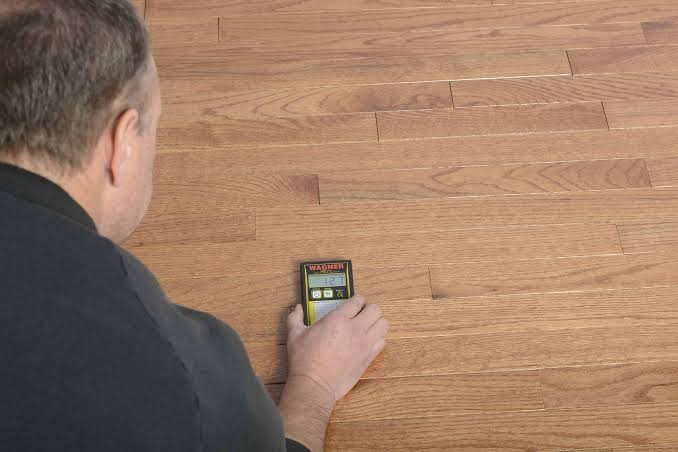
A pin-type meter measures electrical resistance between two small pins driven into the board. Resistance falls as moisture rises, and the meter converts that into a percentage. It leaves two pinholes, which disappear entirely in the sanding.
The number that matters
Fourteen to sixteen per cent is the threshold.
Below it, the timber is close enough to its eventual stable state that cutting it flat now will produce a floor that is still flat later. Above it, the board is carrying water it is going to give up, and it is going to change shape when it does.
That is the whole decision. Everything else follows from it.
What goes wrong when nobody checks
The failure mode is specific and it is expensive.
A floor over a damp subfloor cups — the underside absorbs moisture the heated top face does not, the bottom of each board expands more than the top, and the edges curl upward. Sand that floor flat while it is still wet and the raised edges are removed permanently.
Then the subfloor eventually dries. The boards relax toward flat. But the edges that would have come back down are gone, so instead the centre of every board rises above its shoulders. That is crowning, and it is worse than the cupping it replaced — more visible, harder underfoot, and correctable only with another full cut into timber that has already lost a millimetre it was not budgeted to lose.
On a floor that has been sanded before, there may not be another cut available.
Why one reading is not enough
We take readings at multiple points in every room, and the spread is frequently larger than people expect.
A typical Peninsula house might read 10 or 11 per cent in the middle of a heated open-plan living area, and 17 or 18 along the wall of a rear bedroom that backs onto a shaded southern side with a garden bed built up against the perimeter. Same house, same floor, same day.
Averaging those is meaningless, because the sanding does not average. The wet section will move whether or not the dry section is stable. So what we are looking for is the highest reading in the house, and whether there is a pattern to where the wet areas are — which is usually the most informative thing about the subfloor underneath.
What high readings actually mean
Almost always, one of three things, and none of them are catastrophic.
Blocked perimeter vents. The most common by a wide margin. Vents that were adequate when the house was built in 1958 have been buried under six decades of accumulated sand, mulch, garden bed build-up and shrub growth. We find this constantly in Capel Sound, Tootgarook and the older Seaford stock. Clearing them is a weekend with a spade.
No cross-flow. Some houses were built with vents on only two sides, or a later extension has sealed off whatever air movement existed. Mechanical subfloor ventilation fans solve it and it is a straightforward trade job.
No vapour barrier. A great many pre-1970s Peninsula houses have bare earth under the floor with nothing between the soil and the timber. Ground moisture evaporates upward indefinitely. Laying continuous polyethylene sheet across the soil is the single highest-value intervention available and costs a fraction of any flooring work.
Over a concrete slab the equivalent check is slab moisture, and the equivalent cause is a vapour barrier under the slab that was compromised during construction. That one is harder to fix and worth knowing about before spending money on a finish that will keep moving.
The seasonal option nobody offers
Here is something we mention at quote stage and rarely hear from anyone else: if the reading is marginal and the job is not urgent, wait for a drier month.
A floor in Tootgarook, behind the wetland with the water table where it is, will read meaningfully differently in August than in February. Same house, same subfloor, no work done in between — just the annual cycle.
Where a client wants their floor done before Christmas and it is currently July with a reading of 17 per cent, the honest advice is often simply to book it for November. That costs nobody anything and it substantially changes the outcome.
Why this conversation costs us work
We are not going to pretend otherwise: telling someone their floor is not ready loses jobs.
A contractor without a meter will quote the sand, do the sand, invoice, and be well gone before the crowning appears eighteen months later. Their quote arrives faster, it does not come with conditions, and it does not involve a conversation about subfloor vents. On a straight comparison of two pieces of paper, they win.
There is no way to compete with that on price or convenience. The only thing to compete on is whether the floor is still flat in three years, and that is a difficult argument to make to somebody holding a cheaper quote.
So we make it anyway, and we accept losing some of those jobs. The alternative is taking money for work we know will fail, which is not a business we want.
What to ask other contractors
If you are collecting quotes for a floor anywhere in the low country — Seaford, Capel Sound, Tootgarook, low-lying Frankston, the Karingal drainage basin, or any older house with minimal subfloor clearance — one question separates the quotes usefully.
What was my moisture reading?
If they can tell you a number and where they took it, they have assessed your floor. If the answer is vague, or the question is treated as unusual, they did not take one — and the price they have quoted is a guess about a floor they have not measured.
That is not always fatal. Plenty of Peninsula floors read comfortably and sand without incident. But you would want to know which kind you have before committing several thousand dollars to the assumption.
The ten-minute version
A pin meter costs less than a decent power tool. Using one across a house takes ten minutes. The reading it produces determines whether the most expensive part of the job — the irreversible part, where timber comes off boards and does not go back — should happen this month or in four months.
It is not a sophisticated piece of diagnosis. It is just a step that is easy to skip, invisible when skipped, and expensive to have skipped.
COMMON QUESTIONS
What moisture reading is acceptable before sanding?
Below 14 to 16 per cent on a pin-type meter. Above that the timber is still carrying water it will eventually give up, and levelling it now means it will not be level later. The exact figure within that band depends on the species and the conditions the floor will live in.
Why take readings at multiple points?
Because a floor is not uniform. It can sit comfortably at 11 per cent in the middle of a heated living room and 18 per cent along the wall backing onto the wet side of the house. One reading near the front door tells you almost nothing about the room, let alone the house.
What is a pin-type meter and why that kind?
It measures electrical resistance between two pins driven into the timber, which varies with moisture content. Pinless meters read a broader area without marking the surface but are more easily thrown by density variation and surface conditions. For a decision this consequential we want the direct reading.
What happens if the reading is too high?
We stop and look at the subfloor rather than cutting the floor flat. Usually the cause is blocked perimeter vents, no cross-flow ventilation, or no vapour barrier over the soil — all of which cost a fraction of a second sanding job to fix. Then the timber is given time to come back to a stable moisture content.
Does the time of year matter?
Considerably, especially in Tootgarook, Seaford and Capel Sound. A floor that reads high in August will often read acceptably in February. Where a job is not urgent, timing it for the drier end of the year is free and effective, and we will say so at quote stage.
Do you charge to take the reading?
No. It is part of quoting the job properly. A quote given without one is a guess about a floor nobody has actually assessed, and we would rather lose the work than put a number on a floor we have not measured.