Floor Sanding Mount Martha
Mount Martha · 3934 · Mornington Peninsula
Cool, damp and heavily shaded is exactly the environment the Common Furniture Beetle wants, and Mount Martha supplies it better than anywhere else on the bay side. The treed enclaves through here — established canopy, limited direct sun, houses set back into the vegetation — produce subfloor conditions that stay humid year-round. That matters because Anobium punctatum targets well-seasoned softwood and the sapwood of certain hardwoods, and it does its damage entirely out of sight.
The signs are easy to miss and easy to misread. Exit holes one to two millimetres across, scattered rather than clustered, with a fine powdery dust called frass around them. Most owners notice the holes and assume they are old. Sometimes they are. The test that matters is the frass itself: active infestation produces fresh, pale, creamy-white powder that falls freely from the holes when the board is tapped. Historical infestation leaves dark grey, compacted dust that does not move.
We check the undersides of boards through the subfloor access rather than judging from the room above, because the surface holes are the exit wounds and the actual galleries are underneath. The larvae bore through the internal cellular structure for years before emerging, which means a board can look sound from above while retaining almost no structural section below. That is the scenario that catches people out.
Sanding an infested floor is the mistake that turns a repairable problem into a replacement. Take two millimetres off the top of a board that has been hollowed out internally and you remove the last solid wear layer holding it together. The surface opens into the galleries and then collapses underfoot. We assess board by board before quoting, and structurally compromised boards come out and get replaced with matched aged reclaimed timber rather than sanded and hoped for.
Where the infestation is live, penetrating borate-based wood preservative goes onto the subfloor joists and the board undersides before any coating work begins. Borates penetrate rather than sitting on the surface, which is what is required when the target is inside the timber. Coating over an active infestation seals the surface and does nothing about what is happening two millimetres down, and the floor keeps degrading under a perfectly good finish.
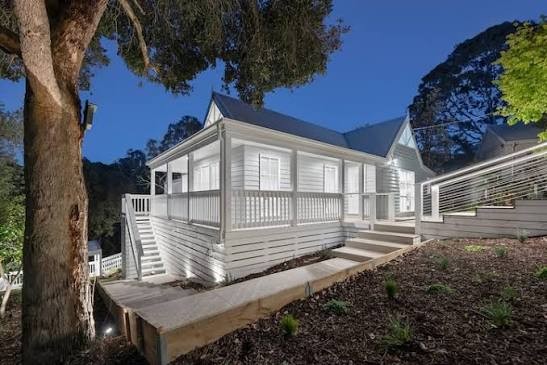
The Mount Martha housing stock is 1970s to 1990s architect-influenced homes with generous floor plans and bay-view orientations, which means large timber areas and a lot of glazing. Native Australian hardwoods dominate — Blackbutt, Tasmanian Oak, Spotted Gum in the later builds — with engineered oak in the modern extensions. Floor plates run to the upper end of the 90 to 140 square metre band typical of this pricing tier.
Mount Martha sits in the Mount Eliza band at $55 to $80 per square metre turn-key, putting a typical 110 square metre residence between $6,050 and $8,800. Borer remediation is quoted separately because it varies enormously: board replacement runs $8 to $20 per square metre or from $50 a board, and borate treatment of the subfloor is its own line item. We would rather show those numbers at quote stage than fold them into a rate and have the scope drift on site.
Tannin bleed is the second technical issue here and it follows from the species. Spotted Gum and Blackbutt carry high levels of water-soluble tannins and extractives. Apply a waterborne polyurethane directly onto bare timber and the evaporating water draws those tannins up to the surface, producing dark brown blotchy discolouration, uneven sheen and coating adhesion failure. It is not a fixable defect once it has happened — the floor has to be cut back and started again.
The prevention is a fast-drying alcohol-based or shellac-based isolation primer laid over the bare timber before any waterborne topcoat. It forms a chemical barrier that locks the tannins into the grain. On the hardwood species common through Mount Martha this is not optional, and the fact that it appears on our quote and not on a cheaper one is usually the entire explanation for the price difference.
Coating recommendation is two-pack waterborne, satin, with the isolation primer underneath where the species requires it. The bay-view glazing that makes these houses what they are also delivers a lot of UV onto the floor, and a solvent-based polyurethane will amber a Blackbutt floor toward orange within a few years, unevenly, following the sun path. Waterborne holds its clarity, cures hard enough for the traffic, and lets the household back in within 24 hours instead of evacuating for a week.
Execution on a 120 square metre Mount Martha house spans four to five days, with an additional day or two where borer remediation is in scope. Days one and two cover tack strip removal, board levelling, nail punching and the multi-directional coarse passes with full edge grinding and corner scraping. Day three is rotary orbital finishing, vacuuming and the isolation primer. Day four is screening and the high-build topcoats. Light traffic day five, heavy furniture at seven to ten days.
The advice we give every Mount Martha owner regardless of whether borer is present is to look at the subfloor ventilation. Blocked vents, garden beds built up against the perimeter, leaf litter accumulated under the house — all of it keeps the subfloor humid, and a humid subfloor is what makes the timber attractive to borer in the first place. Clearing it is cheap. Dealing with an established infestation across a whole-house floor is not.
REPLACING THE FLOOR IN MOUNT MARTHA INSTEAD?
If the existing boards are past saving, or you are after something different underfoot, we also supply and install timber, engineered and hybrid flooring here.