Floor Sanding Tootgarook
Tootgarook · 3941 · Mornington Peninsula
There is a wetland named after this place and it is not a coincidence. The Tootgarook Wetland sits behind the residential strip and the water table underneath the whole pocket is high year-round, which makes this the most moisture-driven flooring environment on the back beach side of the Peninsula. Every quote here starts with a meter, and a meaningful proportion of them end with a recommendation to wait.
The relevant threshold is 14 to 16 per cent timber moisture content. Below it, a floor is stable enough to sand flat and expect it to stay flat. Above it, the timber is still carrying water that it will eventually give up, and cutting it level now means it will not be level later. We take pin-type readings across multiple points of every room rather than one convenient spot, because a floor can sit comfortably at 11 per cent in the middle of a heated living area and 18 per cent along the wall backing onto the wet side of the house.
Seasonality matters more in Tootgarook than anywhere else we work. A floor that reads high in August will often read acceptably in February, and where a job is not urgent, timing it for the drier end of the year is free and effective. We will say that at quote stage. It is worth understanding that a contractor who sands your floor in the middle of a wet winter is not necessarily doing anything visibly wrong on the day — the consequences arrive eighteen months later as crowning.
Where the readings will not come down, the fix is at the subfloor rather than the floor. Continuous polyethylene vapour barrier laid across the soil under the house is the single highest-value intervention and it is not expensive relative to a sanding job. Mechanical ventilation fans move air through a subfloor that has no natural cross-flow. Clearing vents that sand and garden beds have buried over the decades is free. We will tell you which combination this particular house needs.
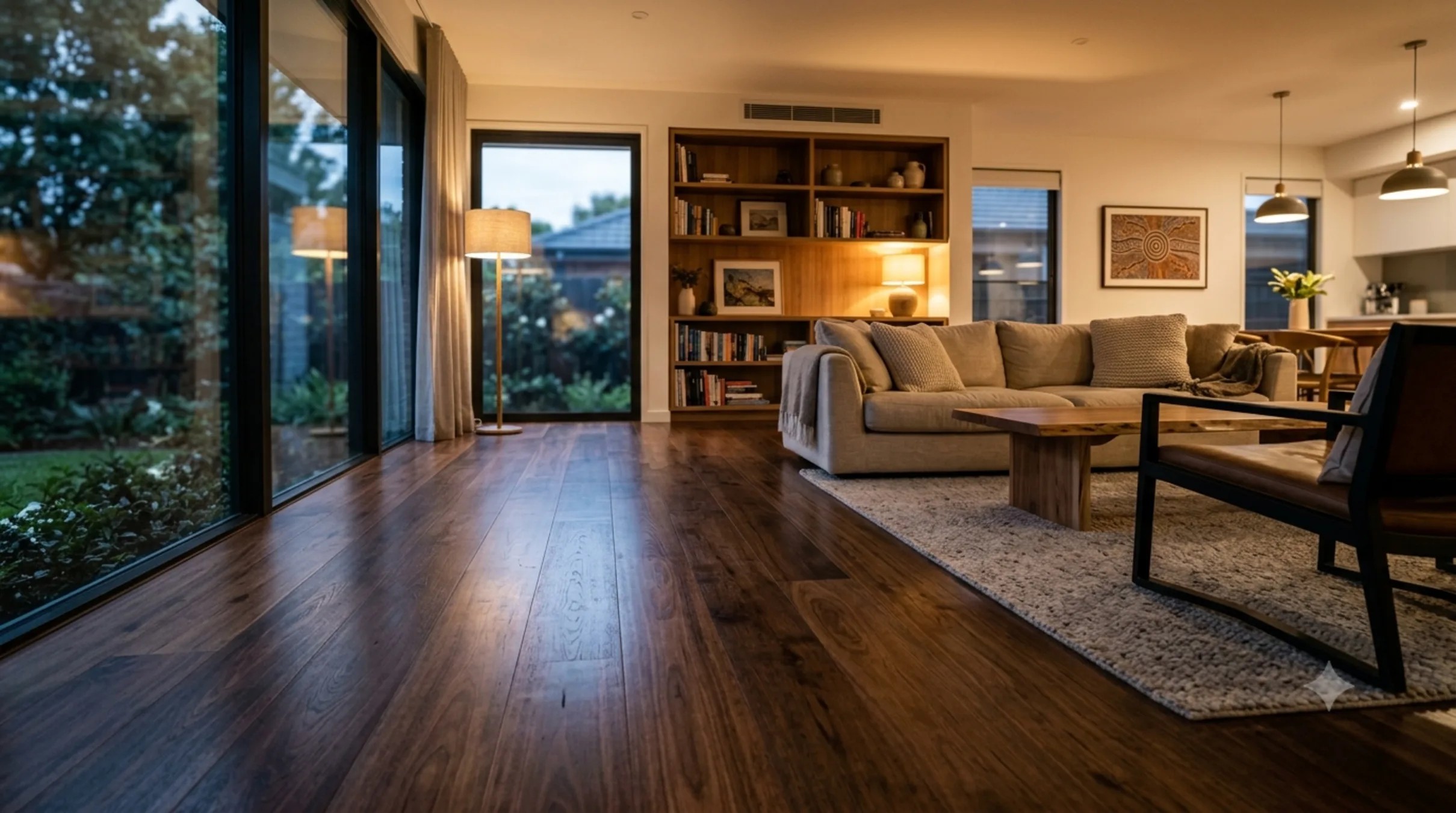
The housing itself is modest 1960s and 70s beach stock with pockets of newer development, low-set, generally on shallow footings. Flooring is narrow-strip native hardwood or Baltic Pine on bearers and joists in the older houses, with engineered overlay in anything recent. Subfloor clearance under the original builds is often under 300 millimetres, which is precisely the condition that traps evaporating ground moisture against the underside of the boards.
Cupping is the defect that follows and it is nearly universal in the untreated older houses here. The boards curl upward at their edges because the underside is absorbing what the top face is not. It looks alarming and it is entirely reversible — a cupped floor that comes back to a stable moisture content will flatten substantially on its own, which is exactly why sanding it flat while damp is the wrong move. Let it flatten, then cut it, and you keep the board thickness.
Tootgarook sits in the Mount Eliza pricing band at $55 to $80 per square metre turn-key. Typical scopes of 90 to 140 square metres put whole-job contracts between $6,050 and $8,800. Where a floor has been damaged rather than merely moved by long-term damp — boards that have delaminated, cupped past recovery, or gone soft at the ends where they meet a wet wall — replacement runs $8 to $20 per square metre or from $50 a board.
Gap-filling on a floor in this environment needs care. Boards that expand and contract across a wide seasonal moisture range will crush a rigid resin filler and eject it, particularly on wide Baltic Pine. Open gaps cleaned out with a multitool, or tapered pine splines glued in and sanded flush, at $5 to $15 per square metre. On narrower hardwood strip a wood-flour resin mix will generally hold, but we would rather leave a gap honest than fill it twice.
Coating is two-pack waterborne, satin, and there is a moisture-specific argument for it beyond the usual ones. Waterborne systems tolerate a slightly less than perfect substrate better than solvent-based ones do, they cure fast enough to get the floor closed up before the next humid night, and re-entry is within 24 hours rather than the five to seven days a solvent system needs while it off-gasses. On a small beach house with nowhere else to be, that matters.
Three to four days for a standard scope once the floor is ready. Day one is containment, staple and tack strip removal, nail punching and the coarse and medium passes with the sealer down late. Day two is fine rotary sanding, screening with a 150-grit mesh pad, vacuuming and the topcoats. We watch the weather across those days more carefully here than elsewhere, because coating a floor on a heavy, still, foggy Peninsula morning slows the cure and can affect the finish.
The summary for Tootgarook is that patience is the whole technique. These are good floors in a difficult environment, and the difference between a sanding job that lasts twenty years and one that fails in three is almost entirely about whether the timber was stable when it was cut. Sort the subfloor, wait for the reading to come down, then sand. Done in that order it works. Done in any other order it does not.
ALSO AVAILABLE IN TOOTGAROOK
Because Tootgarook is a coastal Peninsula suburb, we also offer deck sanding and oiling and lime-wash finishes here.
REPLACING THE FLOOR IN TOOTGAROOK INSTEAD?
If the existing boards are past saving, or you are after something different underfoot, we also supply and install timber, engineered and hybrid flooring here.