Water-Based Polyurethane
$55 – $75/m² turn-key with a three-coat 2K system
Water-based polyurethane is the system we specify on the majority of Peninsula floors, and the reasoning has less to do with fashion than with two practical properties: it does not yellow, and you can be back in the room the next day.
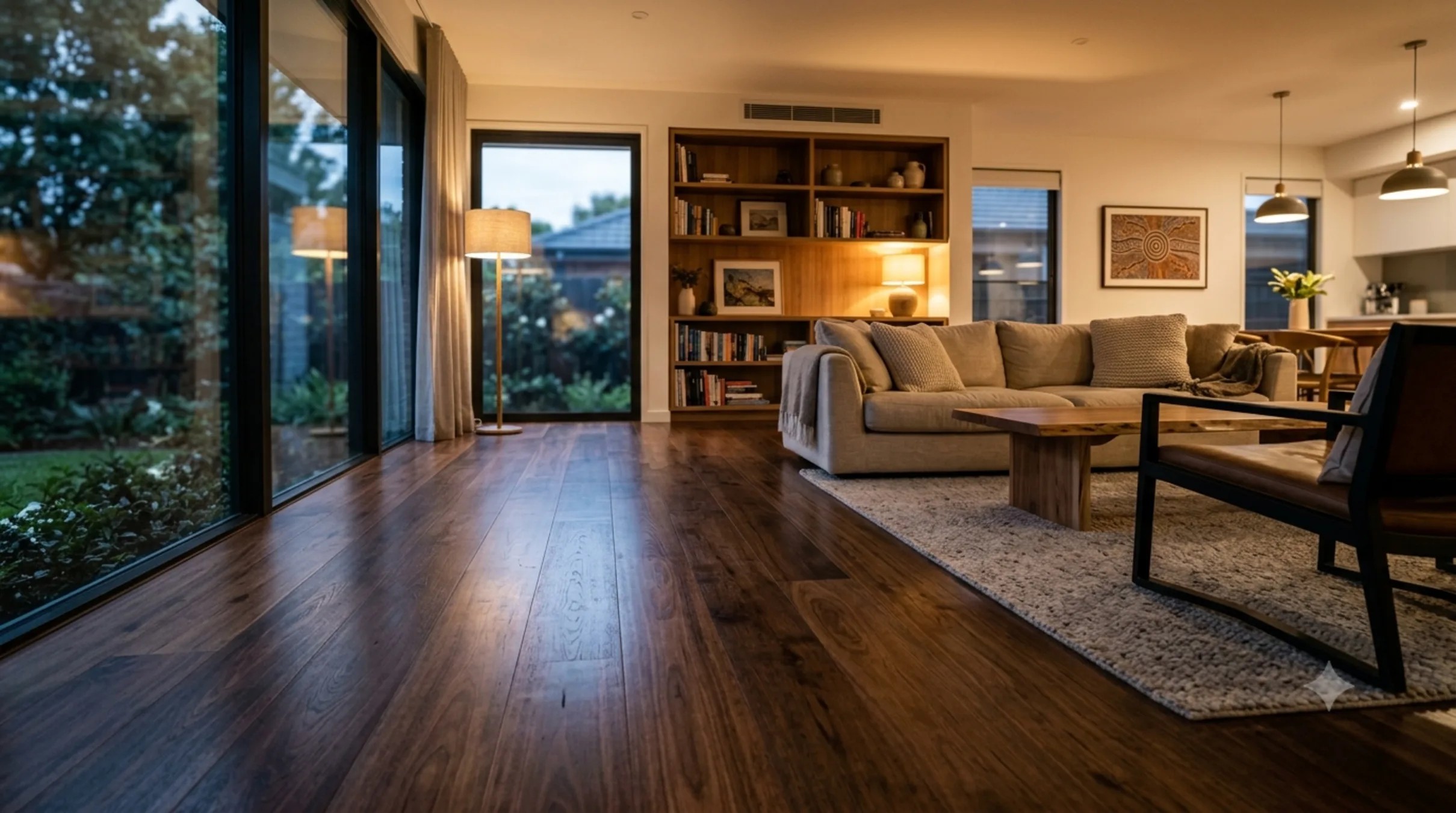
Both of those matter more here than they would inland. Peninsula homes are glazed toward the water, which puts UV onto the floor at an intensity that will amber any solvent-based coating within a few years. And a great many of the houses we work in are occupied during the job, or are holiday properties that cannot afford a week of downtime between bookings.
The trade-off used to be durability, and that is no longer true. Commercial-grade two-pack waterborne systems — the class of product that Bona and Loba built their reputations on — carry abrasion resistance comfortably above what a domestic floor demands, and hold up to animal claws and grit-laden foot traffic without breaking down.
AT A GLANCE
| Turn-key cost band | $55 – $75/m² turn-key with a three-coat 2K system |
|---|---|
| Material cost | $35 – $45/m² |
| VOC level | Very low — under 27 g/L on commercial-grade 2K products |
| Odour | Minimal |
| Re-entry | Light foot traffic within 24 hours of the final coat |
| Full cure | 3 – 7 days for furniture; 7 – 10 days for heavy pieces and rugs on large floors |
| UV behaviour | Excellent — stays optically clear, no amber drift over the life of the finish |
| Abrasion resistance | Very high on commercial-grade two-pack systems |
| Sheen options | Matte, satin, semi-gloss, gloss |
| Maintenance cycle | Screen-and-recoat at $25 – $40/m² every 8 – 12 years in a domestic setting |
HOW IT WORKS
Water-based polyurethanes are resins emulsified in water rather than dissolved in solvent. As the water evaporates the resin particles coalesce into a continuous film. That is the whole mechanism in a single-pack (1K) product.
Two-pack (2K) systems add a hardener — usually an isocyanate or an aziridine — which cross-links the resin chemically as it cures rather than relying on physical coalescence alone. The result is a denser, harder, more chemically resistant film. The cost is a limited pot life once the two components are mixed, which is why 2K is applied in planned runs rather than opened and left.
Because the carrier is water, the first coat raises the grain of the timber — water swells the wood fibres and they stand up as the surface dries. That is why the sequence includes a screen with a 150-grit mesh pad after the sealer, followed by a thorough vacuum, before any topcoat goes on. Skipping that step leaves a finish that feels rough underfoot no matter how well the floor was sanded.
On tannin-rich species the water also creates a specific risk. Spotted Gum, Blackbutt and Australian Cypress carry high levels of water-soluble tannins, and the evaporating water draws them to the surface as dark blotchy discolouration and uneven sheen. A shellac or alcohol-based isolation primer applied to the bare timber first locks the tannins into the grain and prevents it entirely.
HOW IT PERFORMS
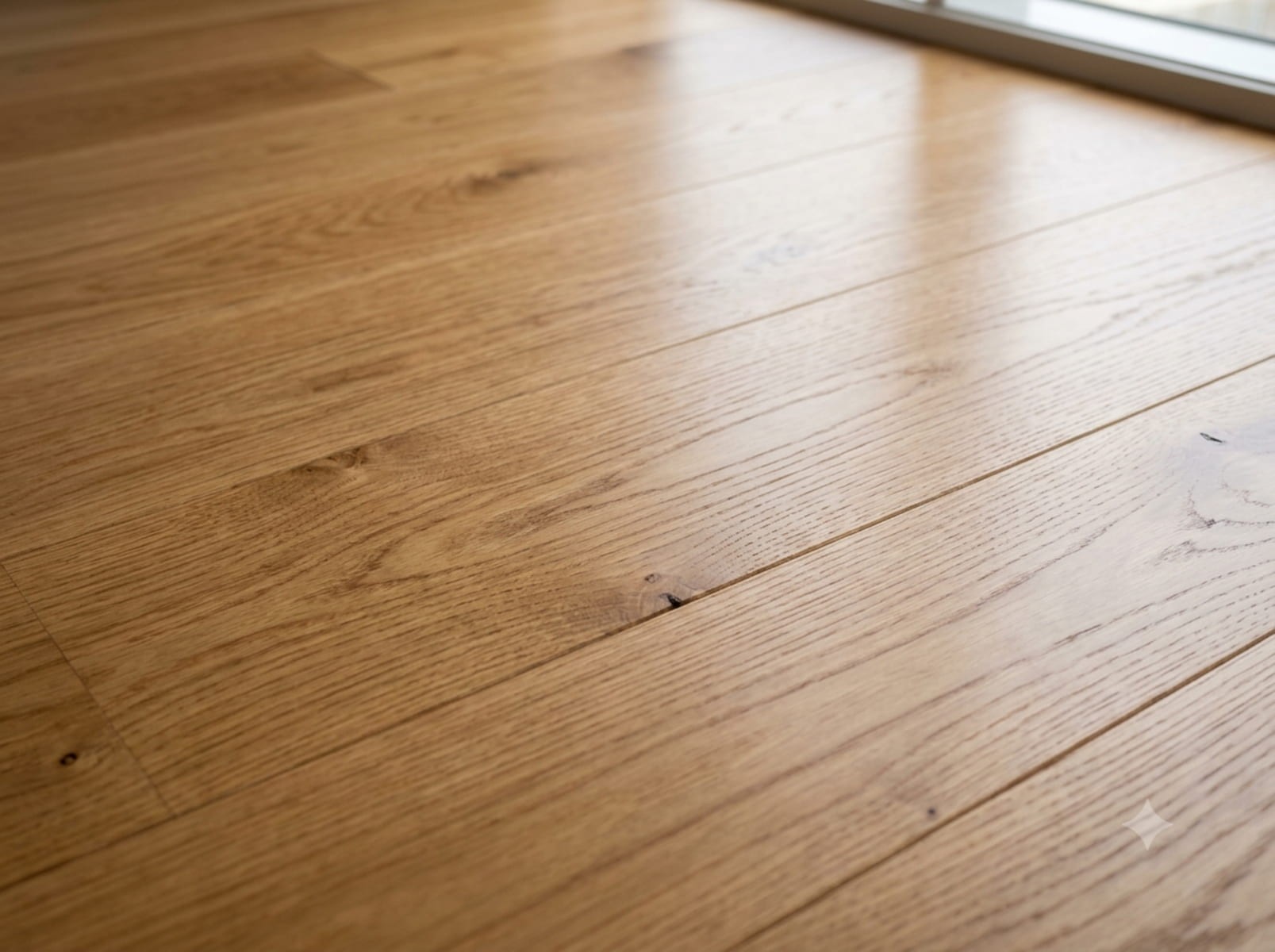
Optical clarity is the headline property. A waterborne finish stays the colour the timber came off the sander, indefinitely. On pale species — Tasmanian Oak, Baltic Pine, European oak — that is the difference between a floor that reads honey-blonde in ten years and one that reads orange.
Abrasion resistance on commercial-grade 2K products is very high, which is what actually matters on a floor taking beach sand, dog claws and daily traffic. Where a household is hard on floors, an additional topcoat through the entry and traffic lanes at $10 to $15/m² roughly doubles the useful life of the finish in the zone that takes the punishment.
The health and occupancy numbers are the other half of the case. VOC content under 27 g/L, minimal odour, and safe residential re-entry within 24 hours. Against a solvent-based system requiring the house to be evacuated for five to seven days, that difference decides the specification for most occupied homes before durability is even discussed.
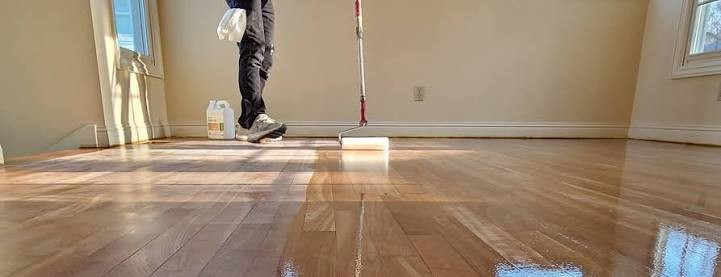
Where it is less forgiving is in application. Waterborne systems dry fast, which means a wet edge left standing will show as a lap line. On a large open-plan floor that requires planning the coating runs and having enough hands on site to complete a continuous area without stopping.
ON THE PENINSULA
We recommend waterborne almost universally in Mount Eliza, Mornington and Mount Martha, where large bay-facing glazing makes UV stability non-negotiable and where households consistently prioritise indoor air quality. The same applies across the top-end Peninsula suburbs — Sorrento, Portsea, Blairgowrie — where it is also the base coat under any lime wash or Nordic tint.
Through Frankston, Karingal, Seaford and Langwarrin the calculation is slightly different but lands in the same place for owner-occupiers. Solvent-based is cheaper per square metre, but the five to seven day evacuation is a genuine imposition on a modest three-bedroom house with nowhere to retreat to, and the ambering on a pale Baltic Pine or Tasmanian Oak floor undoes the result within a few years.
On engineered floors — common through Carrum Downs, Skye and the newer Safety Beach and St Andrews Beach builds — waterborne is close to mandatory. The wear layer is finite, which means the finish is doing more of the protective work than it would on a solid floor, and an ambered coating cannot simply be sanded off when there is no thickness to spare.
COMMON QUESTIONS
Is water-based polyurethane as tough as solvent-based?
On commercial-grade two-pack systems, yes — abrasion resistance is very high and generally exceeds what a domestic floor demands. Single-pack waterborne products are softer and better suited to light-traffic rooms. The old assumption that waterborne means less durable came from early-generation products and no longer holds for current 2K systems.
What does 2K mean?
Two-pack. A hardener — usually an isocyanate or aziridine — is mixed into the resin immediately before application and cross-links it chemically as it cures, producing a denser and harder film than a single-pack product that dries by evaporation alone. The trade-off is a limited pot life once mixed, so it is applied in planned runs.
How soon can we walk on it?
Light foot traffic within 24 hours of the final coat. Furniture at three to seven days. On a large floor, heavy pieces and rugs should wait seven to ten days — putting a rug down early traps solvent still leaving the film and can mark the finish permanently.
Will it yellow over time?
No. Waterborne polyurethanes stay optically clear indefinitely, which is the main reason we specify them under the large bay-facing glazing typical of Peninsula homes. Solvent-based polyurethane ambers as an inherent property of its chemistry, not as a fault.
Why does my floor need a primer first?
Because of the species. Spotted Gum, Blackbutt and Australian Cypress carry high levels of water-soluble tannins, and the water in a waterborne coating draws them to the surface as dark blotching and uneven sheen. A shellac or alcohol-based isolation primer locks them into the grain. Tasmanian Oak and Baltic Pine generally do not need it.
What does it cost?
A full sand with a three-coat 2K waterborne system runs $55 to $75/m² as a standard market rate, with material cost sitting at $35 to $45/m² of that. Our turn-key band rates start at $45/m² in the Frankston band, $55/m² in the Mount Eliza band and $70/m² across the Peninsula band.
Can it be recoated later without a full sand?
Yes, and it should be. A screen-and-recoat at $25 to $40/m² buffs the surface, removes light scratching and lays a fresh protective topcoat without taking timber off the board. Done every eight to twelve years in a domestic setting, it means the floor may never need another full cut.