
Small round holes in your floorboards, a millimetre or two across, with a fine dust around them. Almost everyone who finds them assumes the same two things: that it is old, and that it is not urgent.
Sometimes both are true. Sometimes neither is. And the difference between those two situations changes the scope of a floor restoration completely — which is why it is the first thing we establish on any floor showing the signs, before anyone talks about sanding or coating or price.
What you are looking at
The culprit on the Mornington Peninsula is almost always the Common Furniture Beetle, Anobium punctatum. It is not a dramatic pest. There are no swarms, no visible activity, no noise. Everything it does happens inside the timber, out of sight, over years.
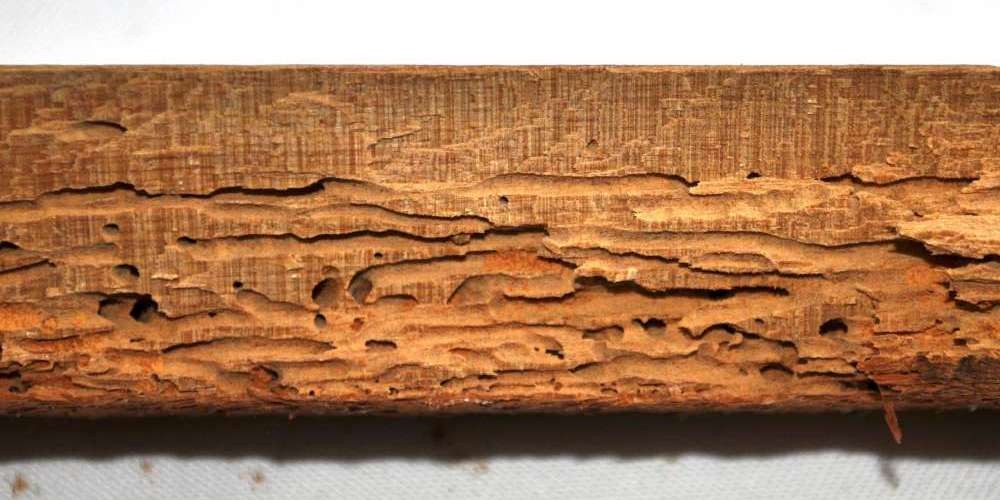
The adult beetle lays eggs in cracks and end grain. The larvae hatch and bore into the board, and they stay there — tunnelling through the internal cellular structure, eating their way along the grain, for anywhere between two and five years. Then they pupate near the surface and the adult chews its way out, leaving the one to two millimetre exit hole you can see.
So the holes are not the damage. The holes are the exits. The damage is the network of galleries running through the inside of the board, which you cannot see from the room above and which may be considerably more extensive than a scattering of small holes suggests.
Active or historical: the test that matters
Everything downstream depends on this question, and it has a straightforward answer.
Look at the frass — the powdery wood dust the beetles push out of the exit holes.
Active infestation produces frass that is fresh, pale and creamy-white, with a fine powdery texture. Tap the board near the holes and it falls freely, in a small shower. It looks like something that happened recently, because it did.
Historical infestation leaves frass that is dark grey, compacted and stuck in place. Tapping does not dislodge it. It has been sitting there long enough to collect dust, oxidise and consolidate.
If you want to be certain, clean the area thoroughly, note the date, and come back in a fortnight. Fresh pale powder means something is still working in there. Nothing new means the colony finished its business years ago, which is common in floors that have since been kept warm, dry and well ventilated.
Where the damage actually is
Here is the part that catches people out, and it is why we go under the house rather than judging from above.
The exit holes are in the top face because that is where the adult beetle emerged. The galleries are underneath. A board can look almost untouched from the room — a handful of small holes, nothing dramatic — while retaining very little solid section below.
So we check the undersides through the subfloor access wherever it is reachable. That is where you see the real extent: the honeycombing, the areas where a board has been reduced to a thin shell, the joists that have their own problem.
It is not glamorous work and it is the difference between quoting the job that exists and quoting the job you can see from the doorway.
Why sanding an infested board is the wrong move
A tongue-and-groove floorboard has perhaps eight to twelve millimetres of usable timber above the tongue. A full sand takes roughly a millimetre. On a sound board that is nothing.
On a board that has been hollowed out from underneath, that millimetre may be a substantial fraction of the solid material holding the surface together. The larvae leave a thin intact wear layer over the void — often just a couple of millimetres — because they work below the surface rather than through it.
Take that layer down and the surface opens into the galleries. Sometimes immediately, under the machine. More often a few weeks later, under a foot, in a spot that looked perfectly fine when the coating went on.
This is the scenario that turns a repairable floor into a replaced one, and it is entirely avoidable by assessing before cutting.
What the fix actually involves
Where the infestation is historical and the boards have retained their section, the answer is straightforward: sand and finish normally. Old exit holes fill and blend, and on a period floor many owners choose to leave the finer ones legible as part of the timber’s history.
Where boards have lost structural section, they come out. Replacement is with matched aged reclaimed timber — species, width, thickness and, on anything more than about thirty years old, period. A new board next to a fifty-year-old one reads as a patch regardless of stain, because the grain compression and surface character of aged timber cannot be manufactured. Board replacement runs $8 to $20 per square metre, or from $50 a board for individual swaps.
Where the infestation is active, treatment comes before anything else. Penetrating borate-based wood preservative goes onto the subfloor joists and the undersides of the boards. Borates work by penetrating into the timber rather than forming a surface film, which is exactly what is required when the target is living inside the wood. Drying time is allowed, and only then does any coating work begin.
The reason for that sequence is worth stating plainly: coating over an active infestation seals the top surface and achieves nothing. The larvae are two millimetres down. They keep going, under a perfectly good finish, until a board gives way.
Where we see it on the Peninsula
Borer wants two things: well-seasoned softwood, and a cool damp environment. The Peninsula supplies both in specific places.
The softwood is 1950s Baltic Pine, which is close to this beetle’s ideal host and which makes up something like 35 to 40 per cent of restorable floors in the Frankston area. It also takes the sapwood of some hardwoods, though the dense heartwood of a Jarrah or an Ironbark board holds no interest for it.
The environment is the treed enclaves — Mount Martha above all, and the shaded pockets of Frankston South backing onto the escarpment. Established canopy, limited direct sun, houses set back into vegetation, and subfloors that stay humid year-round. We see more borer in those two suburbs than anywhere else we work.
It also turns up through the Frankston North Housing Commission stock, where the original Baltic Pine floors have been in place since the 1950s, and in older rural cottages around Red Hill and Main Ridge where subfloor ventilation was never generous.
The prevention nobody mentions
If there is one thing worth doing whether or not you currently have borer, it is looking at your subfloor ventilation.
A humid subfloor is what makes timber attractive to this beetle in the first place. Blocked vents, garden beds built up against the perimeter, leaf litter accumulated under the house — all of it keeps the cavity damp, and damp timber is a target.
Clearing vents is free. Adding mechanical ventilation is a modest trade job. Laying a polyethylene vapour barrier across the soil is inexpensive relative to almost any flooring work. Dealing with an established infestation across a whole-house floor is not.
What to do if you have found holes
Do not panic, and do not book a sand yet.
Look at the frass and decide whether it is pale and mobile or grey and compacted. Clean an area and check it again in a fortnight if you are unsure. Have a look under the house if you can reach it, and see whether the undersides tell a worse story than the top.
Then get someone to assess it properly before quoting a price. A restoration quote that does not distinguish active from historical infestation is a quote for a job nobody has scoped, and the difference between the two is measured in thousands of dollars and, occasionally, in whether the floor survives at all.
COMMON QUESTIONS
How do I tell if borer is active or historical?
Look at the frass — the powdery dust around the exit holes. Active infestation produces fresh, pale, creamy-white powder that falls freely when you tap the board. Historical infestation leaves dark grey, compacted dust that does not move. Clean an area, come back in a fortnight, and see whether fresh frass has appeared.
What causes borer in floorboards?
The Common Furniture Beetle, Anobium punctatum. It targets well-seasoned softwood — 1950s Baltic Pine is close to its ideal host — and the sapwood of some hardwoods. Cool, damp, poorly ventilated subfloors are what make timber attractive to it, which is why the treed enclaves of Mount Martha and Frankston South see more of it.
Can an infested floor still be sanded?
Not if the boards have lost their structural section. The larvae hollow out the inside of the board and leave a thin solid wear layer over the galleries. Take two millimetres off the top and the surface opens into the void and collapses underfoot. Compromised boards come out and get replaced before any sanding happens.
What is the treatment for active borer?
Penetrating borate-based wood preservative applied to the subfloor joists and the undersides of the boards. Borates penetrate into the timber rather than sitting on the surface, which is what is needed when the target is inside the wood. Drying time is allowed before any coating goes on.
Will coating the floor kill the borer?
No. A surface coating seals the top face and does nothing about larvae tunnelling two millimetres below it. The floor keeps degrading under a perfectly good finish, and the first sign is usually a board giving way. Treatment goes underneath, before the coating, or it does not work.
Does borer mean I need a whole new floor?
Rarely. Most infestations affect a proportion of boards rather than all of them, and replacing the compromised ones with matched aged reclaimed timber at $8 to $20 per square metre or from $50 a board is usually far cheaper than relaying. The calculation only shifts when a majority of boards have gone.