Baltic Pine
AT A GLANCE
| Common name | Baltic Pine |
|---|---|
| Botanical name | Pinus sylvestris |
| Janka rating | 2.5 kN (dry) |
| Colour range | Pale straw yellow when fresh; ambers to a warm honey-orange over decades of light exposure. |
| Grain pattern | Distinctively knotty — small round dark knots scattered through pale wood — with a soft, resinous look. |
| Typical board widths | 130mm to 180mm common; some Peninsula stock up to 200mm. |
| Era commonly laid | Pre-1950s heritage stock; particularly common in Federation-era and early postwar cottages. |
| Tannin bleed risk | Low |
| UV behaviour | Strong ambering over decades. New Baltic pine can shift noticeably yellow within a few years under a sunny north-facing window. |
| Coastal suitability | Fair |
HOW TO IDENTIFY IT
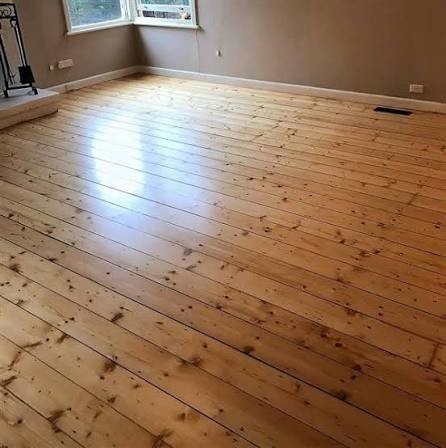
Baltic pine is instantly different from any Australian hardwood you will find under carpet. The colour is a pale straw yellow when fresh, ambering to a warm honey-orange over decades of light exposure. The grain is distinctively knotty: small round dark knots scattered through pale wood, with a soft, resinous look. Board widths are almost always wider than hardwood — 130mm to 180mm is common, with some Peninsula stock going up to 200mm.
The give-away is hardness. Push a fingernail firmly into an obscure edge and Baltic pine dents easily. It is a softwood, and it feels like one under your fingertip. If a floor is old, has wide boards, has visible knots and dents when you press it, it is almost certainly Baltic pine — sometimes called Baltic redwood in the older documentation.
You will find Baltic pine floors in pre-1950s Peninsula homes, particularly in older Sorrento and Portsea cottages, some inner-Frankston pockets, and heritage stock in Mount Eliza. Cypress pine is a similar-era alternative and often gets confused with Baltic. The difference is Cypress has a strong distinctive smell when freshly sanded; Baltic does not.
HOW IT SANDS
Baltic pine sands fast and can catch an inexperienced sander out. It is soft — Janka around 2.5 kN, less than a third of a typical eucalypt — so the drum will cut through it quickly. Dishing is a real risk if the machine is not kept moving. Progressive grits are essential: 40, 60, 80, 100. Do not skip.
Because the timber has strong colour variation between the pale wood and the darker knots, the sanded surface looks patchier than a hardwood floor at the same stage. That is the timber, not the sand. It evens out under a clear coat and pulls together beautifully under a colour stain or lime wash.
Tear-out risk is moderate around the knots. The grain lifts at the knot boundary and can splinter if the drum sander is loaded too heavily. Keep the passes light and let the paper do the work. Older Baltic that has been oiled multiple times over decades will have absorbed the oil deep into the timber; the sanding pass will reveal a paler unstained core that needs an extra coat of finish to sit right.
HOW IT FINISHES
Baltic pine is happy under almost any finish, but the choice of coating dramatically changes how it reads. Left unstained under a water-based clear coat, it looks pale, warm and cottage-like — this is the traditional Peninsula-cottage look. Oil-based polyurethane pushes the same floor deep amber, closer to how it probably looked before its most recent sanding. Both are legitimate; both suit different rooms.
Lime wash on Baltic pine is one of the best applications of that finish. The soft grain takes the pigment beautifully, the knots stay visible as dark accents, and the floor lightens to a chalky, coastal-modern surface without the flat-painted look. It is a common request for Peninsula holiday cottages.
Staining works, but sample-test always. The mix of pale wood and darker knots takes stain differently in each area, and the final tone can surprise you. Darker stains cover the variation more evenly than pale stains do. Tannin bleed is not an issue with Baltic; resin bleed occasionally is, particularly around larger knots — a shellac spot-seal before coating handles it cleanly.
ON THE PENINSULA
Baltic pine floors on the Peninsula are almost always heritage. If you have one, it is probably in a pre-1950s cottage — Sorrento's older streets, Portsea's original stock, some Federation-era houses in Frankston and Mount Eliza. These floors were laid in an era when Baltic pine was imported cheaply as house-framing timber and doubled up as flooring in modest houses.
Coastal suitability is fair rather than excellent. The timber's softness means it dents where hardwood would not, and the resinous surface can go slightly sticky in very humid weather. For a holiday cottage used flat-out over summer, a Baltic pine floor will show wear faster than a Blackbutt or Spotted Gum floor would.
But, kept well and refreshed every few years with a targeted re-coat, and matched to the aesthetic of the house it is in, a Baltic pine floor is one of the most charming surfaces on the Peninsula. It ages in a way modern engineered flooring cannot replicate. When a real-estate agent describes a house as having “original floorboards”, they are usually talking about Baltic pine.
The recurring failure we are called in to correct is gap filler. Baltic pine boards are wide and they move substantially across their width through a Peninsula seasonal cycle, and a rigid resin or water-based filler in the joints gets crushed and ejected the first humid summer. What is left is a floor with hard grey lines of broken filler standing proud of the timber, which is worse than the open gaps it was meant to hide. Our position is to clear the gaps out properly with a multitool or chisel and leave them open, or where closure is genuinely needed, to glue in tapered timber splines cut from reclaimed pine and sand them flush. Splines move with the boards instead of fighting them.
Baltic pine is also the species the Common Furniture Beetle likes best, because it targets well-seasoned softwood. On any pine floor in the cool, damp, shaded pockets through Frankston South, Mount Martha and Red Hill we check for borer before quoting: one to two millimetre exit holes, and frass that is pale, powdery and falls freely when the board is tapped means the infestation is active and needs borate treatment to the joists and board undersides before any coating goes on.
GALLERY
Placeholder slots — drop real photos into src/assets/ and swap the slot for <Image />.
- Photo slot 1
Close-up macro showing prominent dark knots against a pale straw background — natural daylight. - Photo slot 2
Side-by-side of two boards: freshly sanded raw vs decades-old with amber patina. - Photo slot 3
Full room shot of a finished Baltic pine floor in a Sorrento heritage cottage. - Photo slot 4
Knot detail with a resin-ring showing where sealer was spot-applied before coating.
COMMON QUESTIONS
Can Baltic pine floors be sanded and restored, or is it past saving?
Almost always worth restoring. Baltic pine floors that have not been sanded in 40 or 50 years still typically have plenty of timber above the tongue-and-groove. Only floors with widespread rot or extensive replacement patches are truly past saving.
Why do the knots in my Baltic pine floor look different colours?
Knots are the densest part of the tree and take stain, oil and finish very differently to the surrounding wood. Some absorb heavily and go dark; some seal themselves with resin and stay light. Both outcomes are normal.
Does Baltic pine amber over time?
Yes, noticeably. Baltic pine yellows faster than any Australian hardwood. Under water-based coating you slow this; under oil-based coating you accelerate it. Neither is a defect — it is the timber.
Is Baltic pine soft enough that I should not restore it?
No. Baltic pine is soft but appropriate for the era of house it is in. If you replace it with modern flooring you lose the character of the original cottage. Restoration is almost always the better call.
Can I lime wash a Baltic pine floor?
Absolutely. Baltic pine takes a lime wash beautifully. The soft grain absorbs pigment evenly and the knots remain as visible accents. It is a popular finish for Peninsula holiday cottages.
What's the difference between Baltic pine and Cypress pine?
Cypress pine is denser, more heavily knotted, more coloured (often mid-brown with dark streaks) and has a strong distinctive scent when sanded. Baltic pine is paler, softer, less scented, and typically laid in wider boards.