Australian Cypress Pine
AT A GLANCE
| Common name | Australian Cypress Pine |
|---|---|
| Botanical name | Callitris glaucophylla |
| Janka rating | 5.4 kN (dry) |
| Colour range | Pale cream sapwood against honey-gold to mid-brown heartwood, with dark knots throughout. |
| Grain pattern | Fine and dense for a softwood, dominated visually by frequent tight dark knots. |
| Typical board widths | 80mm to 130mm most common; wider boards in rural and period installations. |
| Era commonly laid | 1930s through 1970s, concentrated in rural and semi-rural Peninsula properties. |
| Tannin bleed risk | High |
| UV behaviour | Warms and deepens toward mid-brown with exposure; a non-yellowing finish stops the honey background drifting orange. |
| Coastal suitability | Fair |
HOW TO IDENTIFY IT
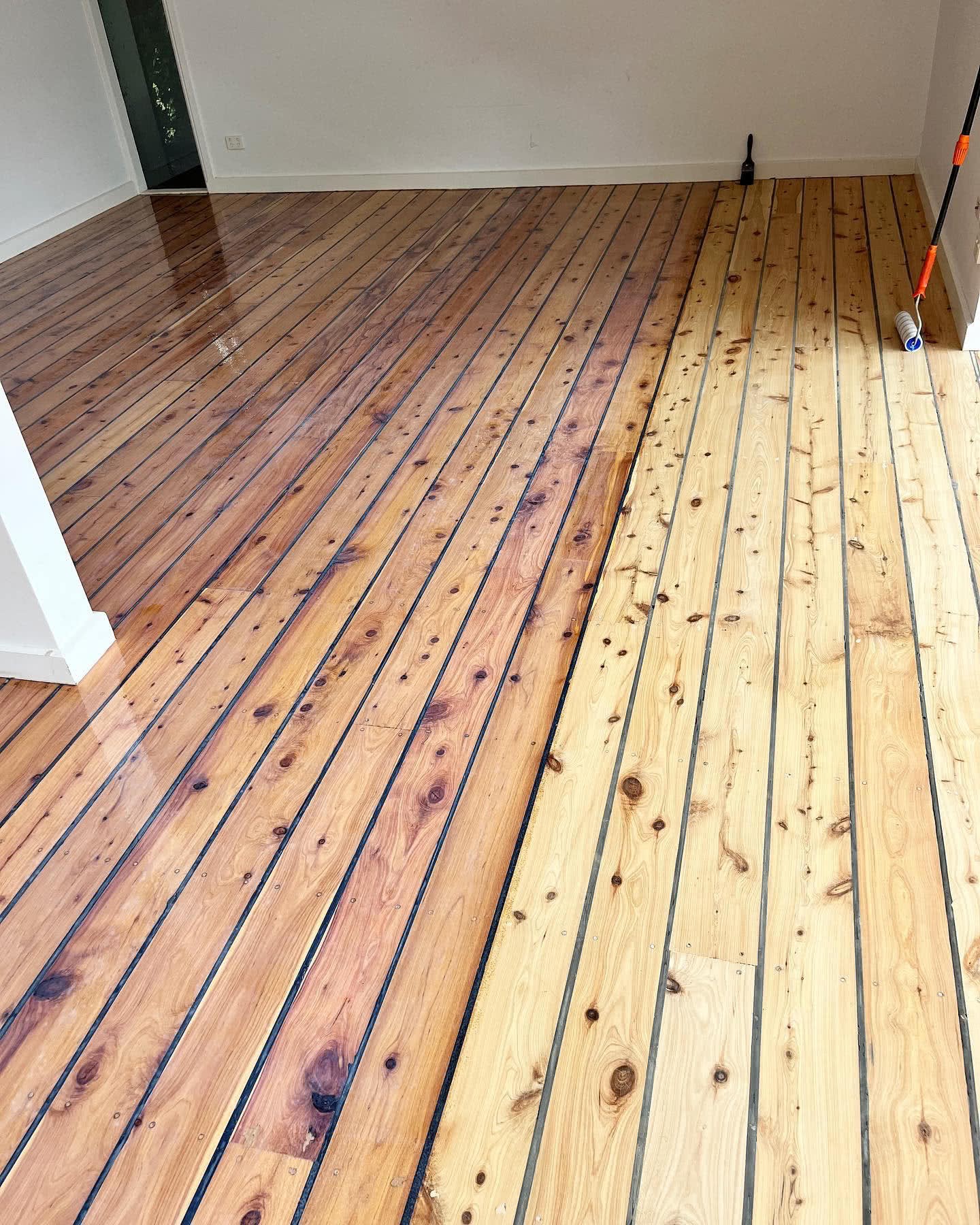
Cypress Pine is unmistakable once you have met it, and the knots are why. The timber is riddled with small, tight, very dark knots distributed across every board, set against a background that runs from pale cream sapwood to honey-gold and mid-brown heartwood. No other flooring timber has that particular busy, freckled appearance.
The scent is the other identifier and it is definitive. Sanding Cypress Pine releases a strong, distinctive, camphor-like aroma that fills a house and is completely unlike the smell of any eucalypt or of Baltic Pine. Anyone who has sanded one recognises it immediately from the next room.
Despite the name, it is considerably denser than Baltic Pine. At 5.4 kN dry it sits close to Tasmanian Oak in hardness, which surprises people expecting softwood behaviour. It resists a fingernail and does not dent the way Baltic Pine does under a dropped tool.
Board widths run 80mm to 130mm through most Peninsula installations, with wider boards in period rural properties. Where Baltic Pine is pale, soft, wide and sparsely knotted, Cypress is darker, denser, narrower and heavily knotted — the two are easy to separate side by side.
HOW IT SANDS
The knots are the technical problem and there is no way around them. Cypress knots are extremely hard and set in a softer surrounding matrix, so an abrasive cuts the background faster than the knot. The result, if the sequence is rushed, is a floor where every knot stands slightly proud — invisible until the coating goes on and light rakes across the surface.
Managing that means more passes at each grit and patience through the medium stages, rather than trying to force the level with a coarse belt. It also means the drum needs to be genuinely well set: a machine running out of true will chatter across a hard knot in a way it never would on uniform timber.
Resin is the second issue and it behaves differently to Baltic Pine resin. Cypress carries natural extractives that soften under the heat of a coarse belt and load the abrasive, but they also concentrate around the knots where they can interfere with coating adhesion later. Belt changes are more frequent than the floor area alone would suggest.
The dust is worth flagging for a practical reason: the aromatic compounds that give Cypress its scent are respiratory irritants for some people, and the smell carries through a house for days. Full containment and extraction matter more here than on a neutral timber, and it is worth warning the household in advance.
HOW IT FINISHES
Australian Cypress carries high levels of natural water-soluble tannins and extractives, putting it in the same category as Spotted Gum for finishing risk. A waterborne coating applied directly to bare timber draws those extractives to the surface as dark blotchy discolouration, uneven sheen and adhesion failure.
A fast-drying alcohol-based or shellac-based isolation primer over the bare timber is therefore mandatory before any waterborne system. On Cypress it does a second job as well — sealing the resin concentrations around the knots that would otherwise cause patchy absorption and, in bad cases, coating that never fully hardens over the knot.
Beyond the primer, a two-pack waterborne in satin or matte suits the timber well. The non-yellowing clarity keeps the honey-gold background from drifting orange, which matters because Cypress is already a warm timber and a solvent-based coating pushes it further than most clients want.
Hardwax oil is worth considering on period Cypress floors in rural properties, where a softer natural sheen suits the building and the ability to spot-refresh a worn area fits the wear pattern. It still needs the resin around the knots addressed, and the oil should be tested on the actual floor first because knot-heavy timber absorbs unevenly.
ON THE PENINSULA
Cypress Pine is a rural timber on the Peninsula and it turns up accordingly — the hobby-farm cottages and hillside houses through Red Hill, Red Hill South and Main Ridge, the older rural builds around Fingal, Boneo and Merricks, and occasionally in period properties through Baxter and Pearcedale.
Its density is a genuine advantage in those settings. Rural properties take grit tracked in from unsealed driveways and paddock access, and at 5.4 kN Cypress handles that abrasion considerably better than the Baltic Pine that often sits in comparable houses. It is a more durable floor than its softwood name suggests.
Where Cypress appears alongside Baltic Pine in the same rural house — which happens, typically with Cypress in the later rooms — the two will not sand to a common tone. Cypress is darker, warmer and knottier, and no stain closes that gap convincingly. It is generally better to treat the transition as a deliberate line.
Wood heat is the recurring rural complication. In properties through Red Hill South and Main Ridge where a slow-combustion heater runs all winter, boards in the hearth zone dry out, shrink and can split. On knot-heavy Cypress a split frequently runs from a knot, and filling it is temporary at best — the same seasonal cycle reopens it the following winter.
GALLERY
Placeholder slots — drop real photos into src/assets/ and swap the slot for <Image />.
- Photo slot 1
TODO: close-up of Cypress Pine showing the dense dark knot pattern against honey-gold heartwood. - Photo slot 2
TODO: raking light across a finished Cypress floor showing knots level with the surrounding surface. - Photo slot 3
TODO: Cypress Pine floor in a Red Hill hobby-farm cottage, natural daylight, wide shot. - Photo slot 4
TODO: hearth-zone detail showing a split running from a knot in front of a slow-combustion heater.
COMMON QUESTIONS
What is the difference between Cypress Pine and Baltic Pine?
Cypress is denser, darker, far more heavily knotted, and has a strong distinctive camphor-like scent when sanded. Baltic Pine is paler, softer, laid in wider boards and much more sparsely knotted. At 5.4 kN Cypress is close to Tasmanian Oak in hardness, which surprises people expecting softwood behaviour.
Why do the knots stand proud after sanding?
Because the knots are much harder than the surrounding timber, so an abrasive cuts the background faster than the knot. It is invisible until the coating goes on and light rakes across the floor. Preventing it means more passes at each grit and patience through the medium stages rather than forcing the level with a coarse belt.
Does Cypress need a primer?
Yes, and it is not optional. Australian Cypress carries high water-soluble tannins and extractives, and a waterborne coating on bare timber draws them up as dark blotching and adhesion failure. A shellac or alcohol-based isolation primer also seals the resin concentrations around the knots that would otherwise cause patchy absorption.
What is the strong smell when it is sanded?
Aromatic compounds naturally present in the timber — the same ones that give Cypress its traditional reputation for resisting insects. The scent is strong, carries through a house for days, and is a respiratory irritant for some people. Full containment and extraction matter more on this species than on a neutral timber.
Is Cypress Pine durable enough for a busy house?
More than its name suggests. At 5.4 kN it sits close to Tasmanian Oak and comfortably above Baltic Pine, and it handles the grit tracked into rural properties well. Pair it with a two-pack waterborne over a proper isolation primer and it is a genuinely hard-wearing floor.
Can a split running from a knot be filled?
Temporarily. Where the split is in a hearth zone or anywhere with a strong seasonal moisture cycle, the same movement that opened it will reopen the filler within a season. Replacement with matched stock is the durable answer, at $8 to $20/m² or from $50 per board, though on a character rural floor an honest visible split is often the better outcome.