
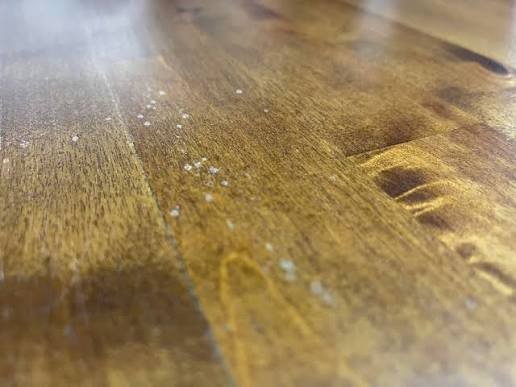
The floor looked perfect on the day it was finished. Clean, even, exactly the colour everyone agreed on. Then, over the following few days, dark patches started appearing — brown, blotchy, following no pattern anyone could explain, worst in some boards and absent in others. The sheen went uneven. Running a hand across it, some areas felt different to others.
That is tannin bleed. It is not dirt, it is not mould, it is not a cleaning problem, and it cannot be fixed by putting anything else on top of it.
What tannins are and why they move
Native Australian hardwoods are chemically busy timbers. Alongside the cellulose and lignin that make up the structure, they carry extractives — natural compounds the tree produced for its own purposes, principally resistance to fungi and insects. Tannins are the group that matters here, and the critical property is that many of them are water-soluble.
While the timber is sealed under an old coating, or sitting untouched under carpet, those tannins stay where they are. Nothing is moving them.
Then the floor gets sanded to bare timber, and a water-based coating goes on.
Water-based polyurethane is exactly what it sounds like: resin emulsified in water. The film forms as the water evaporates. And as that water leaves the surface, it travels — pulling dissolved tannins out of the grain and up toward the surface with it, where they concentrate and deposit as the water finally goes.
What you get is dark brown discolouration in patches, following the grain and the density variations in the timber. Uneven sheen, because the deposits interfere with how the film forms. And in the worst cases, adhesion failure, because the coating has effectively been keyed to a layer of extractives rather than to the wood.
The species that do it
This is not a risk that spreads evenly across the timbers in Peninsula housing, and knowing which floor you have is most of the answer.
High risk — primer is not optional:
- Spotted Gum (Corymbia maculata). The premium modern specification through Portsea, Sorrento, Blairgowrie and the newer Mount Martha builds. High tannin content and, given these are usually large wide-board floors in heavily glazed rooms, an extremely visible place for a defect.
- Blackbutt (Eucalyptus pilularis). Widespread in Peninsula homes from the 1940s through the 1980s and frequently found under carpet. High tannin.
- Australian Cypress Pine (Callitris glaucophylla). The rural timber through Red Hill, Main Ridge, Fingal and Boneo. High in both tannins and resin, and the resin concentrations around the knots cause their own adhesion problems.
- Sydney Blue Gum and Grey Ironbark both carry high levels, with Blue Gum’s open pore structure making migration particularly easy.
Moderate — generally primed as insurance:
- Jarrah and Brush Box. Not the near-certainty of the above, but enough that on a visible floor the primer is cheap protection.
Low risk — usually fine on bare timber:
- Tasmanian Oak, Victorian Ash and Baltic Pine. These make up a large share of Frankston, Karingal, Langwarrin and Seaford floors, and they generally take a waterborne coating directly without incident.
That last group is worth noting, because it explains why plenty of people have had waterborne coatings applied straight to bare timber with no problem at all. If your floor is Tasmanian Oak, it probably was fine. The trouble starts when the same approach is applied to a Spotted Gum floor by someone who did not check.
The fix that takes twenty minutes
Prevention is a fast-drying alcohol-based or shellac-based isolation primer, applied to the bare sanded timber before any waterborne coating goes on.
It works by forming a chemical barrier at the surface. The tannins stay locked in the grain where they have always been, because the water in the topcoat never reaches them. The topcoat then keys to the primer rather than to bare wood, which also improves adhesion.
Shellac is the traditional choice and it remains excellent for this. It dries fast, it seals comprehensively, and it is compatible with waterborne systems over the top. On Cypress it does a second useful job, sealing the resin concentrations around the knots that would otherwise cause patchy absorption and, in bad cases, coating that never fully hardens over the knots.
It is one additional step in a multi-day job. It is the least expensive line item on the quote.
Why it gets skipped
Because it is invisible, and because leaving it out looks like nothing at the time.
A contractor who skips the primer on a Spotted Gum floor does not produce a bad-looking floor on the day. The sanding is the same. The topcoats go on the same. The floor is handed over looking correct. The staining develops over the following days or weeks, by which point the invoice has been paid.
When you are comparing quotes and one is meaningfully cheaper on the same species, the primer is one of the first places to look. Along with the moisture reading, the staple removal and the number of topcoats, it is one of the steps that costs money, does not show, and determines whether the floor is right in a month.
Why it cannot be fixed afterwards
This is the part that makes it worth caring about in advance.
The staining sits at or just below the surface of the film. Anything you apply on top goes over the problem, not through it. Recoating makes it marginally darker. Cleaning does nothing, because it is not a surface contaminant. There is no chemical treatment that reaches under a cured polyurethane film and removes deposited tannin.
The only remedy is cutting the floor back to bare timber and starting again — properly, with a primer this time. That is a full sand of board thickness spent on correcting something that a twenty-minute step would have prevented.
On a solid strip floor with plenty of thickness that is annoying and expensive. On an engineered floor with a two millimetre wear layer, it may not be available at all.
Why this is more common now than it used to be
Thirty years ago most Australian floors were finished in solvent-based polyurethane, and the mechanism described here largely depends on water. Solvent-based coatings do not carry tannins to the surface the same way, so the problem was rare enough that many people in the trade never encountered it.
Waterborne systems have since become the default, for good reasons: they do not amber, VOC content sits under 27 grams per litre against heavy off-gassing from solvent products, and you can be back on the floor in 24 hours rather than evacuating the house for five to seven days.
But the chemistry that makes them better in every one of those respects is also the chemistry that mobilises tannins. The right response is a primer, not a return to solvent-based coatings — the ambering and the week of evacuation are a far worse trade.
What to ask before you sign
Two questions cover it.
What species is my floor? If the answer is vague, that is informative on its own. Species identification takes a couple of minutes for anyone who has sanded a few hundred floors, and everything downstream — machine settings, abrasive choice, primer, finish, price — depends on getting it right.
Does the quote include an isolation primer? On Spotted Gum, Blackbutt, Cypress, Blue Gum or Ironbark, the answer needs to be yes. On Tasmanian Oak or Baltic Pine, no is a perfectly reasonable answer and you should not be paying for a step the floor does not need.
A contractor who can answer both clearly has looked at your floor. One who cannot has quoted a generic job on a floor they have not assessed, and tannin bleed is only one of several ways that goes wrong.
COMMON QUESTIONS
What is tannin bleed?
Natural water-soluble tannins and extractives in the timber being drawn to the surface by the water in a coating as it evaporates. They deposit under or within the finish as dark brown blotchy discolouration, uneven sheen and, in bad cases, coating that never keys properly to the timber.
Which timbers are at risk?
Spotted Gum, Blackbutt and Australian Cypress Pine are the high-risk species commonly found in Peninsula homes. Sydney Blue Gum and Grey Ironbark also carry high levels. Jarrah and Brush Box are moderate. Tasmanian Oak, Victorian Ash and Baltic Pine are low risk and generally do not need a primer.
How is it prevented?
A fast-drying alcohol-based or shellac-based isolation primer applied to the bare timber before any waterborne coating. It forms a chemical barrier that locks the tannins into the grain so the water in the topcoat cannot draw them up. It is one extra step and it is completely effective.
Can tannin bleed be fixed after it has happened?
Not by coating over it. The staining is under or within the finish, so anything applied on top sits over the problem. The only remedy is cutting the floor back to bare timber and starting again with a primer — a full sand of board thickness spent on a correction.
Does it happen with solvent-based coatings?
Far less, because the mechanism depends on water. Solvent-based polyurethane does not carry tannins to the surface the same way. That is not a reason to choose it — it ambers badly and needs the house evacuated for five to seven days — but it explains why the problem is more visible now than it was thirty years ago.
How do I know if my quote includes a primer?
Ask directly, and ask what species the contractor identified. On Spotted Gum, Blackbutt or Cypress the primer is not optional, and its absence is frequently the entire explanation for a cheaper quote. It is the least expensive line on the job and the most expensive one to leave off.