
There is a particular look to a Baltic Pine floor that has been gap-filled badly, and once you have seen it you notice it everywhere. Hard grey lines between the boards, standing slightly proud of the timber. Cracks running along them. Sections missing entirely, leaving a shallow trench with jagged edges. Little grey crumbs that turn up in the vacuum for months.
It is one of the most common things we are called in to correct on Frankston floors, and it was entirely predictable from the day the filler went in.
What Baltic Pine actually does
Baltic Pine makes up something like 35 to 40 per cent of the restorable timber floors around Frankston, concentrated in post-war weatherboard stock, the Frankston North Housing Commission streets, and the older cottages nearer the bay. It arrived as structural subfloor planking — tongue-and-groove, typically 150 millimetres wide, occasionally wider in period cottages through Mornington and Sorrento.
It is a softwood, it is resinous, and it is dimensionally active. That last property is the one that matters here.
Every timber board takes up and gives off moisture with the surrounding air, and expands and contracts across its width as it does. The amount of that movement scales with the width of the board. An 80 millimetre hardwood strip moves a little. A 150 millimetre pine board moves several times as much, because there is nearly twice the width for the same percentage change to act across, and because pine is more responsive than a dense eucalypt to begin with.
On the Peninsula, with genuine seasonal humidity swings between a damp winter and a dry summer, that movement is not theoretical. It is a visible, measurable annual cycle. Gaps that are three millimetres in February can close to almost nothing by August.
Why rigid filler cannot survive that
Now put a hard resin or water-based filler into that joint.
In the dry months, when the gaps are open, the filler goes in and sets. It bonds to both board edges. It looks perfect. The floor gets coated and handed over and everyone is happy.
Then winter arrives. The boards take up moisture and expand. They have nowhere to go — they are fixed at their edges and pressing toward each other across the joint — and the only thing between them is a piece of set resin with no give in it at all.
So the boards crush it. The filler has excellent compressive strength in a laboratory and none of the flexibility needed here, so it fractures rather than compressing. Once it has fractured, its bond to the board edges is gone. Come the next dry season the gap reopens and the broken filler, no longer attached to anything, works loose and gets kicked out underfoot.
What is left is worse than the gap it was meant to hide. An open gap is a clean line and reads as part of an old floor. A gap containing broken grey filler reads as a failed repair.
The professional position on this
We generally leave the gaps open on 1950s Baltic Pine, and it is occasionally an unpopular thing to say.
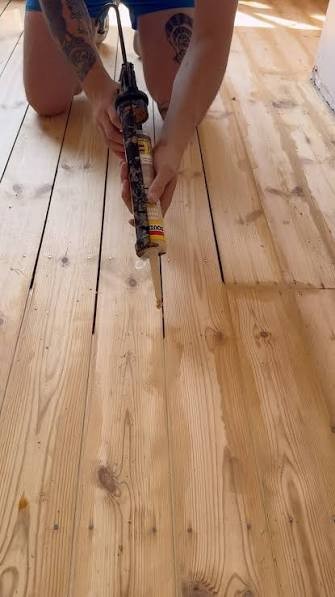
What that actually involves is more work than it sounds. The joints get cleared out properly — a multitool or a chisel run down each one to remove decades of accumulated dirt, old filler, paint runs and general debris, back to clean timber on both edges. A cleared open gap looks deliberate. A neglected one looks like neglect. The difference is entirely in the preparation.
Then the floor gets sanded and coated normally, and the timber is left free to do what it is always going to do.
Most clients, once they have seen a properly cleared open-gap pine floor, are perfectly happy with it. It reads as an honest original floor of its period, which is what it is.
When you genuinely need the gaps closed
There are legitimate reasons to want gaps closed and we do not dismiss them.
Draughts, where the subfloor is unsealed and cold air comes up through the joints. Dust, for the same reason. A rug that keeps catching. Small objects disappearing between the boards. Underfloor heating, where open joints defeat the purpose. In a house where any of those apply, closure is a reasonable brief.
The correct answer is timber splines.
A spline is a tapered strip of timber — ideally reclaimed pine of similar age and species — cut to the profile of the gap, glued in, and sanded flush with the surrounding floor. Because it is wood, it responds to the same seasonal humidity as the boards either side of it. It expands when they expand. It moves with the floor instead of resisting it.
It is slow, individual hand work, joint by joint, and it costs accordingly. Gap treatment runs $5 to $15 per square metre depending on which approach the floor calls for, with splining at the upper end. It is more expensive than a tube of filler and it is still there in fifteen years.
Where resin filler is fine
None of this is an argument against gap filler in general, and it is worth being precise about that.
On narrow strip hardwood — the 65 to 85 millimetre Tasmanian Oak and Victorian Ash that fills out the 1970s brick veneer subdivisions through Langwarrin, Karingal and Frankston South — a wood-flour resin mix toned to the floor colour is perfectly stable. Those boards move a fraction of what wide pine does, the joints are narrower, and the filler survives the annual cycle comfortably.
The failure mode described here is specific to wide, seasonally active softwood. If a contractor tells you resin filler works on your hardwood strip floor, they are probably right. If they tell you it works on your 150 millimetre Baltic Pine, they have not been back to look at one.
Fixing a floor where it has already failed
This is a substantial part of the Baltic Pine restoration work we do around Frankston, and it needs saying that it is not a quick job.
All of the old filler comes out first. Every joint, cleared back to clean timber on both edges. New filler laid over crushed old filler fails faster than the original did, because the bond surface is compromised from the start, so there is no shortcut here.
That clearing is slow, unglamorous work that does not look like much on an invoice, and we quote it as its own line item rather than folding it into a rate per square metre. Trying to hide it inside a sanding rate is how a job runs over.
Once the joints are clean, the decision gets made again properly — open gaps or splines — with a clear explanation of what each costs and how each behaves. Then the floor gets sanded and finished.
The broader point
Almost every recurring defect we deal with on Peninsula floors comes from the same root cause: someone treating timber as if it were a stable material.
It is not. It moves with the seasons, it responds to what is happening in the subfloor beneath it, and every durable decision about a timber floor works with that rather than against it. Rigid filler in a wide pine joint is the clearest example, but the same logic runs through cupping, through crowning, through failed splines cut too tight, and through floating floors laid hard against a skirting with no room to expand.
If you are getting quotes on a Baltic Pine floor and someone offers to fill the gaps with resin, ask them what happens to it next winter. The answer to that question tells you most of what you need to know about the quote.
COMMON QUESTIONS
Why does gap filler pop out of Baltic Pine floors?
Because the boards move and the filler does not. Wide Baltic Pine expands and contracts significantly across its width through a seasonal humidity cycle, and a rigid resin filler locked into the joint gets crushed when the boards expand. Crushed filler loses its bond, breaks up and works its way out underfoot.
Should I fill the gaps in an old pine floor at all?
Usually not with rigid filler. The professional default on 1950s Baltic Pine is to clear the gaps out properly with a multitool or chisel and leave them open, letting the timber move as it always will. Where closure is genuinely needed, tapered timber splines are the durable answer.
What is a timber spline?
A tapered strip of timber — ideally reclaimed pine of the same age and species — glued into the gap and sanded flush with the floor. Because it is wood, it expands and contracts with the boards either side of it instead of fighting them. It is slower and more expensive than resin and it lasts.
What does gap treatment cost?
$5 to $15 per square metre, depending on which approach the floor calls for. Clearing and leaving gaps open is at the lower end. Splining is at the upper end because it is individual hand work, board joint by board joint.
Can hardwood floors be gap-filled with resin?
Generally yes. Narrow strip hardwood at 65 to 85 millimetres moves far less across its width than a 150 millimetre pine board, so a wood-flour resin mix mixed to the floor colour is stable enough to hold. The failure mode described here is specific to wide, seasonally active softwood.
My filler has already failed. What now?
It all comes out before anything else happens — every joint cleared back to clean timber, because new filler over crushed old filler fails faster than the original did. Then the decision is made again properly: open gaps, or splines. Clearing failed filler is slow work and it is quoted as its own item.