
There is a conversation we have several times a month, usually in a 1970s or 1980s house somewhere around Langwarrin, Karingal or Mount Eliza. The owner walks us into the living room, points at the floor, and says some version of: it never used to be this colour.
They are right. It did not. And the good news, which frequently takes some convincing, is that the timber underneath has not changed at all.
What is actually orange
Solvent-based polyurethane is a moisture-curing polymer dissolved in aromatic hydrocarbon solvents. It was the default finish on Australian timber floors for decades, it is hard-wearing, it resists standing water well, and it does one thing that nobody mentions at the time of application: it yellows.
The aromatic components in the resin oxidise under ultraviolet light. As they do, the film shifts progressively — first faintly yellow, then amber, then a distinct orange. It is not a product defect and it is not a sign that a cheap coating was used. Every polyurethane in this chemical class does it. It is what the chemistry is.
On a dark timber the change is subtle enough that many people never notice. On a pale one it is dramatic. A Tasmanian Oak floor that came off the sander a clean honey-blonde reads as distinctly orange within about five to eight years under decent light, and after twenty it can be closer to tan-brown with all the timber’s original character muddied under it.
Why it is worse on the Peninsula
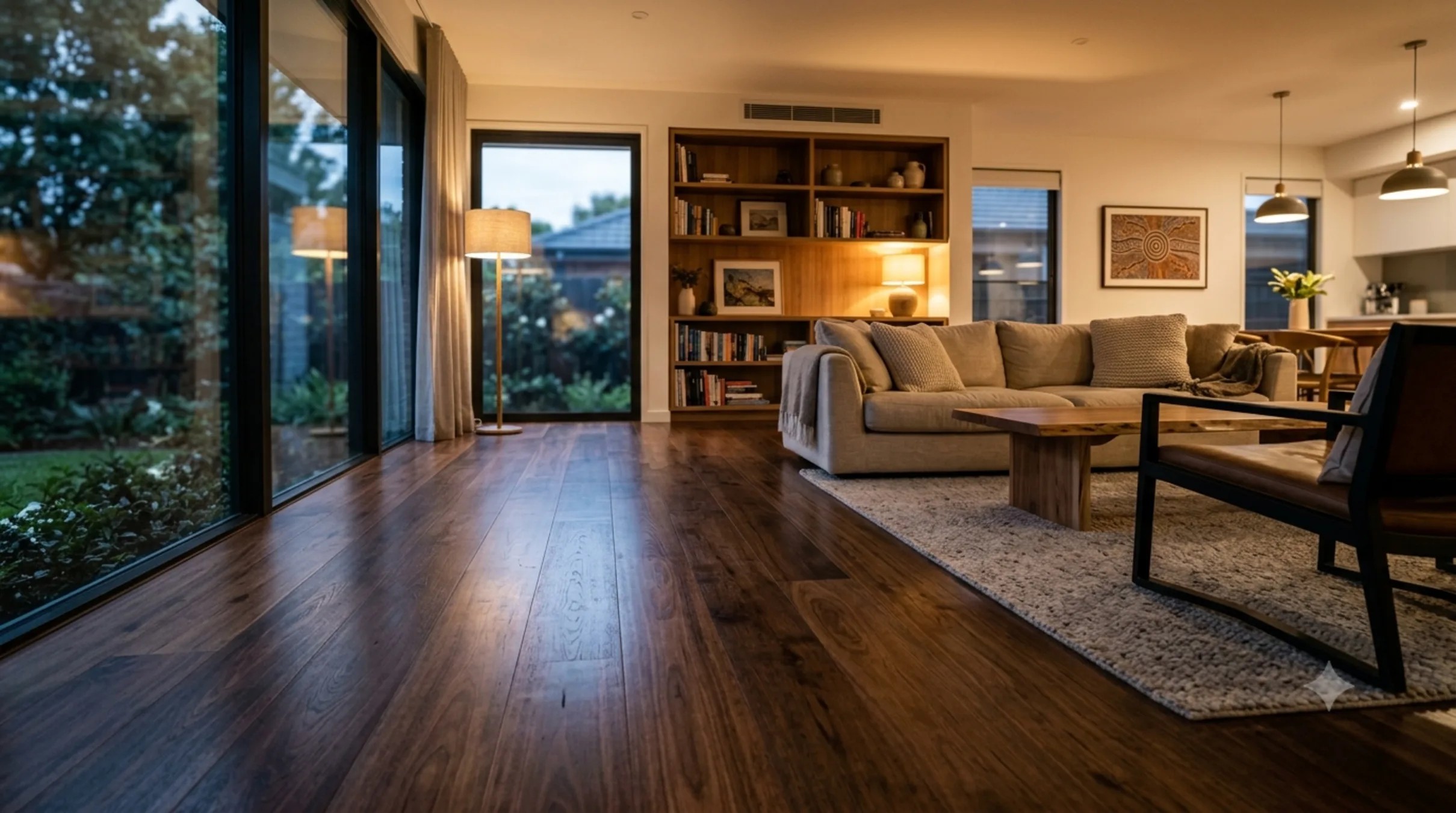
Peninsula houses are built to look at water. That is the entire proposition of a Mount Eliza block with a bay aspect, a McCrae ridge house, a Portsea rebuild facing Bass Strait — big north and west-facing glazing, and as much of it as the budget allowed.
Which means UV loading on the floor at an intensity that an inland house never experiences, amplified further by reflection off the water through the middle of the day. The coating that might have lasted a decade before anyone noticed the shift in a Melbourne terrace gets there in half the time in a Mount Martha living room.
Then there is the pattern. Because the sun path across a room is not uniform, the ambering is not uniform either. What you end up with is a floor that is noticeably darker in a band across the exposed third, lighter along the wall the light never reaches, and often with a sharply defined pale rectangle where a rug or a sofa has been sitting since the nineties.
That unevenness is frequently what finally prompts the call. A floor that ambers evenly reads as a design choice. A floor with a dark stripe across it and a pale ghost of a rug in the middle reads as a problem.
The first coarse pass
This is the part of the job that most reliably surprises people.
The ambering lives entirely in the coating. It has not penetrated the timber, it has not changed the wood chemically, and there is nothing wrong with the boards. The colour is in a film sitting on top, perhaps a couple of hundred microns thick.
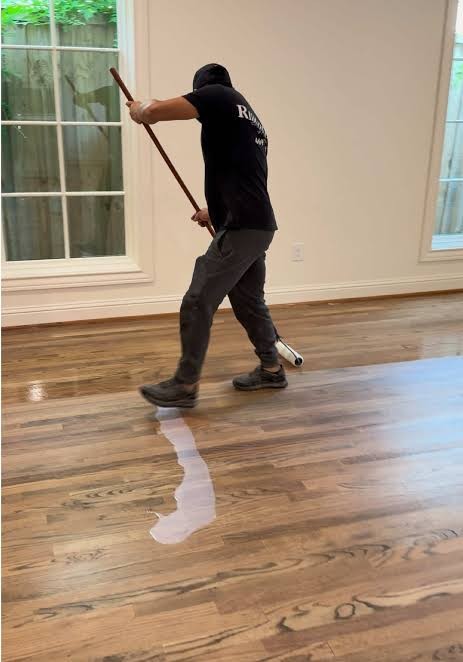
So when the drum sander makes its first pass across an orange floor, what appears behind it is a stripe of pale, clean, original timber — the exact colour the floor was on the day it was laid. Owners who have lived with an orange floor for fifteen years frequently do not believe it is the same room.
There is usually more coating to remove than expected, though, and it is worth knowing that before quoting. A great many of these floors were recoated once in the 1990s or 2000s without being sanded back first, so there are two layers of aged polyurethane to cut through. Aged solvent-based film comes off in hard, glassy flakes that load abrasive quickly rather than powdering cleanly, and it takes a genuine coarse cut. We allow for the belt consumption rather than trying to force it with a loaded abrasive, which stops cutting and starts burnishing — polishing the timber instead of levelling it and leaving old coating down in the grain.
Not going back there
The obvious question, once the floor is bare and pale again, is how to stop it happening a second time.
Two-pack waterborne polyurethane is the answer and it is not a close decision on a Peninsula house. These systems cross-link with an isocyanate or aziridine hardener as they cure, and they hold optical clarity indefinitely. Non-yellowing under UV. No amber drift. The floor stays the colour it came off the sander.
The old objection to waterborne was durability, and it no longer holds. Commercial-grade two-pack products carry very high abrasion resistance, comfortably above what a domestic floor demands, and handle animal claws and grit-laden traffic without breaking down. Bona and Loba both built their reputations on products in this class.
The other properties matter too. VOC content sits under 27 grams per litre with minimal odour, and re-entry is within 24 hours of the final coat. Against a solvent-based system requiring the house to be evacuated for five to seven days while it off-gasses, that difference decides the specification for most occupied homes before durability is even discussed.
Where the house takes serious traffic, an additional topcoat through the entry and traffic lanes at $10 to $15 per square metre roughly doubles the useful life of the finish in the zone that takes the punishment.
If you actually like the warmth
A fair number of clients, having lived with an amber floor for years, discover they have grown fond of the warmth and are unsettled by how stark the pale timber looks bare.
That is a legitimate preference and there is a correct way to get it.
Use a stain. Applied at $12 to $25 per square metre over the sanding rate, a stain delivers the warmth deliberately, evenly, across the entire floor, on day one — under a non-yellowing waterborne topcoat that then holds that colour rather than continuing to drift for the next fifteen years.
The difference between a stain and an ambering coating is control. One is a colour you chose and approved on a sample panel on your own floor in your own afternoon light. The other is a colour that happened to you, unevenly, following the sun.
Where solvent-based still makes sense
None of this makes solvent-based polyurethane obsolete, and we would rather be straight about where it still fits.
A vacant rental between tenancies. A property being prepared for sale. A holiday house with a long empty stretch ahead of it. Where the budget is genuinely tight, the property can absorb the five to seven day evacuation, and the floor is being brought back to a serviceable standard rather than specified for design, solvent-based does the job for less money — material cost of $30 to $40 per square metre against $35 to $45 for waterborne.
Those conditions are common enough through Frankston, Frankston North, Seaford and Rosebud that the product still has a real place.
Where it does not belong is on a heavily glazed owner-occupied house facing the bay, or on any engineered floor. On an engineered board with a two to six millimetre wear layer, an ambered coating cannot simply be sanded off later — there is no thickness to spare for the correction, and the floor is stuck with the colour permanently.
The short version
If your floor has gone orange, the timber is fine. The coating did it, UV drove it, and your glazing accelerated it.
Sanding it back reveals the original colour, and specifying a non-yellowing waterborne system keeps it there. The only real decision left is whether you want the pale timber as it comes off the machine, or a warmer tone chosen deliberately and locked in with a stain.
Either way, it should be a decision rather than something that happens to the floor over the next decade.
COMMON QUESTIONS
Why has my timber floor turned orange?
Almost certainly the coating rather than the timber. Solvent-based polyurethane contains aromatic components that oxidise under UV and shift progressively yellow, then amber, then orange. On a pale timber like Tasmanian Oak or Baltic Pine the change is dramatic, and it is inherent to the chemistry rather than a fault.
Why is the colour uneven across the room?
Because the UV exposure is uneven. The sun path across a room concentrates light in a band, so the coating there ambers faster than the coating under the sofa or behind a door. That is why the pattern often matches the shape of a window or the footprint of furniture that has not moved in years.
Can the orange be removed?
Yes, by sanding it off. The ambering is entirely within the coating, so the hardwood underneath is the colour it always was. Sanding an orange floor back is one of the more satisfying jobs in this trade — a stripe of pale, clean timber appears behind the machine on the first coarse pass.
Will a new finish go orange too?
Not if it is waterborne. Two-pack waterborne polyurethanes stay optically clear indefinitely — non-yellowing under UV, no amber drift over the life of the finish. That is the single most important reason we specify them on the heavily glazed houses typical of the Peninsula.
Does the timber itself change colour?
Gently, yes. Most timbers warm and deepen a little with light exposure over years, and some — Jarrah, Sydney Blue Gum, Ironbark — darken noticeably over decades. But that natural change is slow and even. The dramatic, uneven orange shift people notice is the coating.
What if I like the warm tone?
Then get it deliberately with a stain rather than by accident from an ambering coating. A stain at $12 to $25 per square metre delivers the warmth evenly across the whole floor immediately, under a non-yellowing topcoat that holds it there — rather than arriving unevenly over five years and continuing to drift.