Spotted Gum
AT A GLANCE
| Common name | Spotted Gum |
|---|---|
| Botanical name | Corymbia maculata |
| Janka rating | 11.0 kN (dry) |
| Colour range | Pale honey-brown through to deep chocolate and reddish-brown, often with dramatic variation within one board. |
| Grain pattern | Frequently wavy or interlocked, producing a distinctive figure; occasional gum vein. |
| Typical board widths | 80mm, 130mm and 180mm; wide-board installations common in newer builds. |
| Era commonly laid | 1990s onward as a premium specification, with some earlier use in feature areas. |
| Tannin bleed risk | High |
| UV behaviour | Deepens and unifies with exposure; a non-yellowing finish is essential to keep the natural colour variation legible. |
| Coastal suitability | Excellent |
HOW TO IDENTIFY IT
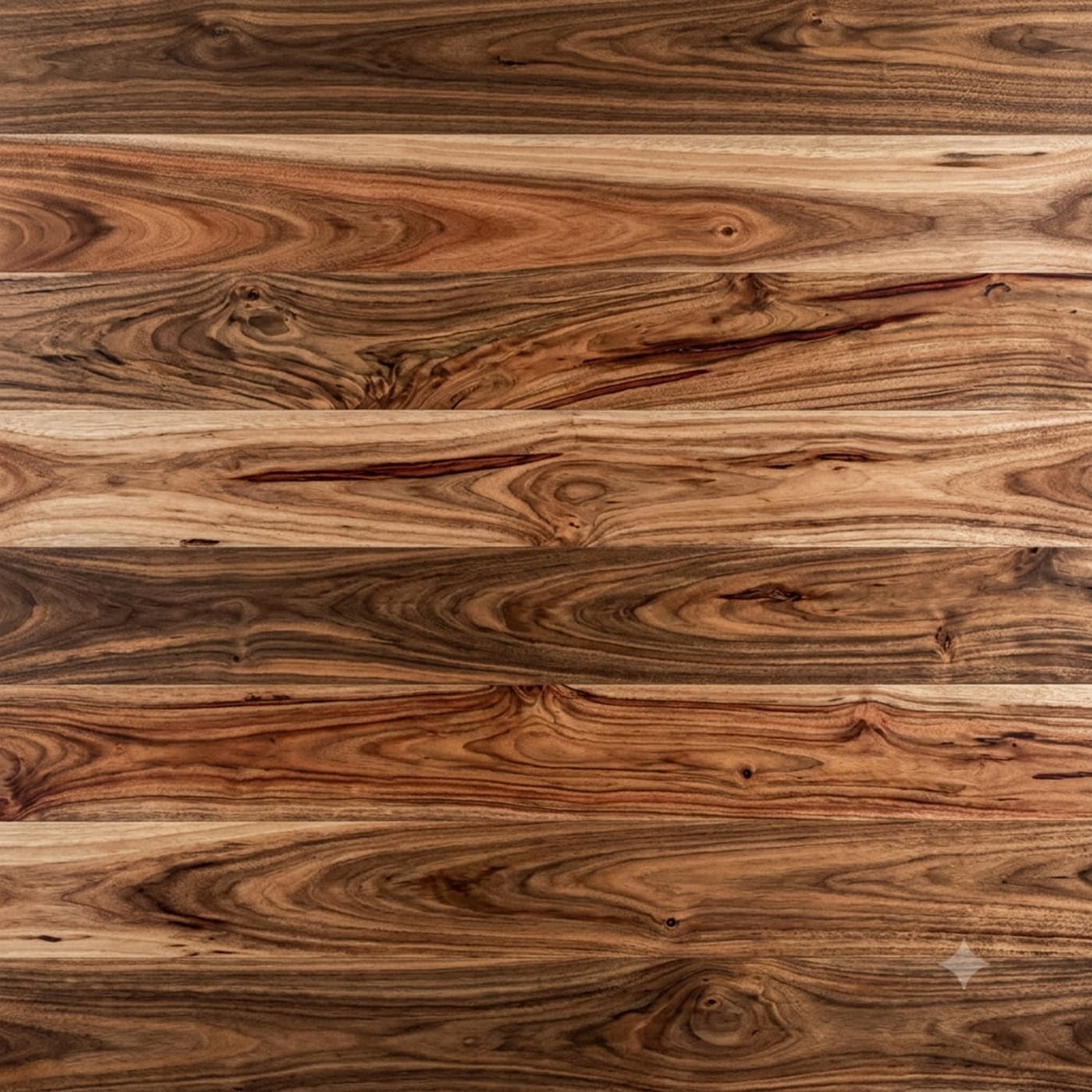
Spotted Gum is the most visually dramatic timber commonly laid in Peninsula houses, and the variation is the giveaway. A single board can run from pale honey through mid-brown to deep chocolate, and adjacent boards can be entirely different tones. Where Tasmanian Oak is quiet and uniform, Spotted Gum is loud and inconsistent, deliberately so.
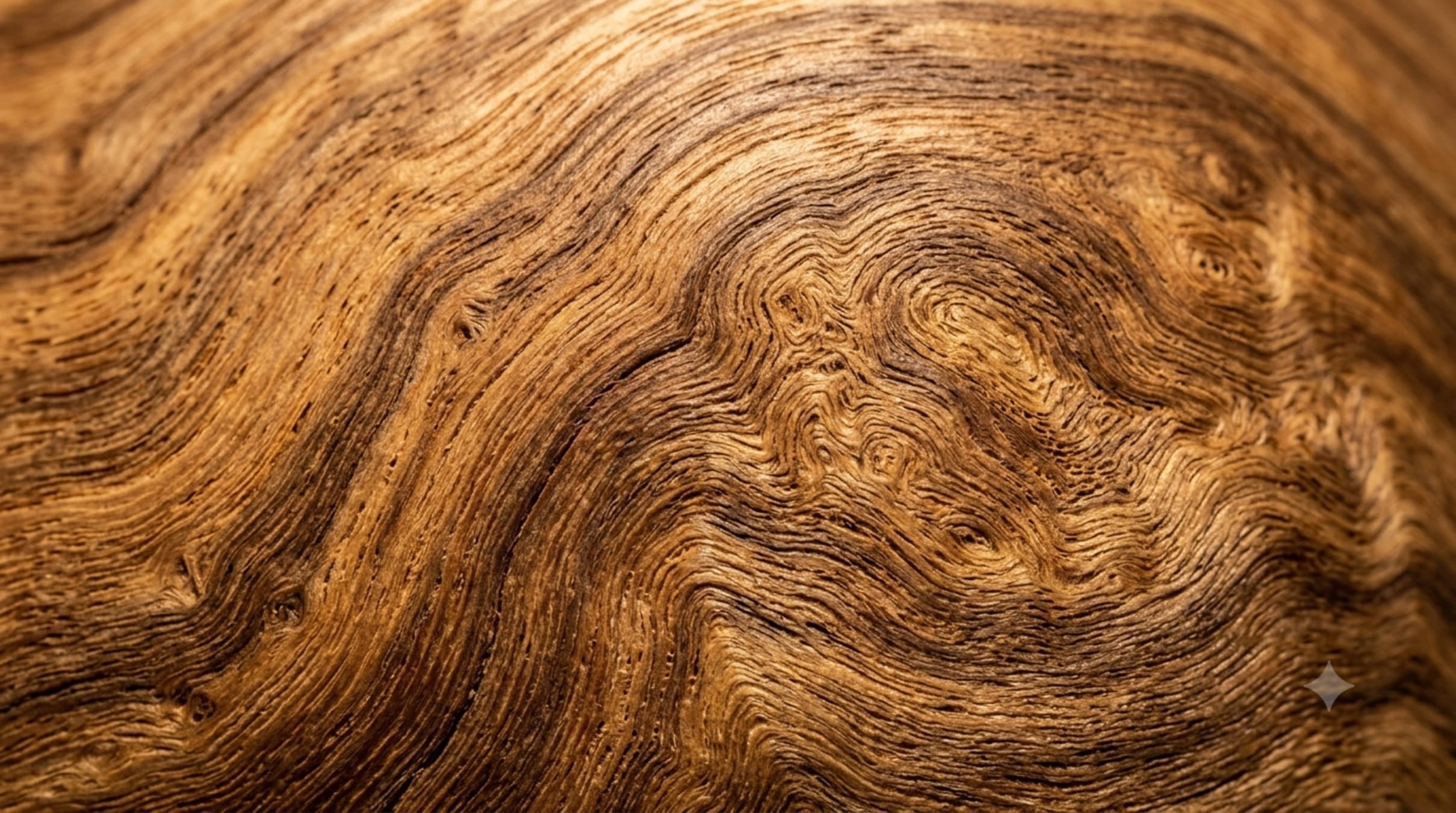
The grain is frequently wavy or interlocked rather than straight, which produces a rippling, three-dimensional figure that shifts as you move across the room. On a wide board that figure is the whole point of the specification, and it is why Spotted Gum is generally laid in 130mm or 180mm widths rather than narrow strip.
The name comes from the bark of the living tree rather than anything visible in the timber, which catches people out. There are no spots in the floor. What there is, occasionally, is gum vein — dark streaks following the grain — and a characteristic slightly greasy feel to the freshly sanded surface.
At 11.0 kN dry it is one of the hardest timbers you will find in a residential floor, well above Blackbutt and Jarrah. A fingernail makes no impression whatsoever and even a dropped tool often leaves no mark. That extreme hardness, combined with the colour variation, is conclusive identification.
HOW IT SANDS
Spotted Gum is genuinely demanding to sand and the density is only half of it. At 11.0 kN the timber requires sharp ceramic abrasives and frequent belt changes; a dulled belt simply stops cutting and burnishes the surface, which then rejects coating unevenly.
The interlocked and wavy grain is the harder problem. Fibres run in multiple directions within a single board, so there is no orientation that cuts cleanly with all of them, and an aggressive coarse pass tears the surface where the grain reverses. Tear-out on Spotted Gum has to be sanded out with the following grits, which costs thickness, so the coarse pass is deliberately restrained.
The slightly oily or greasy character of the freshly cut surface has consequences for the finish rather than for the cutting. Sanding dust can burnish natural extractives back into the surface, particularly if the final pass is too fine or the abrasive is loaded, and that affects how evenly a coating keys to the timber.
Wide boards raise the flatness stakes. A 180mm board shows unevenness far more readily than an 80mm strip, because the eye reads a long uninterrupted surface differently, and the sanding tolerance on a wide-board Spotted Gum floor is genuinely tighter than on narrow strip of the same area.
HOW IT FINISHES
Spotted Gum carries high levels of water-soluble tannins and extractives, and this is the single most important thing to know before finishing one. Apply a waterborne polyurethane directly to bare Spotted Gum and the evaporating water draws those tannins to the surface, producing dark brown blotchy discolouration, uneven sheen and coating adhesion failure.
That defect is not repairable. Once the tannins have bled through and the coating has failed to key properly, the only remedy is cutting the floor back to bare timber and starting again — a full sand of thickness spent on a correction that a primer would have prevented.
The prevention is a fast-drying alcohol-based or shellac-based isolation primer applied to the bare timber before any waterborne topcoat, forming a chemical barrier that locks the tannins into the grain. On Spotted Gum this is not optional, and the fact that it appears on our quote and not on a cheaper one is frequently the whole explanation for the price difference.
Beyond the primer, a two-pack waterborne in satin is the natural specification. The non-yellowing clarity keeps the dramatic colour variation legible, where a solvent-based coating would push everything toward a uniform dark brown and flatten the contrast that justified the timber in the first place. Lime wash is not appropriate — pigment over this much natural colour variation reads as an accident.
ON THE PENINSULA
Spotted Gum is a premium modern specification and it turns up accordingly: the architect rebuilds through Portsea, Sorrento and Blairgowrie, the ridge homes at McCrae and Arthurs Seat, the newer Mount Martha and Mount Eliza builds, and contemporary work across Safety Beach and St Andrews Beach. It is rare in pre-1990s Peninsula housing.
Because these are the most heavily glazed houses on the Peninsula, the non-yellowing requirement is doubled. A wall of north-west facing glass over the bay or Bass Strait puts serious UV onto the floor, and a solvent-based coating over Spotted Gum ambers into an increasingly uniform dark brown that loses everything the timber was chosen for.
The extreme hardness is a genuine advantage in the coastal environment. Beach sand tracked in on feet is loose abrasive, and at 11.0 kN Spotted Gum resists it better than almost anything else. On a St Andrews Beach or Rye property taking sand daily, it is close to the ideal timber provided the coating is specified for the abrasion.
Where these floors appear as wide-plank installations over concrete slab — common through Safety Beach and the Martha Cove builds — slab moisture becomes the controlling variable. A wide Spotted Gum board over a damp slab will cup and telegraph its joints regardless of how well it is finished.
GALLERY
Placeholder slots — drop real photos into src/assets/ and swap the slot for <Image />.
- Photo slot 1
TODO: close-up showing extreme colour variation across three adjacent Spotted Gum boards. - Photo slot 2
TODO: wavy interlocked figure catching raking light across a 180mm wide board. - Photo slot 3
TODO: shellac isolation primer being applied to bare Spotted Gum before waterborne topcoats. - Photo slot 4
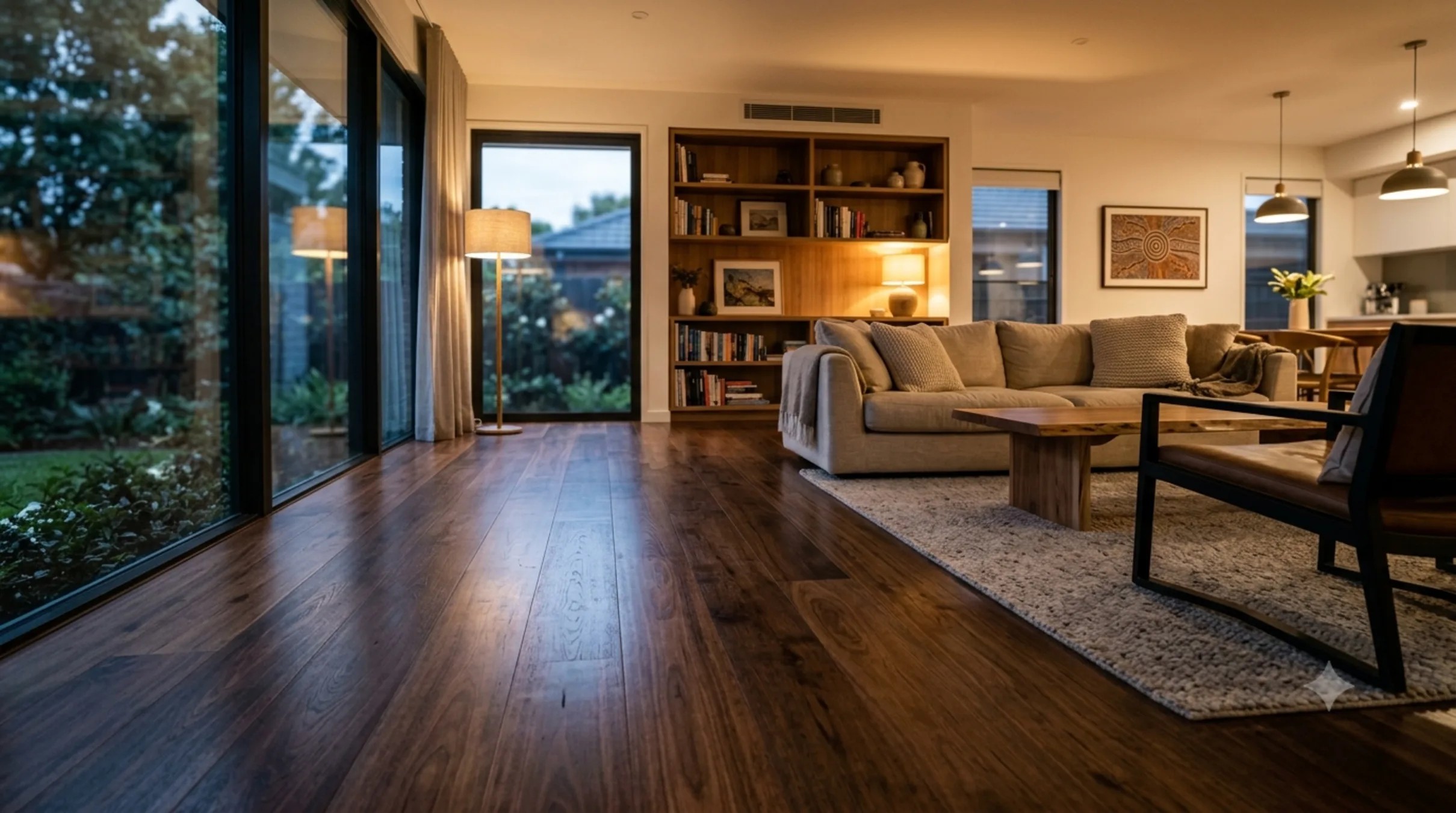
TODO: finished wide-plank Spotted Gum floor in a heavily glazed Peninsula living room.
FLOORS WE SUPPLY IN SPOTTED GUM
Spotted Gum appears across 3 floors in our range. Every one is quoted supply-and-install — request a quote and we will price it for your rooms.
COMMON QUESTIONS
Why does Spotted Gum need a primer?
It carries high levels of water-soluble tannins. Apply a waterborne coating directly to bare timber and the evaporating water draws them to the surface as dark brown blotching, uneven sheen and adhesion failure. A shellac or alcohol-based isolation primer locks them into the grain. On this species it is not optional.
What happens if the primer is skipped?
Dark blotchy discolouration through the floor and a coating that has not keyed properly. It is not repairable — the only remedy is cutting back to bare timber and starting again, which spends a full sand of board thickness on a correction. It is the most expensive corner anyone cuts on this species.
Are there actually spots in Spotted Gum?
No. The name comes from the mottled bark of the living tree, not from anything in the timber. What you see in a floor is dramatic colour variation between and within boards, a wavy or interlocked figure, and occasional gum vein.
Is it too hard to sand properly?
Not too hard, but genuinely demanding. At 11.0 kN it needs sharp ceramic abrasives and frequent belt changes, and the interlocked grain tears if the coarse pass is too aggressive. It takes more machine time and more consumables than a Tasmanian Oak floor of the same area, and a quote that does not reflect that has not accounted for the species.
Can Spotted Gum be lime washed?
We would advise against it. The timber already has dramatic natural colour variation, and white pigment laid over that reads as an accident rather than a finish. Lime wash works on quiet, even timbers — Tasmanian Oak, European oak. On Spotted Gum it fights the material.
Is it a good choice near the beach?
One of the best. Beach sand is a loose abrasive and at 11.0 kN Spotted Gum resists it better than almost any alternative. Pair it with a commercial-grade two-pack waterborne over a proper isolation primer, plus an extra topcoat at the entry, and it handles a coastal house very well.