Floor Sanding Rosebud
Rosebud · 3939 · Mornington Peninsula
If your Rosebud floor has been sanded twice already, the third time may not be available. That is the single most important thing to establish before spending money here, because the postwar beach shacks and the 1960s to 80s brick veneer through the town centre have been in continuous use for long enough that many of these floors are on their second or third refinish, and every cut takes roughly a millimetre off a board that started with a finite amount above the tongue.
Working out how much is left is a measurement, not a guess. A secret-nailed strip floor has perhaps eight to twelve millimetres above the tongue when new. Two full sands and a heavy edge cut around the perimeter can take a third of that. We check at a threshold, a vent or a lifted board, and where the tongue is close to the surface we say so. A floor with no thickness left is a recoat-only floor, and putting a drum sander across it produces broken boards and exposed nails.
The perimeter is where over-sanding shows first, because edge grinders cut with a rotating disc and a heavy hand takes material fast. A floor that has been edged aggressively twice will have a visible dish around the walls where the edger has cut deeper than the field. That dish cannot be corrected by sanding the field down to meet it — there is not enough timber for that — so it gets accepted, coated, and mostly disappears under furniture.
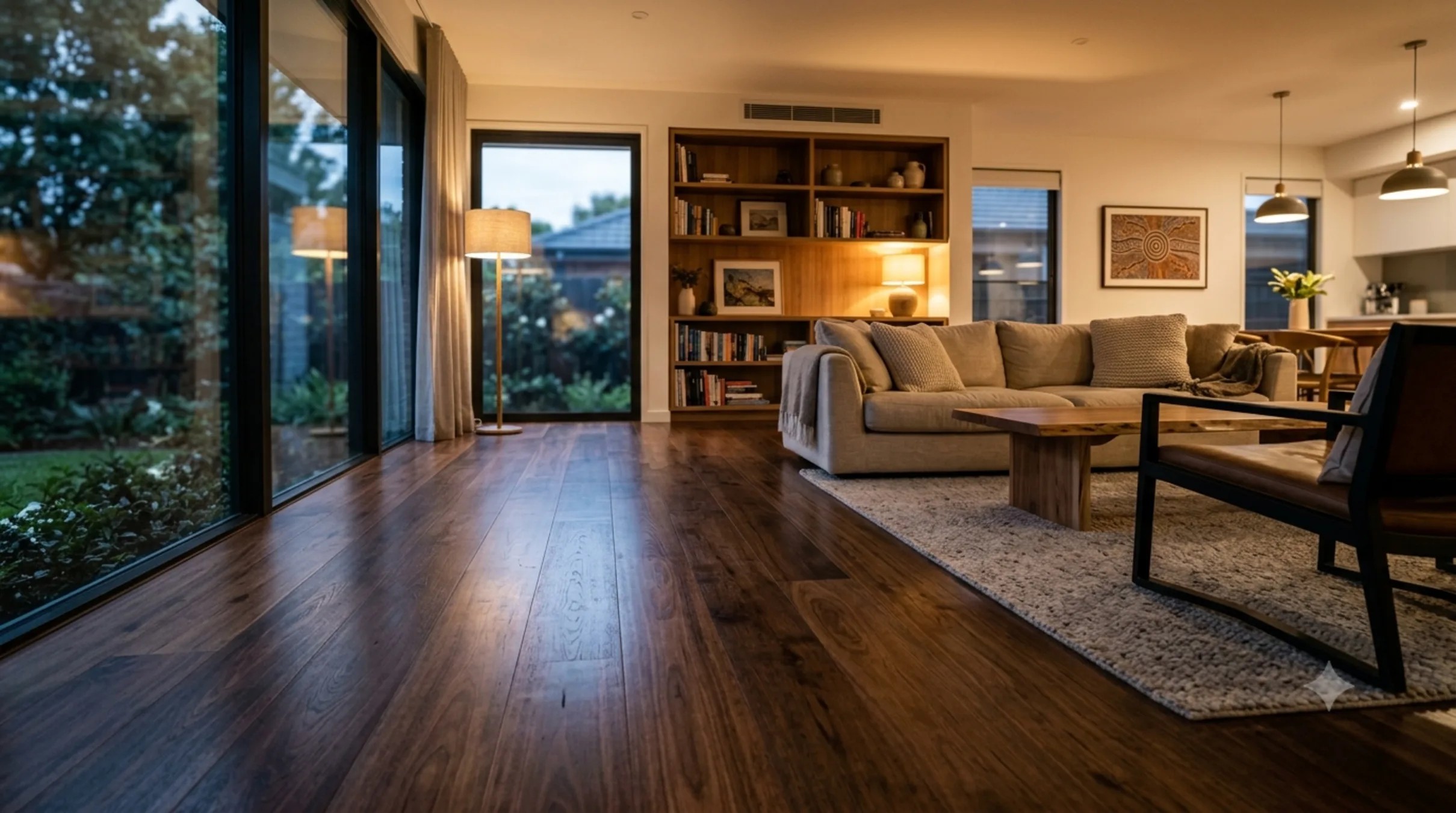
Where a Rosebud floor does have thickness left, it is generally a good restoration prospect. The postwar shack floors are narrow-strip native hardwood or Baltic Pine, laid straight and never disturbed, and after decades under carpet the timber has been protected from UV and traffic. The brick veneer stock through the town centre is 1970s Tasmanian Oak and Victorian Ash on conventional joists, which is durable, tight-grained and forgiving to sand.
Rosebud sits in the Mount Eliza pricing band at $55 to $80 per square metre turn-key for a full sand-and-polish, with typical 90 to 140 square metre scopes landing between $6,050 and $8,800. But the number that matters for a lot of Rosebud floors is the screen-and-recoat rate of $25 to $40 per square metre — surface buffing, light scratch removal and a fresh protective topcoat, with no material taken off the board. On a thin floor that is not a compromise, it is the correct treatment.
The other Rosebud-specific issue is what previous contractors have left behind. Gap filler crushed out of the joints, drum stop marks where a machine was left running in one spot, chatter across the boards from a badly tensioned belt, and swirl from an edger blended carelessly into the field. Some of that can be sanded out if there is thickness available. Some of it — a drum stop that has cut a hollow into the boards — cannot be, and it is better to know that before paying for a sand that will not remove it.
Subfloor clearance on the older shack stock is minimal and sand accumulation against the perimeter has usually buried whatever vents there were. That produces cupping, which is the board edges curling up because the underside is absorbing moisture the heated top face is not. We take pin-type moisture readings at multiple points before sanding. Above 14 to 16 per cent the floor is not ready, and sanding it flat while damp is how you produce crowning two summers later.
Two to four days covers most Rosebud scopes, or a single day plus drying for a screen-and-recoat. Where legacy adhesive from lino needs removing, add time and cost — $10 to $20 per square metre for the scraping and the coarse cut, and it loads abrasive fast. Where the floor turns out to be thinner than expected once we open it up, we stop and have the conversation rather than pushing on and hoping.
Waterborne is our coating recommendation, and on a thin floor the argument is stronger than usual. When there is limited timber left to sacrifice, the finish is doing more of the protective work, so specifying a commercial-grade two-pack with high abrasion resistance directly extends how long you can go before the next intervention. It is also non-yellowing, which keeps a pale Baltic Pine or Tasmanian Oak floor from drifting orange under the coastal light.
For a rental refresh between tenancies, solvent-based polyurethane remains defensible on cost — the material is $30 to $40 per square metre against $35 to $45 for waterborne, it dries hard, and an empty property can absorb the five to seven day evacuation while it off-gasses. For an owner-occupied Rosebud house, particularly one that is lived in year-round, the waterborne re-entry window of 24 hours is worth more than the difference.
The honest summary for Rosebud is that the right answer here is more often a recoat than a sand, and any contractor who quotes a full sand without measuring what is left above the tongue is not looking properly. A screen-and-recoat on a sound floor with a tired finish buys you eight to ten years and costs roughly half. Save the sand for when the floor genuinely needs it, because on most of these houses there is only one left.
ALSO AVAILABLE IN ROSEBUD
Because Rosebud is a coastal Peninsula suburb, we also offer deck sanding and oiling and lime-wash finishes here.
REPLACING THE FLOOR IN ROSEBUD INSTEAD?
If the existing boards are past saving, or you are after something different underfoot, we also supply and install timber, engineered and hybrid flooring here.