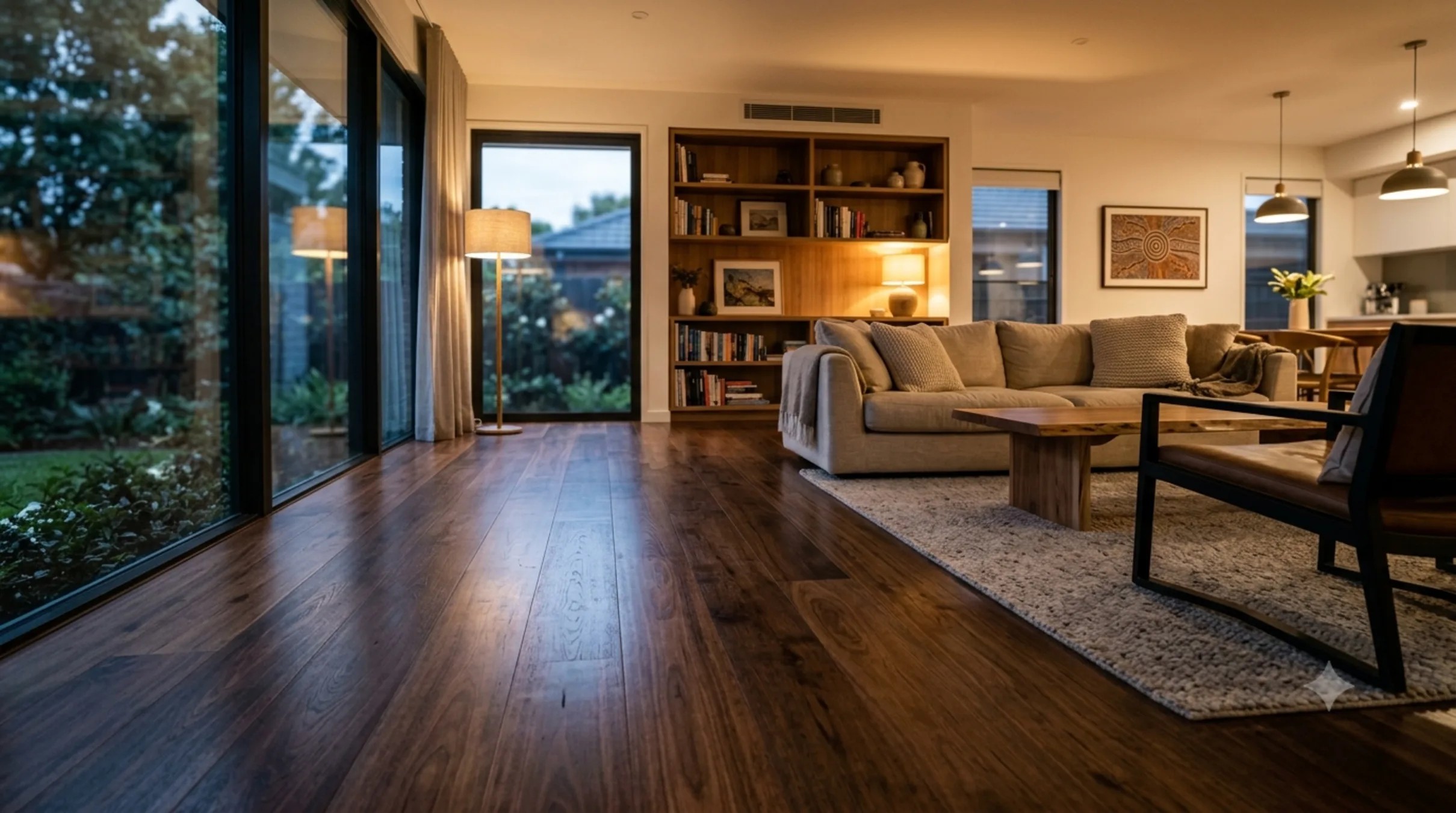
Timber Floor Staining
Priced turn-key from $45–$120/m² across the Peninsula, depending on suburb and job size
Staining changes the colour of the timber itself rather than the coating over it, and that is what makes it both powerful and unforgiving. A stain penetrates the open grain of freshly sanded wood and stays there. Get it right and you have a floor in a tone that no natural species offers. Get it wrong and the only remedy is sanding the whole floor back to bare timber and starting again, which is a full cut of thickness spent on a correction.
The most common reason people stain is not fashion, it is blending. A floor with sections from different eras — an original 1960s Tasmanian Oak living room meeting a 1990s Blackbutt extension — will never sand to a single tone, because the older timber has oxidised through its full depth and the newer has not. A stain deep enough to sit over both narrows that difference substantially. It will not erase it, because the grain structures remain visibly different, and we say so before anyone commits.
The second reason is going darker deliberately. A Tasmanian Oak or Baltic Pine floor is naturally pale and warm, and clients who want depth, contrast against light joinery, or a more contemporary tone have to get there with pigment. The advantage of stain over waiting for a solvent-based coating to amber is that stain delivers the colour evenly across the whole floor immediately, rather than unevenly over five years following the sun path.
Species controls the result more than the stain does. Open-grained timbers like oak and ash take stain evenly and predictably. Dense, tight-grained hardwoods take less and can look blotchy where the density varies within a board. Softwoods like Baltic Pine are the most difficult of all, because stain floods into the soft springwood between the growth rings and is rejected by the harder latewood, producing a strongly striped result that some clients love and others find unacceptable.
Sanding for stain is a discipline of its own. Any variation in the final grit across the floor produces variation in stain uptake, so the fine sanding sequence has to be consistent everywhere — including the perimeter band, where an edger left running finer or coarser than the field will produce a visible frame of different colour around every room. That halo is invisible on a clear-coated floor and glaringly obvious on a stained one.
Sample panels are mandatory on stain work and we will not skip them. The same stain on the same species can read differently between two floors depending on age, previous coating history and how much the timber has oxidised. We prepare panels on the actual floor, in more than one intensity, and view them in the room at the time of day it gets used. Anyone quoting a stain colour from a fan deck without testing on your floor is guessing.
Topcoat selection over stain matters because ambering compounds. A solvent-based polyurethane over a warm stain drifts further toward orange every year, and a colour chosen carefully at the outset ends up somewhere quite different. A non-yellowing waterborne system holds the stain at the tone it was approved at. Where a client specifically wants continued warming, that is a legitimate choice, but it should be a decision rather than an accident.
The one thing we always say before a stain job is that going darker is a one-way decision on a timber floor. Removing a stain means sanding to bare timber across the entire area, which spends a full cut of the board thickness. On a floor that has been sanded before, that may be a cut it cannot afford. It is worth being certain, which is exactly what the sample panels are for.
OUR PROCESS
- 01 Species identification and stain suitability assessment — open-grained timbers take stain evenly, dense hardwoods less so, softwoods most unpredictably.
- 02 Standard preparation: tack strips and staples removed, nails punched, legacy adhesive cleared, moisture confirmed below 14 to 16 per cent.
- 03 Full coarse and medium cutting to bare timber, because stain will not take over any residual old coating.
- 04 Consistent fine sanding sequence across field, perimeter band and thresholds, so stain uptake does not vary between them.
- 05 Sample panels prepared on the actual floor in multiple intensities, viewed in the room in natural light before approval.
- 06 Water-popping where the species and stain require it, to open the grain evenly for consistent penetration.
- 07 Stain applied across the whole continuous area in one session, worked and back-wiped to a uniform loading.
- 08 Full cure of the stain before any sealer, because coating over uncured stain traps solvent and causes adhesion failure.
- 09 Non-yellowing waterborne sealer, then a 150-grit screen taken lightly so the stain layer is not cut through.
- 10 Two waterborne topcoats in the specified sheen, with additional coats through traffic lanes where warranted.
WHAT’S INCLUDED
- Stain application at $12 to $25/m² on top of the sand-and-polish band rate for your suburb.
- Sample panels prepared on your actual floor, in multiple intensities, before any whole-floor commitment.
- Consistent fine-grit sequence across field and perimeter, so no colour halo appears around the rooms.
- Non-yellowing waterborne topcoat as standard, so the approved colour stays the colour.
- Stain blending across mixed-age timber where an extension meets an original floor — narrowed honestly, not promised as a perfect match.
- A plain warning where the species will stain unpredictably, particularly on Baltic Pine and dense red hardwoods.
- Full stain cure before sealing, because coating over uncured stain causes adhesion failure.
- An upfront statement that going darker is effectively a one-way decision on board thickness.
COMMON QUESTIONS
Can staining make my extension match the original floor?
It can narrow the difference substantially and it will not erase it. Older timber has oxidised through its full depth and newer timber has not, and the grain structures of two different species remain visibly different regardless of colour. We sample-test across the actual junction and give you an honest view of how close it will get before you commit.
What does staining cost?
$12 to $25 per square metre on top of the sand-and-polish rate for your suburb band. The variation depends on species, how many passes the colour needs and whether water-popping is required to get even penetration. It is quoted as its own line item rather than folded into the sanding rate.
Can a stain be removed if I don’t like it?
Only by sanding the whole floor back to bare timber, which spends a full cut of board thickness. On a floor that has been sanded before, that may be a cut it cannot afford. This is why we insist on sample panels on your actual floor rather than working from a fan deck — going darker is effectively a one-way decision.
Why does my pine floor look striped in the sample?
Because stain floods into the soft springwood between the growth rings and is rejected by the harder latewood, and Baltic Pine has a strong contrast between the two. The striping is inherent to the species rather than a fault in the application. Some clients love it and some find it unacceptable, which is exactly why we sample first.
Will the colour change over time?
Not if the topcoat is non-yellowing. Over a solvent-based polyurethane, yes — the coating ambers year on year and a carefully chosen colour drifts progressively toward orange. A waterborne system holds the stain at the tone it was approved at. If you want continued warming, that should be a deliberate choice rather than something that happens to you.
What is water-popping?
Dampening the sanded timber to raise and open the grain evenly before staining, so the pigment penetrates consistently rather than being absorbed more heavily where the surface has been burnished. It is not needed on every species or every stain, and where it is needed, skipping it produces a patchy result that cannot be fixed without a full recut.
Can you stain just one room?
Yes, provided it is a discrete space rather than part of a continuous open-plan area. Within a continuous floor the stain has to run across the whole space in one session, because a lap line in a pigmented finish is permanent and visible. Separate rooms with a threshold between them can be staged independently.
Does stain make the floor more durable?
No. Durability comes entirely from the topcoat system over it. A stain is colour in the timber and provides no protection on its own. If durability is the goal, the money is better spent on a commercial-grade two-pack waterborne and an additional topcoat through the traffic lanes at $10 to $15 per square metre.