Victorian Ash
AT A GLANCE
| Common name | Victorian Ash |
|---|---|
| Botanical name | Eucalyptus regnans & delegatensis |
| Janka rating | 4.9 kN (dry) |
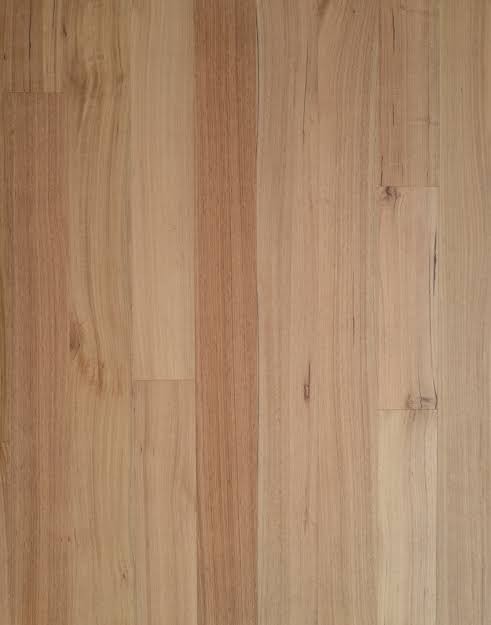
| Colour range | Pale straw to very light pinkish-brown, generally paler and cooler in tone than Tasmanian Oak. |
| Grain pattern | Straight and fine with an even texture; occasional fiddleback figure in select boards. |
| Typical board widths | 65mm to 85mm strip most common; 130mm in later and feature-grade stock. |
| Era commonly laid | 1960s through 2000s, overlapping heavily with Tasmanian Oak in Peninsula housing. |
| Tannin bleed risk | Low |
| UV behaviour | Warms gently and evenly over years; solvent-based coatings drive a far more visible orange shift than the timber does on its own. |
| Coastal suitability | Good |
HOW TO IDENTIFY IT
Victorian Ash and Tasmanian Oak are so close that experienced floor sanders disagree about individual boards. Both names cover overlapping eucalypt species — Victorian Ash is regnans and delegatensis grown in Victorian highland forests, Tasmanian Oak adds obliqua and comes from Tasmania. In a finished floor the distinction is largely academic.
Where there is a tell, it is tone. Victorian Ash tends to run marginally paler and cooler, with more of a pinkish cast in the lighter boards, against the warmer straw-to-honey of Tasmanian Oak. Side by side in the same room the difference is visible. In isolation it is not reliable.
The grain is straight, fine and even, with very little figure through standard grades. Select and feature-grade Victorian Ash occasionally shows fiddleback — a rippled, shimmering figure running across the grain — which is prized and worth identifying before anyone sands aggressively over it.
At 4.9 kN dry it is the softest true hardwood you are likely to find under a Peninsula carpet, marginally below Tasmanian Oak. It dents under a dropped tool and it will not tolerate a proud nail head under an abrasive belt. That softness, combined with the pale colour, is the most useful field identification.
HOW IT SANDS
Victorian Ash sands cleanly and predictably, with one caveat: it is soft enough that machine pressure matters. At 4.9 kN there is less margin than on a Blackbutt or a Spotted Gum floor, and a heavy-handed coarse pass will leave chatter or a dished patch that has to be worked out with the next grit.
The conventional 40, 60, 80, 100 or 120 sequence applies, and skipping steps shows badly. The fine even grain offers nothing to hide a scratch pattern, so a jump from 40 to 80 leaves visible coarse scratching under the finish that only becomes apparent once the coating goes on and the light rakes across it.
Where fiddleback figure is present, it needs a lighter touch and a finer finish grit. Figured timber has grain running in multiple directions within a single board, and an aggressive cut can tear the surface where the fibres reverse. Working up to 120 and taking the last pass gently keeps the figure intact and prevents the fuzzing that ruins it.
Preparation is where softness bites hardest. Every exposed nail must be punched properly below the surface and every carpet staple removed by hand, because the timber will not absorb a proud fixing the way a dense hardwood might. One missed staple tears a belt and scores a line the length of the room.
HOW IT FINISHES
Low tannin content means Victorian Ash takes a waterborne coating straight onto bare timber without an isolation primer, and without the dark blotching risk that Spotted Gum and Australian Cypress carry. That makes it one of the more straightforward species to finish.
Waterborne is the recommendation and ambering is the reason. The pale, cool base colour is exactly what a solvent-based polyurethane destroys — the amber shift is proportionally more visible on a light timber than a dark one, and within a few years a cool pale floor reads warm orange. A two-pack waterborne holds the tone permanently.
It is an excellent candidate for lime wash and Nordic tints, arguably marginally better than Tasmanian Oak because the cooler base colour needs less pigment to reach a genuinely pale result. The technique still requires a precise multi-stage sand finishing at exactly 120 grit for even absorption across the whole floor including the perimeter band.
Hardwax oil suits it well where a softer, more natural surface is wanted, and the ability to spot-refresh a worn area rather than recoat the whole floor is genuinely useful on a softer timber that marks more readily. The trade-off is a maintenance coat every three to five years in traffic areas.
ON THE PENINSULA
Victorian Ash sits alongside Tasmanian Oak within the roughly 50 to 55 per cent of Frankston-area restoration work that is native hardwood, and the two are frequently found in the same street and occasionally in the same house. Through the 1970s and 80s subdivisions across Langwarrin, Skye, Somerville and Carrum Downs, either is likely.
Its softness is the practical Peninsula consideration. In a household with dogs, or in a rural-residential property through Pearcedale or Baxter where grit gets tracked in from unsealed driveways, a 4.9 kN floor wears faster than a Blackbutt one. That argues for a commercial-grade two-pack waterborne and an additional topcoat through the traffic lanes at $10 to $15 per square metre.
In the coastal suburbs it holds up well provided the finish is specified for the exposure. The timber itself is not troubled by salt air, but sand tracked in from the beach is an abrasive and a soft timber under an under-specified coating will show it within a couple of summers.
The other thing worth knowing is that Victorian Ash frequently turns up as the extension timber in a house whose original floor is something else. Where a 1990s Victorian Ash addition meets a 1960s hardwood living room, the two will never sand to a single tone, and a stain sampled across the junction is the honest way to narrow it.
GALLERY
Placeholder slots — drop real photos into src/assets/ and swap the slot for <Image />.
- Photo slot 1
TODO: close-up of Victorian Ash grain showing the cooler pale tone against a Tasmanian Oak board for comparison. - Photo slot 2
TODO: fiddleback figure in a select-grade Victorian Ash board, raking light to show the ripple. - Photo slot 3
TODO: Victorian Ash floor finished in a Nordic tint, Peninsula interior with natural side light. - Photo slot 4
TODO: junction where a Victorian Ash extension meets an older hardwood floor, showing the tonal difference before staining.
FLOORS WE SUPPLY IN VICTORIAN ASH
Victorian Ash appears across one floor in our range. Every one is quoted supply-and-install — request a quote and we will price it for your rooms.
COMMON QUESTIONS
How do I tell Victorian Ash from Tasmanian Oak?
Often you cannot, and experienced sanders disagree about individual boards. Victorian Ash tends to be marginally paler and cooler with a pinkish cast; Tasmanian Oak runs warmer and straw-toned. Side by side the difference shows. In isolation it is not reliable, and it rarely matters because both sand and finish identically.
Is it too soft for a family home?
No, but it deserves a properly specified coating. At 4.9 kN it is the softest true hardwood commonly found in Peninsula housing, so a commercial-grade two-pack waterborne and an additional topcoat through the traffic lanes at $10 to $15/m² is money well spent — particularly with dogs or in a house that takes grit from an unsealed driveway.
What is fiddleback and does it affect sanding?
A rippled, shimmering figure running across the grain in select boards, caused by the timber fibres undulating. It is prized and it needs a lighter cut and a finer finish grit, because an aggressive pass tears the surface where the fibres reverse direction. Worth identifying before anyone runs a coarse belt over it.
Does Victorian Ash suit a lime wash?
Very well — arguably marginally better than Tasmanian Oak, because the cooler base colour needs less pigment to reach a genuinely pale result. It still requires the full multi-stage sand finishing at exactly 120 grit across field and perimeter for even absorption.
Will it dent?
More readily than a denser hardwood, yes. Dropped tools, chair legs without felts and stiletto heels all leave marks in a 4.9 kN timber. Dents are compression rather than loss of material, and minor ones can sometimes be raised with steam during a restoration, though anything through the finish needs the floor sanded.
Can it be sanded as many times as a harder timber?
Yes — sanding life depends on board thickness above the tongue, not on hardness. A solid Victorian Ash strip floor has the same eight to twelve millimetres to work with as any other hardwood strip, giving six to ten cuts. Softness affects how carefully each cut has to be made, not how many are available.