Jarrah
AT A GLANCE
| Common name | Jarrah |
|---|---|
| Botanical name | Eucalyptus marginata |
| Janka rating | 8.5 kN (dry) |
| Colour range | Rich deep red through to dark burgundy-brown, darkening considerably with age and exposure. |
| Grain pattern | Mostly straight, sometimes interlocked, with frequent gum vein and occasional curly figure. |
| Typical board widths | 80mm and 100mm most common in Peninsula stock; some 130mm in feature installations. |
| Era commonly laid | 1930s through 1980s, appearing intermittently rather than as a default flooring choice. |
| Tannin bleed risk | Medium |
| UV behaviour | Darkens noticeably with light exposure over years; a non-yellowing finish keeps the red legible rather than letting it drift toward brown-black. |
| Coastal suitability | Excellent |
HOW TO IDENTIFY IT
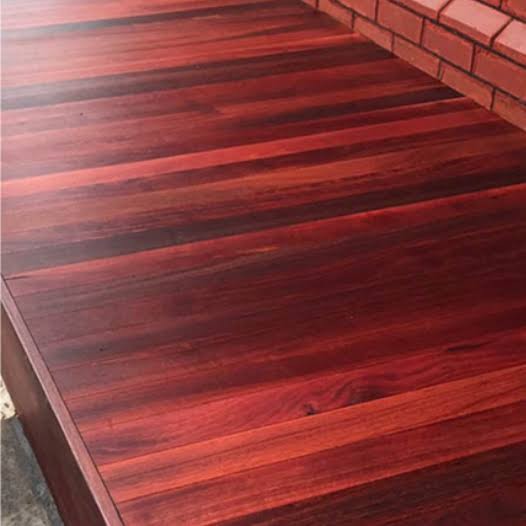
Jarrah announces itself. Nothing else likely to be under a Peninsula carpet is that deep, saturated red, and once you have seen a jarrah floor come up from under a coating you will not mistake it for anything else. Fresh from the sander it runs rich red to burgundy-brown, and it darkens further with age and light exposure.
The grain is generally straight but frequently interlocked, meaning the fibres run in alternating directions between growth layers. That interlocking is what produces the ribbon figure visible on quartersawn boards, and it is also what makes the timber prone to tearing if it is cut against the grain direction.
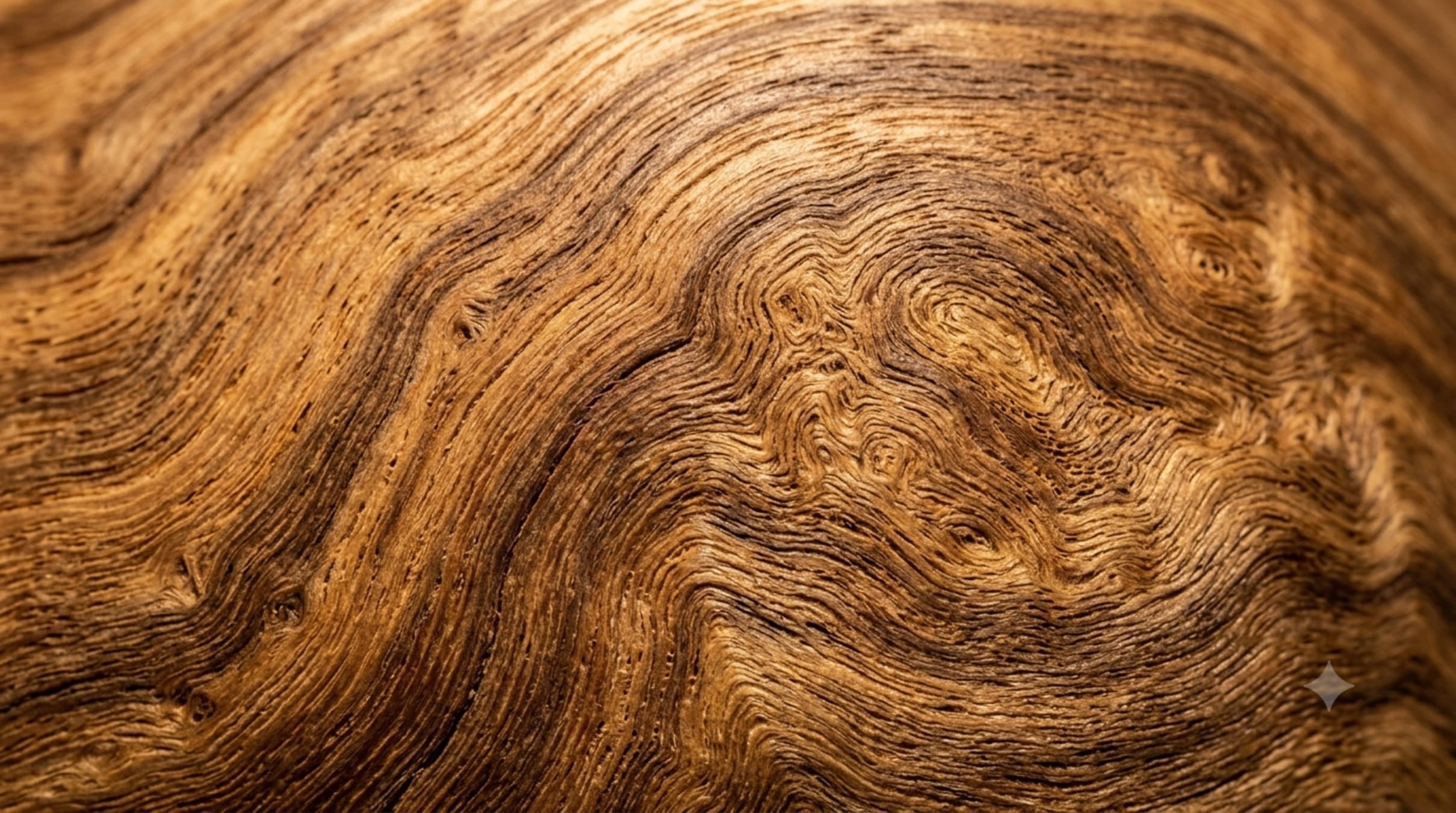
Gum vein is common and characteristic — dark, sometimes cavernous streaks following the grain, occasionally open enough to need filling. On a period jarrah floor these are part of the character rather than a defect, and filling them all produces a flat, lifeless result that misses the point of the timber.
At 8.5 kN dry it is a genuinely hard timber, comfortably harder than Tasmanian Oak and only a little below Blackbutt. A fingernail makes no impression. Combined with the colour, that hardness is conclusive: no softwood is that dense, and no other common Australian hardwood is that red.
HOW IT SANDS
Jarrah is hard work and it is worth understanding why before quoting one. At 8.5 kN the timber resists cutting, which means sharp ceramic abrasives and more of them — a dull belt stops cutting and starts burnishing, polishing the surface rather than levelling it and leaving old coating down in the grain.
Interlocked grain is the technical complication. Because the fibres alternate direction between growth layers, there is no single sanding direction that works with all of them, and cutting against a reversed section tears the surface. Working with the board run and taking the final passes progressively finer manages it. Aggressive coarse work on interlocked jarrah produces tear-out that then has to be sanded away, costing thickness.
The dark dust is worth knowing about practically. Jarrah produces a deep red-brown dust that stains grout, carpet in adjacent rooms and anything porous it settles on. Containment matters more here than on a pale timber, because the evidence of a poorly contained job is highly visible.
Gum vein needs a decision rather than a default. Filling every vein with a resin toned to the timber produces a uniform floor and loses the character. Leaving them open keeps the character and leaves surfaces that catch dirt. Most clients land on filling the deep ones and leaving the fine ones, and it is worth agreeing before the filler comes out.
HOW IT FINISHES
Jarrah carries moderate tannin levels, enough that we generally recommend an isolation primer before a waterborne system on a floor that has been sanded to bare timber. It is not the near-certainty it is on Spotted Gum or Cypress, but the consequence of getting it wrong — dark blotching and uneven sheen across a floor this visible — makes the primer cheap insurance.
The colour makes finish selection unusually consequential. Jarrah is already dark and warm, so a solvent-based polyurethane pushes it further toward brown-black over the years, and detail in the grain is progressively lost. A waterborne system keeps the red legible and lets the timber read as jarrah rather than as generic dark timber.
Lime wash and Nordic tints do not work on jarrah and we will say so plainly. White pigment over a deep red base produces a muddy pink that satisfies nobody, and the technique that gives Tasmanian Oak its pale coastal result simply fights the natural colour here. Clients who want a pale floor and have jarrah are choosing between the timber and the look.
Where jarrah excels is under a clear satin or matte waterborne. The depth of colour, the ribbon figure on quartersawn boards and the gum vein all read properly, and the non-yellowing finish keeps them legible for the life of the coating.
ON THE PENINSULA
Jarrah turns up intermittently across the Peninsula rather than as a default. It appears in better-quality 1930s to 1960s homes through Frankston South and Mount Eliza, in some 1970s builds where the owner specified it deliberately, and occasionally as a feature floor in a single room of an otherwise Tasmanian Oak house.
That last pattern is the one that causes trouble. A jarrah dining room adjoining a Tasmanian Oak hallway cannot be sanded and coated to a common tone — the two timbers are at opposite ends of the colour range and no stain closes that gap. The honest design answer is to treat the threshold as a deliberate line rather than a failed match.
Its hardness makes it an excellent Peninsula floor in practical terms. In rural-residential properties through Pearcedale, Baxter and Somerville where grit comes in from unsealed driveways, and in coastal houses taking beach sand, an 8.5 kN timber under a commercial-grade waterborne handles the abrasion far better than a softer species.
Where we see jarrah in older Frankston South and Mount Martha houses, the borer question still applies. The Common Furniture Beetle targets sapwood rather than the dense heartwood that makes up most of a jarrah board, so infestation is less common than in Baltic Pine — but sapwood inclusions do occur and they get checked like anything else.
GALLERY
Placeholder slots — drop real photos into src/assets/ and swap the slot for <Image />.
- Photo slot 1
TODO: close-up of jarrah grain showing deep red colour, gum vein and interlocked ribbon figure at 100mm scale. - Photo slot 2
TODO: freshly sanded jarrah beside a section still under aged coating, showing how much colour the old finish had obscured. - Photo slot 3
TODO: jarrah floor finished in satin waterborne in a Frankston South period home, natural daylight. - Photo slot 4
TODO: gum vein detail showing filled deep veins alongside unfilled fine ones.
FLOORS WE SUPPLY IN JARRAH
Jarrah appears across one floor in our range. Every one is quoted supply-and-install — request a quote and we will price it for your rooms.
COMMON QUESTIONS
Can jarrah be lime washed or made lighter?
Realistically, no. White pigment over a deep red base produces a muddy pink rather than the pale coastal look people are after, and no amount of technique changes that. If a pale floor is the brief and the house has jarrah, the choice is between keeping the timber and getting the look — we will say so at the first visit rather than after a sample panel.
Why is jarrah more expensive to sand?
Hardness and interlocked grain. At 8.5 kN it resists cutting, which means sharp ceramic abrasives and more belt changes, and the alternating fibre direction means aggressive passes tear the surface and have to be worked back out. It is more machine time and more consumables for the same floor area.
Should the gum veins be filled?
It is a decision worth making deliberately. Filling every vein gives a uniform floor and loses much of the character that makes jarrah worth having. Leaving them all open keeps the character but leaves surfaces that catch dirt. Most clients fill the deep ones and leave the fine ones, and we agree that before the filler comes out.
Does it need a primer under a water-based coating?
We generally recommend one. Tannin levels are moderate — not the near-certainty of Spotted Gum or Australian Cypress, but enough that dark blotching is a real possibility on bare timber. Given how visible a defect would be on a floor this prominent, a shellac or alcohol-based isolation primer is cheap insurance.
My jarrah floor has gone almost black. Can it be brought back?
Usually yes. Most of that darkening is aged solvent-based coating rather than the timber, and sanding it off typically reveals a far redder floor than the owner expected. The timber itself does darken with light exposure over decades, but the dramatic shift is nearly always in the finish.
Is jarrah good for a coastal house?
Very. At 8.5 kN it handles the abrasion from beach sand tracked in on feet far better than a softer species, and the timber itself is untroubled by salt air. Pair it with a commercial-grade two-pack waterborne and an extra topcoat through the entry and it is one of the more durable floors on the Peninsula.