Messmate
AT A GLANCE
| Common name | Messmate |
|---|---|
| Botanical name | Eucalyptus obliqua |
| Janka rating | 7.1 kN (dry) |
| Colour range | Pale straw through to light brown, with pronounced gum vein and colour banding between boards. |
| Grain pattern | Straight but visually busy, defined by frequent gum vein, insect trace and colour variation. |
| Typical board widths | 80mm, 130mm and 180mm; feature-grade wide board is the common modern specification. |
| Era commonly laid | 1990s onward as a feature-grade specification, though the species has been milled far longer. |
| Tannin bleed risk | Medium |
| UV behaviour | Warms gently and evenly; the practical risk is a solvent-based coating darkening the field until the gum vein contrast is lost. |
| Coastal suitability | Good |
HOW TO IDENTIFY IT
Messmate is Eucalyptus obliqua, which is also one of the three species sold as Tasmanian Oak. The difference is grade rather than botany. Where Tasmanian Oak is selected for uniformity, Messmate is sold specifically for its character — the gum vein, the insect trace, the colour banding that a select grade would reject.
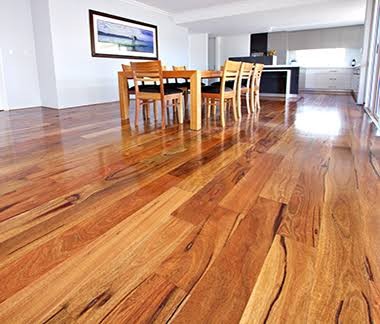
What that produces is a floor with a similar pale straw to light brown base tone to Tasmanian Oak but far more going on across the surface. Dark gum veins run with the grain, sometimes fine and sometimes wide enough to need filling. Small dark insect trace marks scatter through the boards. Colour bands shift noticeably from one board to the next.
Widths are the other tell. Because the appeal is the character, Messmate is generally laid wide — 130mm and 180mm boards are standard in modern installations, where Tasmanian Oak of the same era is more often 80mm strip. A wide, pale, heavily veined eucalypt board is almost always Messmate.
At 7.1 kN dry it is meaningfully harder than the 5.5 kN typical of select-grade Tasmanian Oak, which is a useful reminder that the marketing categories do not track the timber precisely. It resists a fingernail firmly and takes a dropped tool better than a Victorian Ash floor would.
HOW IT SANDS
Messmate sands much like any medium-density eucalypt through the conventional 40, 60, 80, 100 or 120 grit sequence, and the timber itself presents no real difficulty. The complications are all in the features that make it worth specifying.
Gum vein is the main one. Wide veins are effectively voids running with the grain, and a coarse belt passing over an open vein can tear its edges rather than cutting them cleanly. Working restrained through the coarse pass and letting the finer grits do the definition keeps the vein edges crisp, which matters because ragged vein edges look like damage rather than character.
Filling is a decision that needs making before the resin comes out. Filling every vein produces a uniform floor and removes most of the reason for choosing Messmate in the first place. Leaving them all open keeps the character but leaves surfaces that trap dirt and can catch a sock. Most clients fill the wide and deep ones with a wood-flour resin toned to the timber and leave the fine ones legible.
Wide boards raise the flatness requirement. A 180mm Messmate board shows unevenness far more readily than 80mm strip, because the eye reads a long uninterrupted surface differently, and the sanding tolerance is correspondingly tighter.
HOW IT FINISHES
Tannin levels are low to moderate — higher than select-grade Tasmanian Oak because the feature grade includes more of the vein and sapwood that carry extractives, but well below Spotted Gum or Cypress. We assess it on the floor rather than applying a blanket rule, and will specify an isolation primer where the vein content is heavy.
Waterborne polyurethane is the natural specification. The pale base tone is exactly what a solvent-based coating spoils, and the amber shift is doubly unhelpful here because it darkens the background toward the tone of the gum vein and reduces the contrast that gives the floor its character.
Messmate takes a lime wash or Nordic tint interestingly rather than predictably. The pale background accepts pigment well, but the gum veins do not — they stay dark, and the contrast between a whitened field and unchanged dark veins becomes far more pronounced. Some clients find that striking. Others find it too busy. A sample panel on the actual floor settles it.
Hardwax oil suits the timber well where a natural, low-sheen surface is wanted. The oil wets the grain and deepens the vein contrast slightly, and the ability to spot-refresh a worn area rather than recoat the whole floor is useful on a wide-board floor where a full recoat is a substantial job.
ON THE PENINSULA
Messmate is a modern feature specification on the Peninsula rather than a legacy timber, appearing in renovations and rebuilds from the 1990s onward. It shows up through Mount Eliza, Mornington and Mount Martha in extensions and open-plan additions, and across the coastal suburbs in holiday-house rebuilds at Blairgowrie, Rye and Dromana.
That timing creates the most common problem we deal with. A wide-board Messmate extension meeting an original narrow-strip Tasmanian Oak floor is technically the same eucalypt species in two different grades and widths, and it still will not read as one floor. The vein content, the board width and the age difference all separate them. A stain narrows the tonal gap and does nothing about the rest.
Where a whole floor is Messmate, the coastal environment suits it. At 7.1 kN it handles the beach sand tracked into a Rye or Blairgowrie property considerably better than a softer pale timber, and the busy surface disguises the fine scratching that abrasion produces far better than a uniform floor would.
On the newer builds where Messmate is laid wide over concrete slab, slab moisture is the controlling variable. A 180mm board over a damp slab cups and telegraphs its joints regardless of how well the surface is finished, and that is worth testing before spending anything on a refinish.
GALLERY
Placeholder slots — drop real photos into src/assets/ and swap the slot for <Image />.
- Photo slot 1
TODO: close-up of Messmate showing gum vein, insect trace and colour banding across a 180mm board. - Photo slot 2
TODO: gum vein detail showing wide veins filled with toned wood-flour resin beside unfilled fine veins. - Photo slot 3
TODO: wide-board Messmate floor finished in satin waterborne, open-plan Peninsula interior. - Photo slot 4
TODO: junction between wide-board Messmate extension and original narrow-strip Tasmanian Oak.
COMMON QUESTIONS
Is Messmate the same as Tasmanian Oak?
Botanically it overlaps — Messmate is Eucalyptus obliqua, one of the three species sold as Tasmanian Oak. The difference is grade. Tasmanian Oak is selected for uniformity; Messmate is sold for character, keeping the gum vein, insect trace and colour banding a select grade would reject.
Should the gum veins be filled?
Selectively. Filling every vein gives a uniform floor and removes most of the reason for choosing Messmate. Leaving them all open keeps the character but leaves surfaces that trap dirt. Most clients fill the wide and deep ones with a toned wood-flour resin and leave the fine ones legible — worth agreeing before the filler comes out.
Can Messmate be lime washed?
Yes, with a caveat worth seeing before you commit. The pale background takes pigment well but the gum veins do not, so the contrast between a whitened field and unchanged dark veins becomes much more pronounced. Some clients find that striking and others find it too busy. A sample panel on the actual floor settles it.
Why is my Messmate floor so much darker in places?
Colour banding between boards is inherent to the feature grade rather than a fault or a finishing problem. It is the same variation that a select grade sorts out and this grade deliberately keeps. It is worth knowing before sanding that the variation will still be there afterwards — sanding evens the surface, not the colour.
Does it need a primer under a waterborne coating?
Sometimes. Tannin levels are low to moderate — higher than select-grade Tasmanian Oak because the feature grade carries more vein and sapwood, but well below Spotted Gum or Cypress. We assess the actual floor rather than applying a blanket rule, and specify a primer where vein content is heavy.
Is it hard enough for a family home?
Yes. At 7.1 kN it is meaningfully harder than select-grade Tasmanian Oak at 5.5 kN, and it takes a dropped tool better than a Victorian Ash floor would. The busy surface also disguises fine scratching far better than a uniform pale floor does, which is a genuine practical advantage.