Blackwood
AT A GLANCE
| Common name | Blackwood |
|---|---|
| Botanical name | Acacia melanoxylon |
| Janka rating | 5.5 kN (dry) |
| Colour range | Golden brown through to a deep reddish brown, frequently with darker chocolate streaking following the grain. Sapwood is distinctly paler, close to straw. |
| Grain pattern | Usually straight but often wavy, with fiddleback figure appearing on a proportion of boards as a rippling shimmer across the grain. |
| Typical board widths | 80mm and 100mm in older strip flooring; 130mm and wider in modern engineered veneer. |
| Era commonly laid | Rare as a full floor in Peninsula housing. Turns up as feature flooring, thresholds and joinery from the 1930s onward, and increasingly as an engineered veneer today. |
| Tannin bleed risk | Medium |
| UV behaviour | Darkens and enriches with exposure, deepening toward red-brown over the first year or two rather than fading. Rugs left in place will leave a visible lighter patch. |
| Coastal suitability | Fair |
HOW TO IDENTIFY IT
Blackwood is not a timber you often find under a Peninsula carpet, and that is the first thing worth saying about it. Where Blackbutt, Tasmanian Oak and Baltic Pine were laid by the acre through the postwar decades, Blackwood was expensive and went into furniture, joinery and the occasional feature floor rather than whole houses. If you have lifted a carpet and found it, you have found something unusual.
The colour is the giveaway. Blackwood runs golden brown through to a genuine reddish brown, noticeably warmer and redder than Tasmanian Oak but without the deep russet-purple of Jarrah. Look along the board and you will usually see darker chocolate streaks tracking the grain — not the thin dark gum veins of a eucalypt, but broader, softer bands of colour.
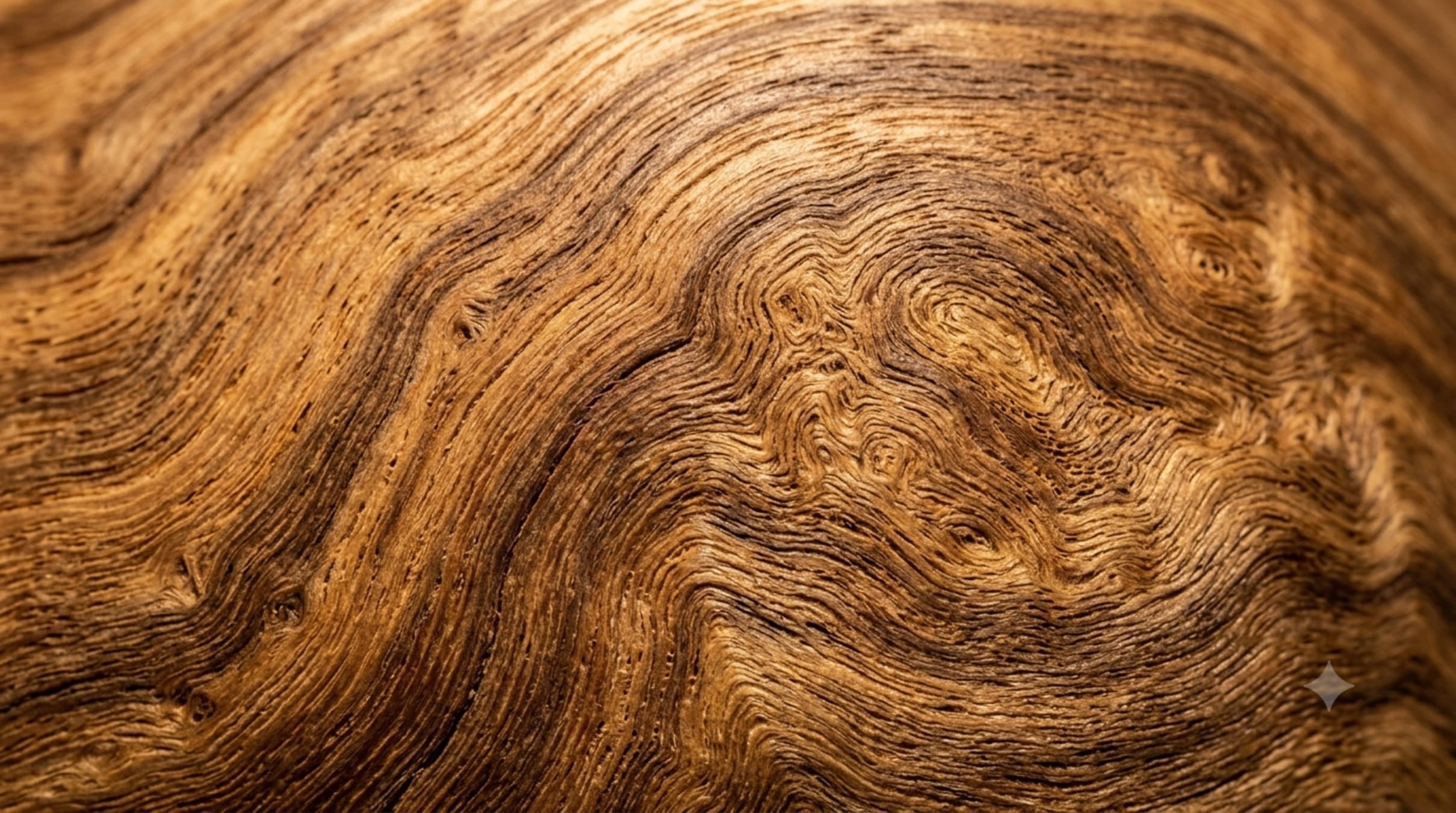
The second giveaway is figure. A decent proportion of Blackwood boards carry fiddleback: a rippling, three-dimensional shimmer running across the grain that appears to move as you change your viewing angle. No eucalypt does this. If you tilt your head and the board seems to ripple, it is almost certainly an acacia.
Sapwood is dramatically paler, close to straw, and where it has been included in a board the contrast is obvious rather than subtle.
The hardness test separates it from the eucalypts too. Blackwood sits around 5.5 kN on the dry Janka scale — well below Blackbutt at 9.1 and Spotted Gum higher again. A firm fingernail in an inconspicuous corner will mark it more readily than it marks a eucalypt floor.
HOW IT SANDS
Blackwood needs a lighter hand than the eucalypts we usually work on the Peninsula. At roughly 5.5 kN it is a medium-density hardwood, closer to Tasmanian Oak than to Blackbutt, and the drum will cut into it considerably faster than an operator used to Spotted Gum expects. The most common damage we see on Blackwood floors is dishing from someone running a Blackbutt technique on a softer timber.
Start higher than you would on a eucalypt. Unless the old coating is genuinely heavy, 60 grit is usually enough for the first cut, and on a floor in reasonable condition 80 is often plenty. Work up through 80 and 100 to 120. Skipping grits shows badly here because the figure catches raking light and any scratch pattern left behind becomes obvious once the coating goes on.
Figure is the real technical challenge. Wherever fiddleback or wavy grain occurs, the fibre direction reverses repeatedly across a short distance, and tear-out risk climbs sharply. Keep the abrasive sharp — a dull belt tears where a fresh one cuts — and slow the pass rate over figured sections rather than forcing the machine through. On strongly figured boards, finishing with a hard-plate buff rather than a final drum pass gives a cleaner surface.
The edger will show its margin more clearly on Blackwood than on a pale even species, because the colour depth exaggerates any difference in cut. Blend it back with a palm sander before coating; do not rely on the finish to hide it.
HOW IT FINISHES
Blackwood is a rewarding timber to finish because the colour does most of the work for you. The natural red-brown has depth that no stain reproduces convincingly, and the usual advice is to stay out of its way.
Hardwax oil is our first recommendation here. It penetrates rather than sitting on the surface, and on a figured board that matters enormously: oil pulls the fiddleback forward and gives the shimmer somewhere to read from, where a thick film coating can flatten it visually. The trade-off is a softer surface than polyurethane and a maintenance cycle measured in refresh coats rather than full sands.
Water-based polyurethane is the practical choice where the floor needs to be harder wearing. It holds Blackwood's colour honestly without the amber shift that oil-based products bring. On this timber that shift is not automatically unwelcome — solvent-based polyurethane deepens the red and can look genuinely handsome on a period floor — but it is a decision to make deliberately with a sample, not by default.
Tannin bleed risk is moderate. Acacias carry more tannin than the eucalypts we usually coat, and water-popping the grain before finishing can draw dark streaks up around nail holes and end joints. Test on an offcut first. If the floor has any ferrous fixings, expect dark staining around them and plan to punch and fill before coating.
Staining is rarely worth it. The timber's own colour is stronger than most stains, and pale washes in particular fight the red undertone and end up muddy.
ON THE PENINSULA
Blackwood is a Tasmanian and Victorian timber, and the Otways and Strzeleckis are closer to its natural range than the Peninsula is. You will not find it as original strip flooring in a Frankston or Seaford postwar house — those were laid in whatever hardwood was cheapest and closest, which meant Blackbutt or Tasmanian Oak.
Where it does appear locally is in the better period houses: Frankston South, Mount Eliza, the larger homes around Mornington, where a 1930s build might have used Blackwood for a feature room, a hallway, or the joinery and thresholds while the rest of the house went on something plainer. We also see it increasingly as an engineered veneer in current renovations, where the stability of an engineered board solves the movement problem that has always limited Blackwood as a solid floor.
That movement is worth being frank about. Blackwood is more reactive to humidity swings than the dense eucalypts, and Peninsula conditions — damp winters, dry northerlies in summer, salt air within a few streets of the water — are demanding. As a solid floor in a coastal house it needs a well-ventilated subfloor and realistic expectations about seasonal gapping. As an engineered veneer over a multi-ply core, none of that applies and it performs perfectly well.
For a holiday let or a beach house, we would generally steer you toward a harder species for the traffic areas and keep Blackwood for rooms where its figure can be appreciated and the floor is not taking sand through the door every day.
GALLERY
Placeholder slots — drop real photos into src/assets/ and swap the slot for <Image />.
- Photo slot 1
Close-up 45° macro showing fiddleback figure rippling across the grain — natural side-light to catch the shimmer. - Photo slot 2
Sanded raw Blackwood board beside a hardwax-oiled panel, showing how much depth the oil brings up. - Photo slot 3
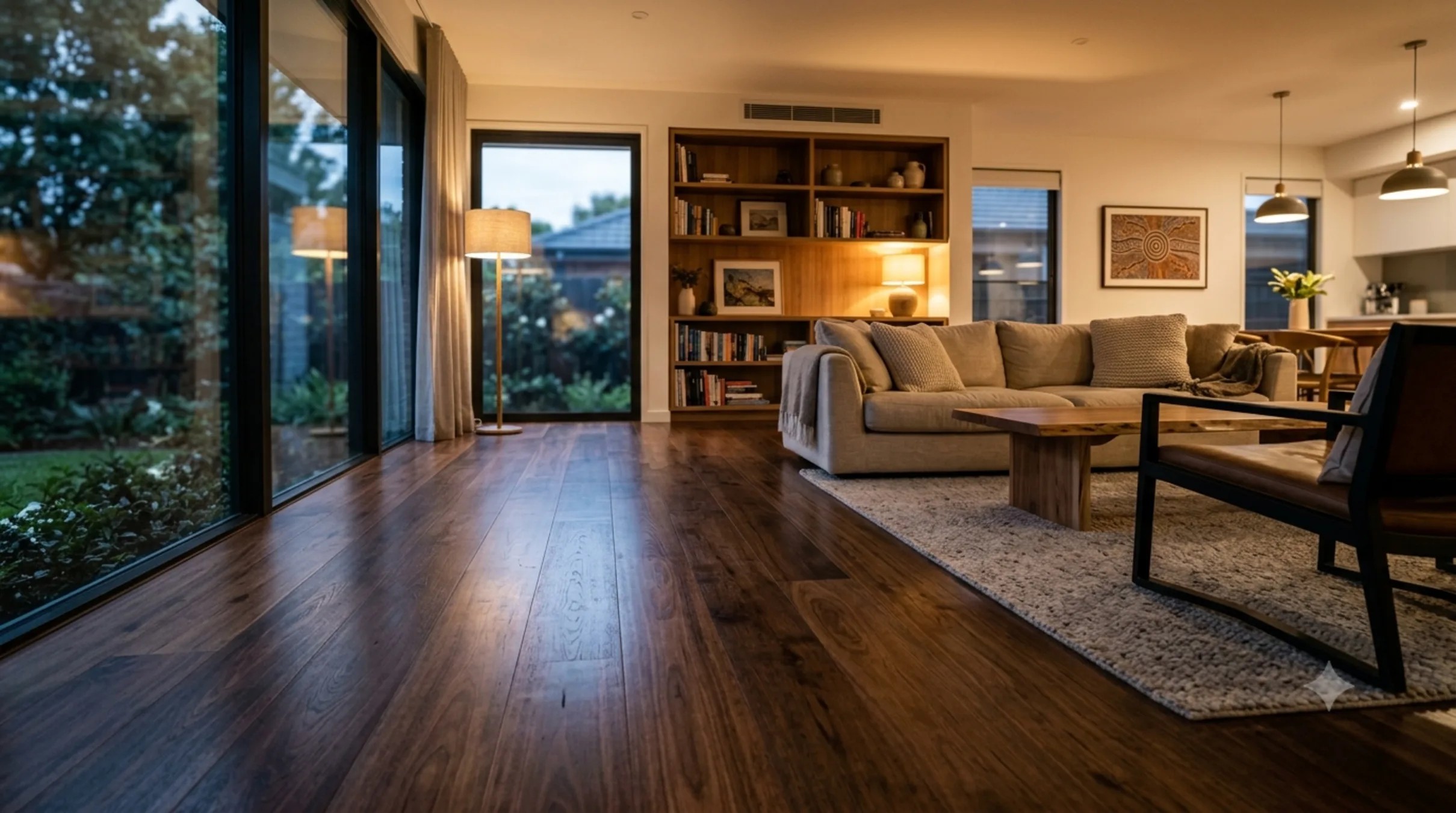
Full-room shot of a finished Blackwood floor in a period Peninsula home, natural daylight. - Photo slot 4
Detail of pale sapwood running alongside heartwood in a single board, showing the tonal contrast.
FLOORS WE SUPPLY IN BLACKWOOD
Blackwood appears across 2 floors in our range. Every one is quoted supply-and-install — request a quote and we will price it for your rooms.
COMMON QUESTIONS
Is Blackwood hard enough for a floor?
For living areas and bedrooms, yes. At around 5.5 kN dry Janka it is comparable to Tasmanian Oak and well below Blackbutt or Spotted Gum. It will mark more readily in a busy entry or hallway, so it suits rooms where the traffic is moderate rather than a front door that opens onto sand.
What is the rippled effect in some of the boards?
Fiddleback figure — a natural wave in the grain that reflects light differently as you move past it. It is a prized characteristic rather than a defect, but it appears unpredictably, so expect some boards to show it strongly and others not at all.
Will Blackwood fade?
It goes the other way. Blackwood darkens and enriches with UV exposure over the first year or two, deepening toward red-brown. Where a rug sits over it for a long period the covered timber stays lighter, so move rugs occasionally during the first year to even it out.
Can Blackwood be sanded like a eucalypt floor?
Not with the same technique. It is a softer timber and the drum cuts into it faster, so an operator used to Blackbutt will dish it if they are not careful. Start at a higher grit and slow the pass rate over any figured sections, where tear-out risk is much higher.
Is Blackwood suitable for a Peninsula coastal house?
As an engineered veneer, yes — the multi-ply core removes the movement problem entirely. As solid strip flooring it is more reactive to humidity swings than the dense eucalypts, so it needs a well-ventilated subfloor and realistic expectations about seasonal gapping.
Should I stain a Blackwood floor?
Rarely worth it. The timber already has a strong red-brown colour with more depth than most stains can add, and pale washes in particular fight the natural red undertone and finish muddy. If you want to shift the tone, a solvent-based polyurethane will deepen the red without adding pigment.