Lime Wash & Whitewash
$55 – $110/m² turn-key, or $12 – $25/m² as an application over a base sand
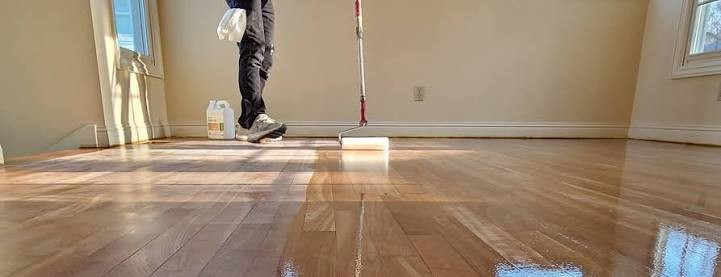
A lime wash is a pigment, not a coating, and that distinction explains almost everything about how it behaves. White titanium dioxide pigment is worked into the open grain of freshly sanded timber, sitting in the wood rather than on it, and a clear protective topcoat goes over the top to lock it in.
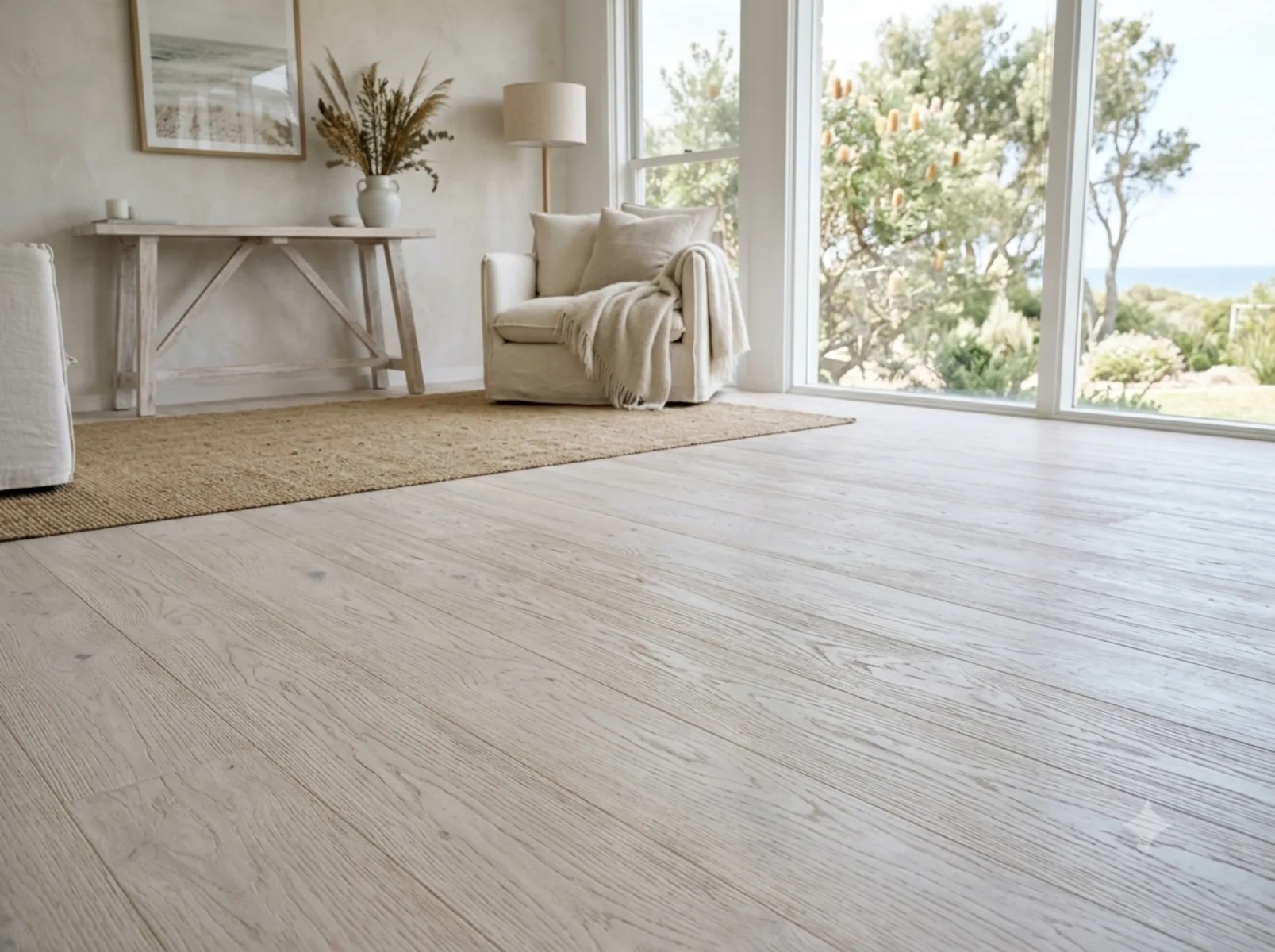
The result is the pale, chalky, softly Scandinavian floor that has become close to a default across coastal Peninsula homes. The brief is almost always phrased the same way: lighter, softer, less orange. A lime wash takes a warm hardwood floor and shifts it toward the pale end of the spectrum without losing the grain that gives the timber its character.
What separates a good lime wash from a poor one is entirely in the preparation and the topcoat. The pigment goes where the sanding lets it go, and it stays the colour the topcoat allows it to stay.
AT A GLANCE
| Turn-key cost band | $55 – $110/m² turn-key, or $12 – $25/m² as an application over a base sand |
|---|---|
| Material cost | Included in the turn-key band — pigment coverage drives the range |
| VOC level | Very low |
| Odour | Minimal |
| Re-entry | 24 – 48 hours depending on the topcoat system |
| Full cure | 3 – 7 days for furniture; 7 – 10 days for rugs |
| UV behaviour | High — maintains light blonde tones, provided the topcoat is non-yellowing |
| Abrasion resistance | Moderate to high — requires maintenance sooner than a clear 2K |
| Sheen options | Ultra-matte, matte, satin |
| Maintenance cycle | Maintenance recoat every 5 – 8 years domestically, sooner on a holiday let |
HOW IT WORKS
Because the pigment sits in the grain, everything depends on how uniformly that grain has been opened. A lime wash requires a precise multi-stage sanding sequence finishing at 120 grit — not coarser, which leaves the surface too open and takes pigment too heavily, and not finer, which burnishes the timber closed and produces patchy absorption.
That consistency has to extend to the perimeter. An edge grinder run at a different final grit to the field produces a visible frame of different colour around every room, which is invisible under a clear coat and glaringly obvious under pigment.
Application runs across an entire continuous floor area in one uninterrupted session. There is no stopping halfway through a room and resuming tomorrow — a lap line in a pigmented finish is permanent, because the pigment loading differs either side of it. On a large open-plan floor that means planning the wet edge and having enough hands on site before starting.
Wire-brushing before the wash is an option worth knowing about. Brushing the surface deepens the grain texture and increases pigment take-up in the softer growth rings, producing the pronounced, heavily textured coastal look at the far end of the range.
HOW IT PERFORMS
The critical specification decision is the topcoat, and it is where cheap quotes fail. A solvent-based polyurethane over white pigment ambers, turning a deliberately pale floor progressively cream, then yellow, then orange — undoing the entire point of the exercise within a few years. Only a non-yellowing waterborne system holds the tone.
Species determines whether the technique will work at all. Lime wash performs well on Tasmanian Oak, European oak and some Blackbutt — open-grained timbers with a relatively neutral base colour. It performs poorly on dense red hardwoods such as Jarrah, where the natural colour fights the white pigment and the result reads muddy or pink rather than pale.
Maintenance expectations should be set honestly at the outset. Where the topcoat wears through in a traffic lane, the pigment underneath goes with it, so wear shows more than it would on a clear-coated floor. Expect a maintenance recoat every five to eight years in a busy household, sooner on a holiday let with guest turnover.
Sample panels are not a formality. Pigment intensity reads completely differently on Baltic Pine than on European oak, and completely differently again in afternoon coastal light than under a showroom fluorescent.
ON THE PENINSULA
Demand for lime wash is concentrated across Sorrento, Blairgowrie, Portsea and Rye, and through the Mount Eliza and Mount Martha holiday residences and premium short-stay properties. Those are the houses where a warm orange floor fights everything else in the room — timber lining, pale joinery, glazing oriented at the water.
It suits the Peninsula for a technical reason as well as an aesthetic one. These houses are heavily glazed, which is the exposure that ambers a conventional finish fastest, and a lime wash under a non-yellowing waterborne topcoat is specifically designed to hold a pale tone under that light.
On a rental or holiday-let property the calculation deserves a second look. A lime wash photographs beautifully for a listing, and it also needs attention sooner than a clear two-pack under guest turnover. Where a Rye or Blairgowrie property is earning income year-round, satin two-pack waterborne is the more boring and often more sensible answer.
COMMON QUESTIONS
Will lime wash work on my floor?
It depends on species. Tasmanian Oak, European oak and some Blackbutt take pigment cleanly and give the pale result people are after. Dense red hardwoods such as Jarrah do not — the natural colour fights the white pigment and the result reads muddy or pink. We confirm species at the first visit and say plainly if the look is not achievable.
What does it cost?
$55 to $110/m² turn-key for the complete system, depending on pigment coverage, number of passes and species. Where it is going over a base sand-and-polish, the wash itself is $12 to $25/m² on top of the band rate for your suburb.
Why is the sanding more expensive for a lime wash?
Because pigment absorption depends entirely on how uniformly the grain has been opened, so the floor needs a precise multi-stage sequence finishing at exactly 120 grit across the whole area including the perimeter band. There is no correcting an uneven wash afterwards without cutting back and starting again.
Will it go yellow?
Not if the topcoat is right. A solvent-based polyurethane over white pigment will amber and turn the floor progressively cream then yellow, which defeats the entire purpose. A non-yellowing waterborne system holds the tone indefinitely. This is the single most important specification decision on a lime wash.
Can you do one room at a time?
Separate rooms with a threshold between them, yes. Within a continuous open-plan area, no — the wash has to go across the whole space in one uninterrupted session, because a lap line in a pigmented finish is permanent and visible.
How does it wear compared to a clear finish?
It needs attention sooner. Where the topcoat wears through in a traffic lane the pigment goes with it, so wear is more visible than on a clear-coated floor. Expect a maintenance recoat every five to eight years domestically, sooner on a holiday let. That is worth knowing before you commit rather than after.