Engineered Oak
AT A GLANCE
| Common name | Engineered Oak |
|---|---|
| Botanical name | Quercus robur (European oak wear layer) |
| Janka rating | 4.9 kN (dry) |
| Colour range | Pale blonde through to mid honey-brown; frequently supplied pre-tinted or smoked. |
| Grain pattern | Straight and open with characteristic medullary ray flecking on quartersawn boards. |
| Typical board widths | 180mm to 260mm wide plank is the standard modern specification. |
| Era commonly laid | 2000s onward, and the dominant specification in current Peninsula rebuilds. |
| Tannin bleed risk | Low |
| UV behaviour | Warms gently on its own; the real risk is a solvent-based coating ambering a pale floor that has no thickness available to sand back. |
| Coastal suitability | Good |
HOW TO IDENTIFY IT
Engineered oak is a construction rather than a species: a real European oak wear layer bonded to a plywood or high-density fibreboard core. The face is genuine timber. What sits under it is not, and that distinction governs everything about how the floor can be treated.
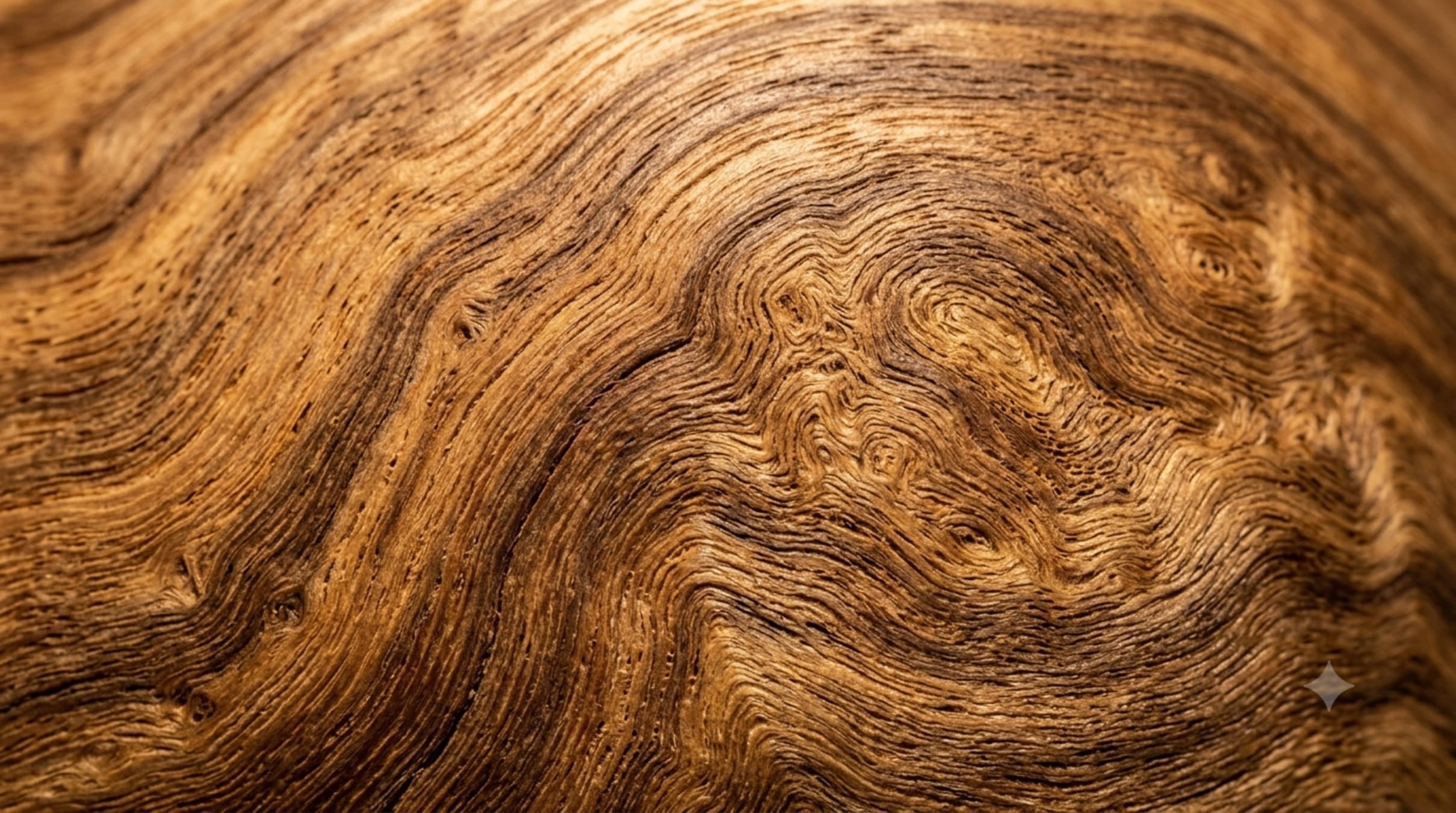
Visually it reads as oak because it is oak — pale blonde to mid honey-brown, straight open grain, and the medullary ray flecking that shows as pale shimmering flecks across quartersawn boards. Modern product is frequently supplied pre-tinted, smoked or brushed, so the colour you see may not be the natural tone of the timber underneath.
The construction gives itself away at any exposed edge. A threshold, a floor vent, a stair nosing or the run under a removed skirting will show the layered section: a thin timber face over visible ply laminations or a uniform fibreboard core. That is the single most useful thing to look at, and it takes seconds.
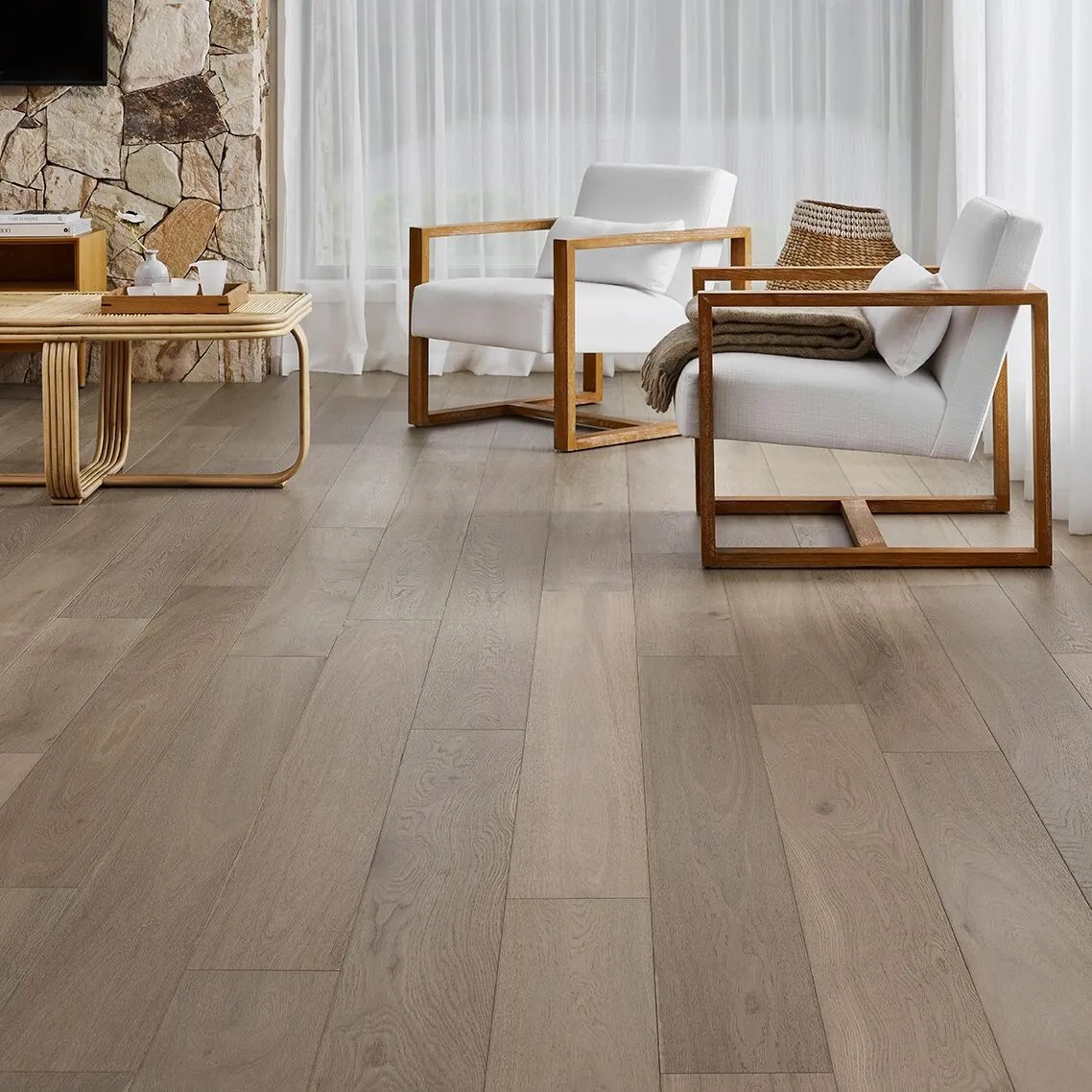
Board width is the other strong indicator. Engineered construction is dimensionally stable in a way solid timber is not, which is precisely why it is used for the 180mm to 260mm wide planks that dominate current specifications. A very wide, very flat oak board in a house built after 2000 is almost certainly engineered.
HOW IT SANDS
The wear layer is the entire constraint and it has to be measured before any scope is agreed. Engineered board carries anywhere from two to six millimetres of real timber over the core, and a full sand takes roughly a millimetre. On a thin specification there may be one cut available across the life of the floor. On the cheapest product there may be none.
We measure at an exposed edge rather than estimating — a threshold, a vent, a stair nosing. Three millimetres or more above the glue line and a careful sand is reasonable. Below two and the honest recommendation is a screen-and-recoat at $25 to $40 per square metre, which restores the surface without spending timber the floor cannot replace.
Where a sand is viable it is done with rotary orbital machines rather than a drum. A belt sander is designed to remove material efficiently across an uneven solid floor, and efficiency is exactly the wrong property when total available thickness is measured in single millimetres. Orbital work is slower and it is the only defensible approach.
Micro-bevels are the detail people forget. Most engineered board has a small chamfer along each edge, and sanding flat removes it progressively — unevenly, because the floor is never perfectly level. A partially removed bevel looks worse than either a full one or none, and it is worth deciding before starting whether the sand will take them out entirely.
HOW IT FINISHES
European oak carries low to moderate tannin levels and generally accepts a waterborne coating directly, though pre-smoked or reactive-stained product can behave unpredictably and is worth testing on an offcut or an inconspicuous area first.
Waterborne is close to mandatory rather than merely recommended. On a finite wear layer an ambered coating cannot simply be sanded off later, because there is no thickness to spare for a correction. A solvent-based polyurethane over pale oak will drift orange within a few years and the floor is then stuck with it. Non-yellowing is the whole argument.
Oak is the best species on this list for lime wash and Nordic tints, and much modern engineered product is supplied already treated that way. Where a factory finish is being sanded off and replaced, matching an existing pigmented tone across a partially refinished floor is difficult, so it is generally better to redo a whole continuous area than to patch.
Hardwax oil is common as a factory finish on engineered oak and is worth continuing rather than switching. An oiled engineered floor can be cleaned and re-oiled locally, which is genuinely valuable when a full sand is a once-in-a-lifetime option. Switching an oiled floor to a film finish requires a full sand, which spends thickness you may want to keep.
ON THE PENINSULA
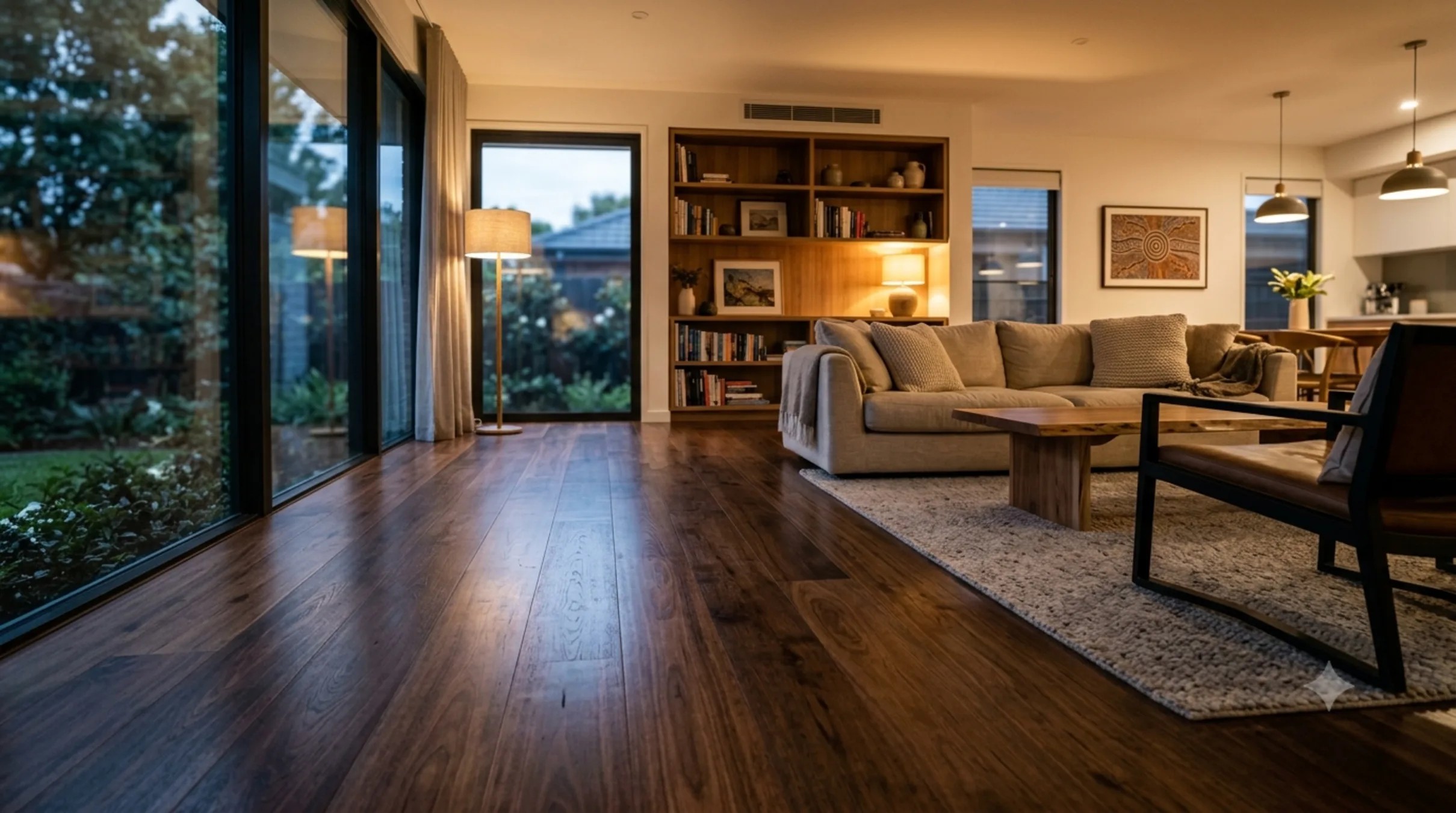
Engineered oak is the dominant specification in current Peninsula construction and it turns up everywhere new money has been spent: the Martha Cove and Safety Beach builds, the architect rebuilds through Portsea, Sorrento and Blairgowrie, the estate housing across Carrum Downs and Skye, and the extensions on older houses in Mount Eliza and Mornington.
Slab moisture is the controlling technical variable on most of these floors. Engineered board is frequently floated or direct-stuck over concrete, and concrete holds construction moisture far longer than programmes allow and wicks ground moisture indefinitely where the vapour barrier was compromised. A wide engineered plank over a damp slab cups and telegraphs its joints regardless of the finish.
The perimeter expansion gap is the second thing worth checking on any floating installation. A floor laid hard against the skirting, or with the gap later filled with sealant, has nowhere to go when humidity rises and peaks at the joints. That is a carpentry problem, not a finishing one, and refinishing over it changes nothing.
Where an engineered oak extension meets an older solid floor — a common pattern through Dromana, Frankston South and Mornington — the two will not read as one. European oak and aged Australian hardwood differ in grain structure as well as colour, and a stain narrows the tonal gap without closing the rest. Treating the threshold as a deliberate line is usually the better design answer.
GALLERY
Placeholder slots — drop real photos into src/assets/ and swap the slot for <Image />.
- Photo slot 1
TODO: cut edge at a threshold showing the engineered section — timber wear layer over ply laminations. - Photo slot 2
TODO: close-up of European oak grain with medullary ray flecking on a quartersawn wide plank. - Photo slot 3
TODO: wide-plank engineered oak floor in a Martha Cove interior, natural light from the water side. - Photo slot 4
TODO: micro-bevel detail along a board edge, before and after a rotary orbital sand.
FLOORS WE SUPPLY IN ENGINEERED OAK
Engineered Oak appears across 16 floors in our range. Every one is quoted supply-and-install — request a quote and we will price it for your rooms.
- Mornington Peninsula Oak Collection · Engineered Timber
- Coastal Mist Peninsula Oak Collection · Engineered Timber
- Byron Honey Peninsula Oak Collection · Engineered Timber
- Empire Natural Peninsula Oak Collection · Engineered Timber
- Ballina Sand Peninsula Oak Collection · Engineered Timber
- European Oak Australian Heritage Hybrid · Hybrid
- Bali Oak Noble Oak Collection · Engineered Timber
- Silver Mink Noble Oak Collection · Engineered Timber
- Nordic Oak Noble Oak Collection · Engineered Timber
- Red Earth Oak Noble Oak Collection · Engineered Timber
- Smoked Oak Noble Oak Collection · Engineered Timber
- Coastal Estate Coastal Oak Collection · Engineered Timber
- Seaside Grey Coastal Oak Collection · Engineered Timber
- Peninsula Oak Coastal Oak Collection · Engineered Timber
- Coastal Sand Coastal Oak Collection · Engineered Timber
- Driftwood Oak Coastal Oak Collection · Engineered Timber
COMMON QUESTIONS
Can engineered oak be sanded?
Sometimes, and the wear layer decides it. Engineered board carries two to six millimetres of real timber over the core and a full sand takes roughly a millimetre. We measure at a threshold, vent or stair nosing rather than estimating. Three millimetres or more and a careful rotary sand is reasonable; below two, a screen-and-recoat is the honest answer.
How do I check the wear layer myself?
Look at any exposed edge — a doorway threshold, a floor vent, a stair nosing, or the run under a removed skirting. You will see the layered section: a thin timber face over ply laminations or a uniform fibreboard core. Measuring that timber face takes seconds and it determines everything about what can be done.
Why do you use a different machine on engineered floors?
Because a belt sander removes material efficiently, and efficiency is exactly the wrong property when your total margin for error is two millimetres. Rotary orbital machines take material off far more slowly and controllably. It is more time on site and it is the only defensible approach on a finite wear layer.
What happens to the bevels between boards?
Sanding flat removes them progressively and unevenly, because no floor is perfectly level. A partially removed bevel looks worse than either a full one or none at all, so it is worth deciding before starting whether the sand will take them out entirely. It changes how the finished floor reads considerably.
Can I put a solvent-based finish on it?
You can, and we would advise against it strongly. On a finite wear layer an ambered coating cannot be sanded off later, because there is no thickness available for a correction. A pale oak floor under solvent-based polyurethane drifts orange within a few years and the floor is then stuck with it permanently.
My engineered floor is cupping. What is wrong?
Almost always the slab rather than the floor. Concrete holds construction moisture far longer than most programmes allow and wicks ground moisture indefinitely where the vapour barrier was compromised. Refinishing the surface treats a symptom — the floor will keep moving and the joints will keep telegraphing through. Test the slab first.