Floor Sanding Dromana
Dromana · 3936 · Mornington Peninsula
The shack is gone from most of Dromana, but it left its floor plan behind. Through the 1950s to 70s this was beach-cottage country — single-storey, modest, timber-framed — and the double-storey coastal homes that have replaced them over the last three decades were very often built onto the original slab or the original footprint rather than from scratch. What that produces, underfoot, is a house with two or three distinct flooring eras meeting at internal thresholds.
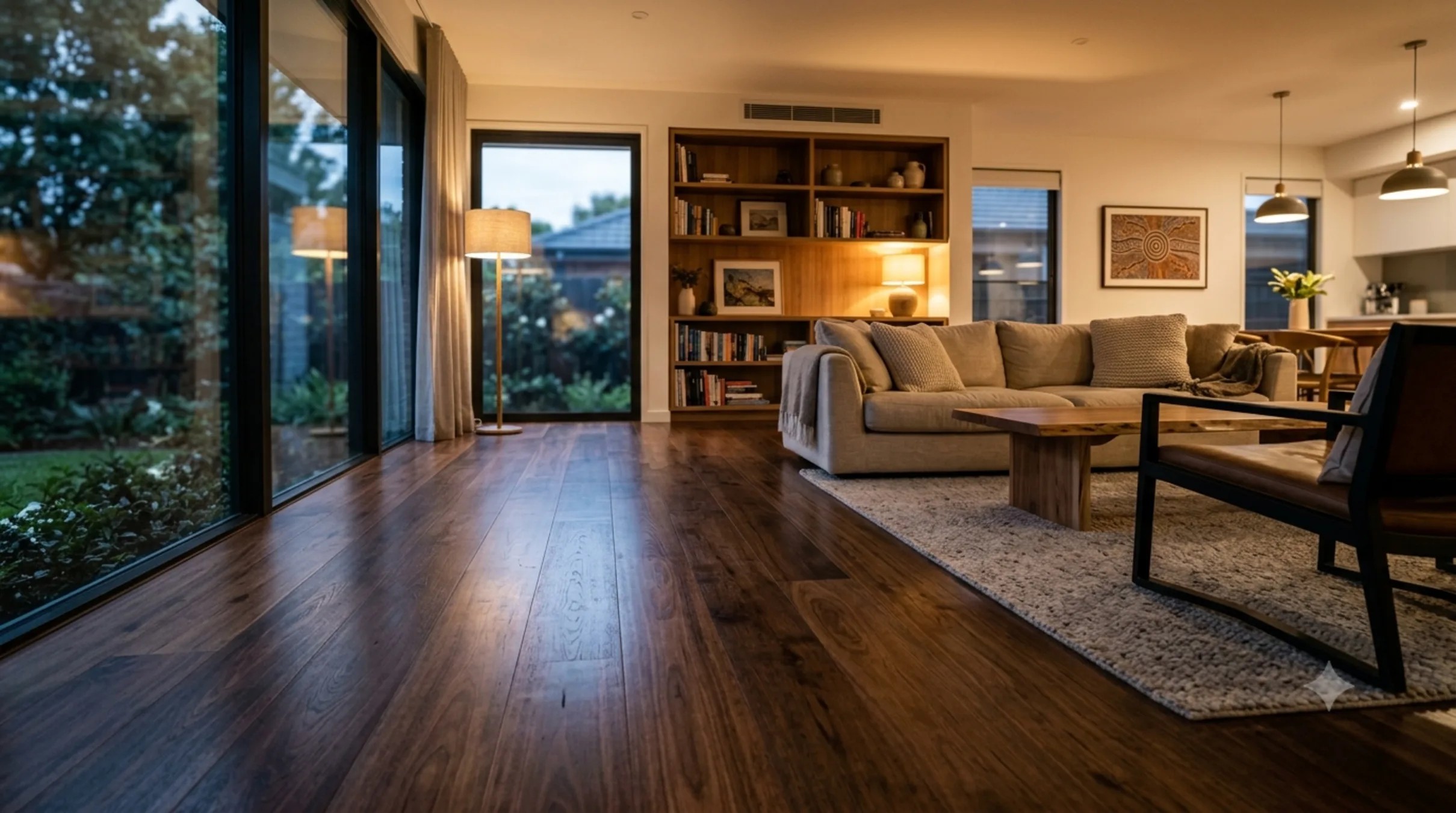
That transition is the technical heart of a Dromana job. An original 1960s hardwood strip floor meeting a 1990s extension meeting a 2010s engineered oak addition is three different timbers, three different board widths, three different fixing methods and, critically, three different levels. Floor heights rarely match exactly across a renovation boundary, and the ramps, thresholds and packing that were installed to bridge them are usually the first thing we have to assess.
Species mismatch is the visible half of the problem. A Tasmanian Oak floor from the sixties has ambered under half a century of coating and will not sand back to the same tone as a Blackbutt extension laid in the nineties, let alone a European oak overlay from last decade. Sanded bare they can look deceptively close. Coated, they separate, because the older timber has oxidised through its full depth and the newer has not.
We sample-test stains across the actual junction before anyone commits to a whole-floor colour, and we are honest about what stain can and cannot do. It will narrow a tonal gap. It will not make Tasmanian Oak and European oak read as the same timber, because the grain structures are visibly different regardless of colour. Where the difference cannot be closed, the better design answer is often to accept it and treat the threshold as a deliberate line rather than a failed match.
The level difference is the other half. Where an extension sits five or ten millimetres above or below the original floor, sanding both to a common plane is not possible — you would be cutting the high side to nothing. The realistic options are a properly made timber threshold strip, or accepting a gentle transition and finishing both sides cleanly up to it. We work this out at quote stage because it changes the scope materially.
Dromana sits in the Mount Eliza pricing band at $55 to $80 per square metre turn-key, with typical scopes of 90 to 140 square metres putting whole-job contracts between $6,050 and $8,800. Where a floor spans multiple eras and needs threshold work, board replacement or stain matching, we itemise those separately — board replacement at $8 to $20 per square metre or from $50 a board, staining at $12 to $25 per square metre over the sanding rate.
Original 1960s Dromana beach cottage floors, where they survive intact, are worth restoring properly rather than overlaying. They are usually narrow-strip native hardwood, secret-nailed, and after decades under carpet the timber is in far better condition than the room around it suggests. The perimeter tack strip holes need filling and the staples need pulling by hand, but underneath that is a floor that has never been cut and has its full thickness available.
Foreshore proximity puts salt and sand into the equation. Homes within a few streets of the Dromana foreshore take a constant low-level supply of beach grit tracked in on feet, and grit under traffic is the fastest way to wear a coating out. The wear pattern is diagnostic — sound everywhere, worn through at the doors and along the main path. An extra topcoat through those zones runs $10 to $15 per square metre and roughly doubles the life of the finish where it takes the punishment.
Coating recommendation is two-pack waterborne, satin. Non-yellowing matters here because the newer Dromana builds are heavily glazed toward the bay and a solvent-based polyurethane will amber under that light, which is particularly unhelpful on a floor where you are already fighting a tonal mismatch between sections. High abrasion resistance handles the sand. Re-entry within 24 hours matters where the house is occupied or let.
Four to five days is realistic for a 120 square metre Dromana home with mixed flooring eras, longer than a single-era floor of the same size. Days one and two cover tack strip removal, board levelling, nail punching and multi-directional coarse sanding with full edge grinding and corner scraping. Day three is rotary finishing, vacuuming and the sealer or stain. Day four is screening and topcoats. Light traffic day five, furniture at seven to ten days.
Where the property is a short-stay rental — and a substantial share of Dromana housing is — we schedule against the booking calendar rather than our own convenience. A Monday start with the final coat down Thursday gives a floor that is trafficable for weekend guests, provided nobody drags a suitcase across it. Heavy furniture and rugs should still wait the full cure. Tell us the booking gaps at quote stage and we will build the program around them.
ALSO AVAILABLE IN DROMANA
Because Dromana is a coastal Peninsula suburb, we also offer deck sanding and oiling and lime-wash finishes here.
REPLACING THE FLOOR IN DROMANA INSTEAD?
If the existing boards are past saving, or you are after something different underfoot, we also supply and install timber, engineered and hybrid flooring here.