Nordic Tints & White Stains
$55 – $110/m² turn-key, or $12 – $25/m² as an application over a base sand
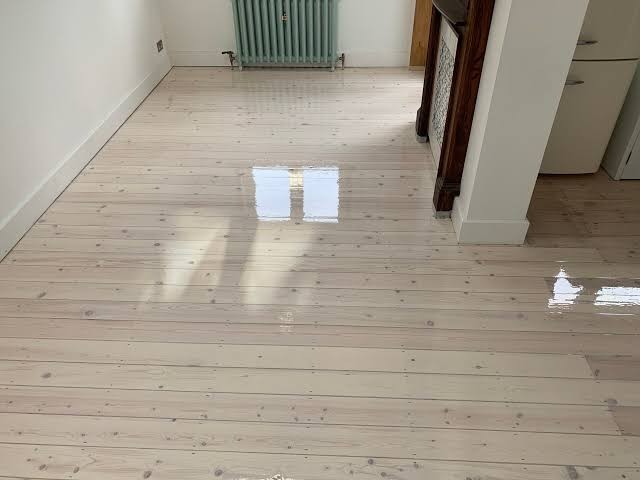
Nordic tints sit alongside lime wash in the same family and the difference between them is how much of the timber you still see. A lime wash leaves the grain fully legible with pigment sitting in it. A Nordic tint or white stain lays more colour across the surface and reads more uniform, closer to a pale painted tone with the grain visible through it.
Which one is right depends entirely on the effect being chased and, importantly, on the floor. A busy, knotty, high-contrast timber — Baltic Pine, Cypress — can look chaotic under a light wash that emphasises every variation, and a more uniform tint calms it down. A clean, even European oak often looks better under a wash that keeps the grain forward.
The other thing worth understanding early is that a tint is a stain, and a stain is a one-way decision. Removing it means sanding the whole floor back to bare timber, which spends a full cut of board thickness. On a floor that has been sanded before, that may be a cut it cannot afford.
AT A GLANCE
| Turn-key cost band | $55 – $110/m² turn-key, or $12 – $25/m² as an application over a base sand |
|---|---|
| Material cost | Included in the turn-key band |
| VOC level | Very low on waterborne tint systems |
| Odour | Minimal |
| Re-entry | 24 – 48 hours |
| Full cure | 3 – 7 days for furniture; 7 – 10 days for rugs |
| UV behaviour | High — holds the specified tone under a non-yellowing topcoat |
| Abrasion resistance | Moderate to high, with wear showing at the pigment layer |
| Sheen options | Ultra-matte, matte, satin |
| Maintenance cycle | Maintenance recoat every 5 – 8 years domestically |
HOW IT WORKS
The pigment is applied to bare, freshly sanded timber and penetrates the open grain, then a non-yellowing waterborne topcoat system goes over it. Unlike a lime wash, where the effect comes from white pigment lodging in the grain texture, a tint deposits colour more evenly across the whole surface.
Consistency of sanding is the controlling variable, exactly as it is with a lime wash. Any variation in the final grit across the floor produces variation in uptake, and the perimeter band is the usual failure point — an edger left running finer or coarser than the field produces a visible frame of different colour around every room.
Water-popping is sometimes required. Dampening the sanded timber raises and opens the grain evenly before the tint goes on, so pigment penetrates consistently rather than being absorbed more heavily where the surface has been burnished. It is not needed on every species or every product, and where it is needed, skipping it produces a patchy result that cannot be fixed without a full recut.
Application runs across a continuous area in one session for the same reason a lime wash does. A lap line in a tinted floor is permanent.
HOW IT PERFORMS
Under a non-yellowing waterborne topcoat, a Nordic tint holds the tone it was approved at indefinitely. Under a solvent-based coating it does not — the coating ambers year on year and a colour chosen carefully at the outset drifts progressively warmer. That is the single specification decision that determines whether the floor still looks right in a decade.
Wear behaves as it does on any pigmented system. Where the topcoat wears through in a traffic lane the pigment goes with it, so wear shows more readily than on a clear-coated floor. A maintenance recoat every five to eight years domestically keeps ahead of it, and an additional topcoat through the entry and traffic lanes at $10 to $15/m² meaningfully extends the interval.
Sample panels are mandatory rather than advisable. The same tint on the same nominal species can read differently between two floors depending on age, previous coating history and how much the timber has oxidised. We prepare panels on the actual floor, in more than one intensity, and ask to see them in the room at the time of day it gets used.
Species behaviour is worth flagging. Softwoods like Baltic Pine take tint unevenly by nature — pigment floods the soft springwood between the growth rings and is rejected by the harder latewood, producing a strongly striped result. Some clients love it. Others find it unacceptable, which is exactly why we sample first.
ON THE PENINSULA
Nordic tints are requested most through Sorrento, Portsea, Blairgowrie and the McCrae and Arthurs Seat ridge homes — the properties with wide-plank oak, big Bass Strait or bay-facing glazing, and a deliberate design brief around pale, calm interiors.
They also do useful work in a less glamorous role. Across Dromana, Safety Beach and the renovated Frankston South and Mornington stock, a great many floors span multiple eras where an original 1960s hardwood meets a 1990s or 2000s extension. Those sections will never sand to a single tone, because the older timber has oxidised through its full depth and the newer has not. A tint deep enough to sit over both narrows that difference substantially.
It narrows it rather than erasing it, and we say so before anyone commits. The grain structures of two different species remain visibly different regardless of colour, and where the gap cannot be closed the better design answer is often to treat the threshold as a deliberate line rather than a failed match.
COMMON QUESTIONS
What is the difference between a Nordic tint and a lime wash?
How much of the timber you still see. A lime wash leaves the grain fully legible with white pigment sitting in the texture. A Nordic tint lays more colour across the surface and reads more uniform. On a busy, knotty timber a tint calms the floor down; on a clean European oak a wash usually looks better.
Can a tint be removed if I do not like it?
Only by sanding the whole floor back to bare timber, which spends a full cut of board thickness. On a floor that has been sanded before, that may be a cut it cannot afford. This is exactly why we insist on sample panels on your actual floor rather than working from a fan deck.
Can staining make my extension match the original floor?
It narrows the difference substantially and it will not erase it. Older timber has oxidised through its full depth and newer timber has not, and the grain structures of two species remain visibly different regardless of colour. We sample across the actual junction and give an honest view of how close it will get.
Why does my pine sample look striped?
Because pigment floods into the soft springwood between the growth rings and is rejected by the harder latewood, and Baltic Pine has a strong contrast between the two. The striping is inherent to the species, not a fault in the application. Some clients love it and some find it unacceptable — which is why we sample first.
What is water-popping?
Dampening the sanded timber to raise and open the grain evenly before tinting, so pigment penetrates consistently rather than being absorbed more heavily where the surface has been burnished. Where it is needed and gets skipped, the result is patchy and cannot be fixed without a full recut.
Will the colour change over time?
Not under a non-yellowing waterborne topcoat — it holds the tone it was approved at. Under a solvent-based polyurethane it will, drifting progressively warmer as the coating ambers. If you want continued warming, that should be a deliberate choice rather than something that happens to you.